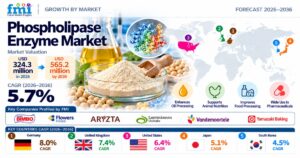

The global phospholipase enzyme market is expanding steadily, with market revenue projected to grow from USD 324.3 million in 2026 to USD 565.2 million by 2036. According to the latest market report published by Future Market Insights, Inc. (FMI), the industry is anticipated to maintain a compound annual growth rate (CAGR) of 5.7% over the forecast period. The market was valued at USD 306.8 million in 2025, reflecting growing opportunities for enzyme manufacturers serving edible-oil refining, bakery production, and other food-processing applications.
Get detailed market forecasts, competitive benchmarking, and industry insights:
https://www.futuremarketinsights.com/reports/sample/rep-gb-2043
KEY MARKET TAKEAWAYS
- Market Valuation: USD 324.3 million in 2026, rising to USD 565.2 million by 2036.
- Growth Rate: Expanding at a sustained 5.7% CAGR from 2026 to 2036.
- Leading Product Type: Phospholipase C is projected to account for 66.8% of product type demand in 2026.
- Leading Form: Powder is expected to represent 67.7% of form demand in 2026.
- Leading Source: Microbial sources are projected to account for 69.1% of source demand in 2026.
- Fastest-Growing Country: Germany is forecast to lead the profiled markets with an 8.0% CAGR.
- Core Growth Driver: Increasing demand for improved oil recovery during degumming, supported by wider enzyme adoption in industrial food processing.
INDUSTRY SHIFTS & MARKET DYNAMICS
The growing need to improve oil recovery during edible-oil refining is creating opportunities for phospholipase enzyme manufacturers. Refiners are using these enzymes during degumming to remove unwanted gums while retaining more usable oil. Phospholipase C is projected to account for 66.8% of product type demand in 2026 because its reaction can help protect neutral oil during processing. Powder formulations are expected to maintain a 67.7% share of form demand, supported by easier storage and transportation across food-processing facilities. Microbial sources are projected to account for 69.1% of source demand as controlled fermentation enables producers to maintain consistent output for specific industrial applications.
Despite these opportunities, market expansion faces challenges related to plant approval procedures, process compatibility, and regulatory requirements. Manufacturers and refiners must evaluate enzyme performance under specific pH, temperature, dosage, and processing-time conditions before adopting a new supplier. Changes in crude-oil quality and production-line configurations can also require additional trials. Food applications introduce further compliance considerations, as permitted enzyme uses differ across countries. However, wider adoption in industrial bakeries, improved application support, and continued product development are creating opportunities for suppliers that can demonstrate reliable performance under commercial operating conditions.
REGIONAL MARKET SUMMARY
The following table highlights selected countries and their projected market growth rates from 2026 to 2036.
Germany CAGR (2026–2036): 8.0% Market Outlook: Enzyme degumming trials and demand for improved oil recovery
United Kingdom CAGR (2026–2036): 7.4% Market Outlook: Bakery applications and food-enzyme compliance requirements
United States CAGR (2026–2036): 6.4% Market Outlook: Large-scale soybean crushing and commercial oil-refining operations
Japan CAGR (2026–2036): 5.1% Market Outlook: Oil-processing applications and food-additive compliance
South Korea CAGR (2026–2036): 4.5% Market Outlook: Food-enzyme qualification and local regulatory documentation
ANALYST INSIGHTS
“Plants are expanding phospholipase use as trials are showing clear oil or dough benefits on existing equipment. Manufacturers should build trials around pH, process time, and permitted food use so plant teams spend less time on rework,” stated Nandini Roy Choudhury, Principal Consultant at Future Market Insights, Inc.
“Opportunities will increasingly depend on demonstrating measurable process improvements and consistent enzyme performance. Suppliers that align product formulations, technical guidance, and regulatory documentation with plant requirements can strengthen their position across oil refining and food-processing applications.”
COMPETITIVE LANDSCAPE
The multigrain and seeded bread market includes established bakery manufacturers and branded bread producers offering products across conventional, whole-grain, organic, and specialty formats. Key companies profiled by FMI include Grupo Bimbo, Flowers Foods, Aryzta, Lantmännen Unibake, Vandemoortele, and Yamazaki Baking.
Grupo Bimbo and Flowers Foods compete through established packaged-bread brands and broad retail distribution, while Aryzta, Lantmännen Unibake, and Vandemoortele serve retail and foodservice customers through fresh, frozen, and bake-off bakery products. Yamazaki Baking, Warburtons, King’s Hawaiian, Europastry, and St Pierre Groupe also participate through their respective bread, roll, and specialty bakery portfolios.
In April 2025, Flowers Foods introduced its Nature’s Own Keto Multi-Grain Loaf and Dave’s Killer Bread organic Sandwich Rolls featuring 21 Whole Grains and Seeds. These product launches illustrate how manufacturers are expanding multigrain offerings through familiar bread formats, differentiated product positioning, and consumer-focused product development.
COMPETITIVE LANDSCAPE
The phospholipase enzyme market includes established enzyme manufacturers and biotechnology companies with capabilities spanning enzyme development, fermentation, formulation, and technical support for food processing and edible oil refining. Key companies profiled by FMI include Novonesis, dsm-firmenich, IFF, AB Enzymes, and NAGASE.
Novonesis, dsm-firmenich, and AB Enzymes offer phospholipase solutions for oil degumming and lecithin processing, while IFF serves bakery applications through enzyme-based dough improvement solutions. NAGASE supplies phospholipase products for bakery and lecithin processing. Competitive differentiation depends on enzyme performance, oil recovery efficiency, formulation stability, processing compatibility, and technical support for industrial customers.
In November 2025, Novonesis launched Quara Supreme, a phospholipase C solution designed for water degumming of vegetable oils. The product highlights the industry’s focus on improving oil recovery and optimizing refining processes without requiring major changes to existing production operations. Such developments underscore the importance of enzyme innovation, processing efficiency, and application-specific solutions in strengthening competitive positions in the phospholipase enzyme market.
FREQUENTLY ASKED QUESTIONS
Q: What is the projected size of the phospholipase enzyme market by 2036?
A: The global phospholipase enzyme market is valued at USD 324.3 million in 2026 and is projected to reach USD 565.2 million by 2036, growing at a CAGR of 5.7%.
Q: Which product type holds the leading market share?
A: Phospholipase C is projected to account for 66.8% of product type demand in 2026, supported by its application in edible-oil degumming and improved oil recovery.
Q: Which form dominates the market?
A: Powder is expected to hold 67.7% of form demand in 2026, reflecting its storage and transportation advantages for industrial processing facilities.
Q: Which source segment leads the market?
A: Microbial sources are projected to account for 69.1% of source demand in 2026, supported by controlled fermentation and consistent production.
Q: Which country exhibits the highest growth rate?
A: Germany is projected to lead the profiled country markets with an 8.0% CAGR from 2026 to 2036.
Q: What are the major factors driving market growth?
A: Improved oil recovery during degumming, demand for efficient refining processes, and expanding applications in industrial bakery and food processing are key growth drivers.
Q: What challenges could restrict market expansion?
A: Plant approval requirements, process compatibility testing, changes in crude-oil quality, and country-specific food-enzyme regulations may delay adoption and supplier changes.
For detailed market forecasts, form and end-use segmentation, country-level growth rates and competitive analysis, read Future Market Insights :
https://www.futuremarketinsights.com/reports/phospholipase-enzyme-market
About Future Market Insights (FMI)
Future Market Insights, Inc. (FMI) is an ESOMAR-certified, ISO 9001:2015 market research and consulting organization, trusted by Fortune 500 clients and global enterprises. With operations in the U.S., UK, India, and Dubai, FMI provides data-backed insights and strategic intelligence across 30+ industries and 1200 markets worldwide.
For Press & Corporate Inquiries
Rahul Singh AVP – Marketing and Growth Strategy
Future Market Insights, Inc.
+91 8600020075
For Sales: sales@futuremarketinsights.com
For Media: Rahul.singh@futuremarketinsights.com
For Web: https://www.futuremarketinsights.com/