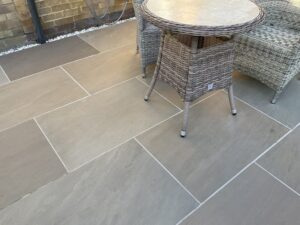

Patio design rarely succeeds on material choice alone. The laying pattern shapes how the surface feels, how light moves across it, how the space connects to the home. Natural stone brings variation and character, porcelain delivers crisp lines and tonal consistency. The pattern chosen decides whether those qualities stand out or fade into the background.
Why Paving Pattern Choice Shapes the Entire Patio Design?
Every paving slab has proportion, texture, and tone. Layout determines how those elements interact. A structured grid creates order and symmetry. A mixed size arrangement softens the finish, giving a relaxed feel. Directional layouts can widen narrow gardens or draw attention towards seating areas, planters, or steps.
At Ammaari Stones, patio projects often begin with colour selection, yet the pattern defines the final look just as strongly. Even the same slab can feel traditional or contemporary depending on how installers position it.
Classic Paving Patterns for Natural Stone
Natural stone suits patterns that celebrate variation. Subtle shifts in tone and surface texture create interest without forcing the design.
Random Course Pattern
A random course layout uses mixed slab sizes laid in a repeating sequence. Installers avoid obvious repetition, allowing the patio to appear organic yet balanced. This approach works particularly well with sandstone and limestone, where tonal differences enhance the relaxed arrangement.
Single Size Stretcher Bond
The stretcher bond offers simplicity. Installers offset each row by half a slab, creating a brickwork effect. This pattern suits rectangular paving, giving structure without appearing rigid. It fits traditional gardens, period properties, and smaller patios where excessive variation could feel busy.
Mixed Size Project Packs
Project packs provide a controlled combination of slab sizes. Installers follow a set layout that repeats across the patio. The result feels planned, though not uniform. Homeowners often choose this option for larger areas where a single slab size might look repetitive.
Circular Features and Centrepieces
Circular kits or radial patterns introduce movement. A central feature can define a dining space or fire pit area. Surrounding paving can remain simple, allowing the circle to stand out without overwhelming the garden.
Contemporary Layouts for Porcelain Patios
Porcelain suits clean lines. Its consistent finish allows sharp joint alignment, narrow grout lines, precise spacing. Modern gardens benefit from structured layouts that highlight this accuracy.
Linear Stack Bond for Modern Gardens
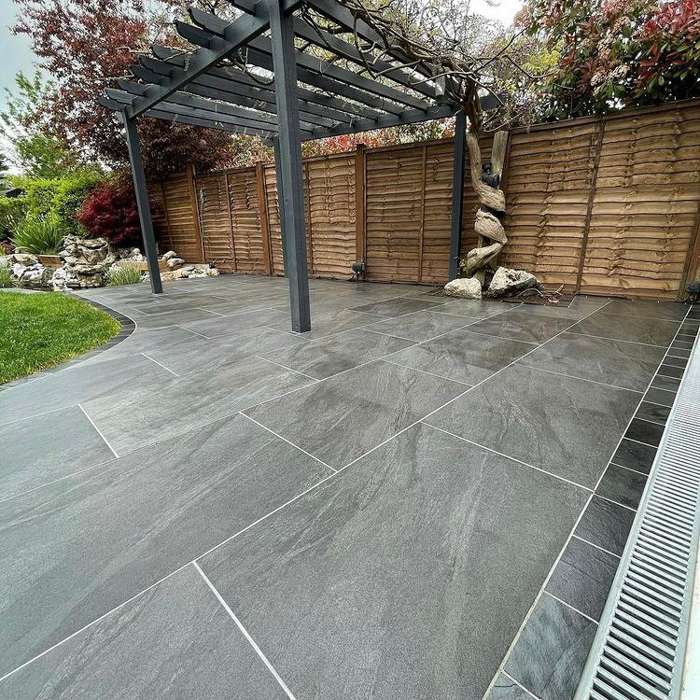
Stack bond places slabs directly above one another, creating straight vertical and horizontal joints. The effect feels architectural. When laid with large format slabs, the patio gains a sleek, uninterrupted appearance.
Raj Green Porcelain works particularly well in this format. Its natural stone-inspired tones soften the geometry, balancing structure with warmth.
Large Format Slab Layouts
Large slabs reduce joint lines, making patios appear expansive. Installers often align slabs with the longest edge of the garden to elongate the space. This technique suits contemporary extensions, bifold doors, minimalist planting schemes.
Grid Patterns with Clean Joint Lines
A true grid layout uses equal slab sizes with consistent spacing. Precision remains essential. When executed correctly, the patio feels orderly and refined, ideal for properties with modern brickwork or rendered finishes.
Combining Raj Green Porcelain with Structured Layouts
Raj Green Porcelain delivers familiar sandstone colouring with the performance of porcelain. When paired with stack bond or grid patterns, it bridges traditional tone with modern installation. The result suits transitional properties where homeowners want a fresh finish without losing warmth.
Creating Contrast with Colour and Pattern
Pattern becomes more striking when paired with tonal contrast. Borders, picture frames, feature strips add detail without complicating the main layout.
Framing Features with Anthracite Porcelain Paving
A darker border can frame a lighter patio, giving definition. Anthracite Porcelain Paving works well as an edge detail around softer shades. The darker tone outlines the space, drawing the eye inward, strengthening the patio’s visual boundary.
Border Details and Picture Framing
Installers often rotate slabs around the perimeter to create a picture frame effect. This subtle shift in direction distinguishes the edge from the main body of paving. The technique suits rectangular patios, terraces, courtyard spaces.
Blending Raj Green Porcelain with Complementary Tones
Combining Raj Green Porcelain with neutral edging slabs can enhance depth without overwhelming the design. Soft greys, charcoal tones, warm beige borders create contrast that feels intentional rather than decorative.
Pattern Direction, Space, and Visual Impact
Orientation influences perception. Laying slabs lengthways across a narrow garden increases the sense of width. Running slabs away from the property can emphasise depth.
Making Smaller Patios Feel Larger
Large slabs with minimal joints reduce visual breaks. Light-coloured paving reflects more light, helping compact areas feel open. A simple grid often performs better than complex mixed patterns in confined spaces.
Guiding Movement Through the Garden
Installers can align paving with pathways, door openings, and garden features. Subtle directional cues guide movement naturally, encouraging flow from house to lawn, seating area, outdoor kitchen.
Coordinating Paving with Wall Cladding and Steps
Matching patio layout with step treads or wall cladding strengthens cohesion. Linear porcelain paving pairs well with horizontal cladding panels, stone steps, raised planters.
Practical Considerations Before Choosing a Layout
Design should always align with installation requirements.
- Allow for appropriate joint widths based on material type and manufacturer guidance.
- Plan drainage falls before finalising pattern direction.
- Consider property style, surrounding brickwork, window lines, garden structure.
A well-chosen paving pattern enhances material choice rather than competing with it. Natural stone thrives in varied arrangements that highlight texture. Porcelain excels in precise, structured layouts. When colour, format, and direction align, the patio feels balanced, intentional, ready to serve as the foundation of the garden.
Professional installation strengthens the final result. Accurate setting out ensures the pattern remains consistent across the entire area. Installers typically dry lay sections before fixing slabs in place, checking alignment against property lines, thresholds, and drainage falls. This extra step prevents awkward cuts near walls or uneven borders that could disrupt the design.
Joint choice also affects the finished appearance. Narrow joints suit porcelain layouts, reinforcing clean lines. Natural stone often benefits from slightly wider joints, which accommodate variation in slab dimensions while maintaining balance. Grout colour can either blend seamlessly with the paving or introduce subtle contrast, depending on the intended finish.
Thickness and sub-base preparation matter just as much as aesthetics. A stable, well-compacted foundation prevents movement, protects alignment, and supports long-term performance. Porcelain requires a full mortar bed with appropriate priming slurry to secure adhesion. Natural stone demands consistent support across the entire slab to avoid rocking or future settlement.
Climate conditions in the UK also influence material performance. Porcelain offers low water absorption, which reduces the risk of staining and frost damage. Natural stone benefits from correct sealing, particularly in high traffic areas or beneath dining furniture. Maintenance planning should align with the selected paving type, ensuring the pattern continues to look sharp over time.
Garden style can further guide pattern decisions. Traditional cottages often suit mixed size sandstone laid in a random arrangement, framed by simple edging. Contemporary new builds tend to favour uniform porcelain slabs installed in a structured grid. Urban courtyards respond well to darker tones with crisp borders, creating contrast against rendered walls or timber fencing.
Lighting introduces another dimension. Up-lighting positioned along borders highlights joint lines, emphasising geometric layouts. Warm wall lights cast soft shadows across textured sandstone, enhancing its natural variation. When planning paving patterns, designers often consider how the patio will appear during evening use, not just in daylight.
Outdoor furniture placement should influence slab orientation. Dining sets benefit from even, uninterrupted surfaces. Seating zones feel more cohesive when slab lines align with furniture edges rather than cutting across them. Careful planning avoids narrow cuts beneath table legs or awkward transitions between levels.
For larger gardens, combining zones can add interest without complicating the main design. A primary patio may feature a consistent stack bond layout, with a separate seating circle or pathway introducing contrast. The transition between areas should feel deliberate, achieved through edging details or subtle shifts in slab direction.
Long-term durability relies on correct product selection, professional installation, and routine care. When pattern, colour, and material align with the property’s character, the patio becomes more than a surface. It frames outdoor living, supports daily use, enhances kerb appeal, and adds lasting value.
A well-considered paving pattern brings cohesion to natural stone or porcelain patios. It reinforces architectural lines, complements garden planting, and supports practical function. With careful planning and quality materials, the finished result delivers structure, style, performance across every season.