
If you have ever tried to choose an NBN plan, you already know the confusion starts before you even compare prices. Providers talk about speeds, tiers and promises, but the most important factor is often hidden in small text. That factor is your NBN connection type.
Your connection type quietly controls how fast your internet can be, how stable it feels during peak hours, and whether upgrading your plan actually makes a difference. Many people pay more every month without seeing real improvement simply because their connection type has physical limits.
This guide is not just an explanation. It is a mindset shift. By the end, you will understand what you actually have, what it can realistically deliver, and how to make smarter decisions instead of guessing.
Why NBN Connection Types Matter More Than Your Plan
Most people believe speed problems come from bad providers or cheap plans. In reality, your NBN connection type sets the ceiling before your provider even enters the picture.
Think of it like water pipes. You can pay for unlimited water, but if the pipe is narrow, the flow never increases. Some NBN technologies use modern fibre pipes. Others rely on older copper or shared wireless infrastructure.
Understanding this changes how you shop for internet. Instead of chasing higher numbers, you start asking better questions and that alone can save you money and frustration.
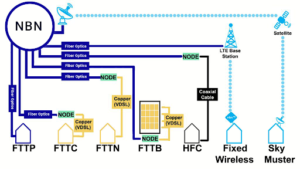
Fibre to the Premises FttP
Fibre to the Premises is the gold standard of NBN connections. Fibre runs directly from the network all the way into your home or business.
What Makes FttP Different
FttP does not rely on copper at any point. That single fact removes most speed and stability issues. Data travels as light through fibre, which means distance barely affects performance.
This is the connection type people describe when they say their internet just works.
Real World Experience
Homes with FttP can stream multiple 4K videos, run video calls, upload large files and play online games simultaneously without noticing slowdowns. Peak hour congestion is far less noticeable compared to other technologies.
Who Benefits Most
Remote workers
Businesses using cloud systems
Content creators
Large households with many devices
If FttP is available at your address, it is almost always worth choosing.
Fibre to the Node FttN
Fibre to the Node uses fibre to a nearby street cabinet, then switches to copper phone lines for the final distance to your home.
The Hidden Limitation
Copper lines were never designed for modern internet usage. The further your home is from the node, the more speed and stability drop.
Two neighbours on the same street can have completely different experiences simply because of distance.
What Performance Feels Like
At its best, FttN can feel fine for browsing, streaming and basic work. At its worst, speeds fluctuate, uploads crawl, and evening usage becomes frustrating.
Many people upgrade plans on FttN and see no improvement because the copper line is already maxed out.
When FttN Still Works
Smaller households
Light streaming and browsing
Homes close to the node
Understanding your distance matters more than the plan itself.
Fibre to the Curb FttC
Fibre to the Curb is a quiet overachiever. Fibre runs almost all the way to your property, stopping near the curb, with a very short copper connection into the home.
Why FttC Is Often Better Than Expected
Because the copper distance is extremely short, performance is far more consistent than FttN. Many users experience speeds close to full fibre without major upgrades.
Real Life Impact
Most households on FttC can stream, work remotely, and use smart devices smoothly. Upload speeds are also noticeably better than older copper based connections.
FttC proves that small infrastructure differences can create big real world improvements.
Fibre to the Building FttB
FttB is common in apartment buildings and offices. Fibre runs to the building basement, then uses existing internal wiring to reach each unit.
Performance Depends on the Building
If the internal wiring is modern and well maintained, FttB can perform very well. Older buildings with outdated wiring may experience inconsistency.
Best Use Cases
Apartments with newer infrastructure
Small businesses in shared buildings
FttB often surprises people with how capable it can be when conditions are right.
Hybrid Fibre Coaxial HFC
HFC was originally built for pay TV networks and later adapted for internet.
The Shared Network Reality
HFC connections are shared across neighbourhoods. This means performance can dip during peak hours when many people are online at the same time.
What Users Experience
During quiet hours, speeds can be excellent. In the evenings, congestion may appear depending on local demand and network upgrades.
HFC is not bad, but it rewards realistic expectations rather than marketing promises.
Fixed Wireless
Fixed Wireless connects homes to nearby towers instead of physical cables. It is common in regional and semi rural areas.
Strengths and Tradeoffs
Fixed Wireless has improved significantly over the years. However, it remains sensitive to distance, weather conditions, and network load.
When It Works Well
Low density areas
Homes without fibre access
Users with moderate internet needs
It is often the best option where fibre is not feasible.
Satellite NBN Sky Muster
Satellite NBN exists to connect the most remote locations in Australia.
Understanding Its Purpose
Satellite is designed for access, not performance. Latency is high due to the distance signals must travel to space and back.
Realistic Expectations
Web browsing and email work fine. Video calls, online gaming, and large uploads can feel slow.
Satellite NBN is about inclusion rather than speed.
How to Find Your NBN Connection Type
The easiest way is to check your address on the official NBN website or ask your provider directly. This single step instantly clarifies what is realistically possible for your home.
Once you know your connection type, marketing noise fades away and decision making becomes clearer.
Choosing the Right Plan Based on Your Connection
Here is the insight most people miss. Not every connection type benefits from higher speed tiers.
On FttP, upgrading often delivers real results.
On FttN, upgrades may do nothing if the line is already limited.
On HFC, peak hour experience matters more than advertised speeds.
The smartest approach is matching your plan to what your connection can truly handle.
The Bigger Picture Most People Ignore
NBN connection types are not just technical details. They shape how you work, learn, communicate, and grow online.
Reliable internet enables better remote work, smoother education, stronger businesses, and less daily friction. When you understand your connection, you stop blaming providers and start making empowered choices.
That shift alone changes your relationship with technology.
Final Thoughts
The NBN is not one network. It is a collection of technologies, each with strengths and limits. Knowing your NBN connection type gives you clarity, confidence, and control.
Instead of chasing faster plans blindly, you start asking smarter questions. Instead of frustration, you get realistic expectations and better outcomes.
That is the difference between consuming internet services and mastering them.