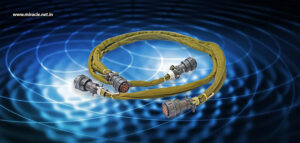

In modern electrical and electronic systems, wire harnesses have transitioned from basic power conduits to intricate networks that convey power, signals, and high-speed data. But, this evolution has made them susceptible to electromagnetic interference, which can jeopardize safety, reliability, and adherence to regulations. EMI is a critical risk that can lead to signal distortion, communication breakdowns, and erroneous sensor readings. While there are many mitigation strategies available, there are a few indispensable practices that establish the groundwork for a resilient wire harness design, guaranteeing consistent EMC performance in real-world applications.
Understanding the EMI challenge in wire harness systems
Wire harnesses are vulnerable to EMI due to their physical structure and routing in terms of length and branching geometry. However, their proximity to high-power devices and exposure to multiple subsystems also add to the noise. In high-density electrical platforms, the same wire harness may run close to high-speed communication lines, switching power supplies, motor drives and inverters, and DC-DC converters. This environment creates interference that can easily couple into sensitive circuits, unless deliberate mitigation strategies are implemented at the design stage. For instance, in modern vehicle architectures where multiple electronic domains coexist within confined spaces, EMI in automotive wire harnesses can be addressed through EMC-driven design practices that ensure reliable operation of electric powertrains, in-vehicle networks, and safety-critical sensor systems.
Core design practices for effective EMI mitigation
Reliable EMI control relies on essential design practices that ensure signal integrity, EMC compliance, regulatory adherence, and consistent performance in demanding electrical environments.
- Shielding with 360-degree termination
Shielding is the most effective and widely adopted method for controlling EMI in critical wire harness systems, as it prevents external electromagnetic energy from entering the wire harness, and stops internally generated noise from radiating outward. However, the effectiveness of shielding is determined less by the shield material and more by how it is terminated. A properly designed system ensures 360° shield termination, continuous shielding across interfaces, and direct bonding to conductive connector backshells. This creates a low-impedance path for high-frequency noise and maintains electromagnetic containment. For critical applications, shield continuity through connectors and bulkheads is essential, as most EMI leakage occurs at transition points rather than along the wire harness length.
- Grounding and bonding
While shielding is the most effective and widely adopted method, it alone cannot control EMI without a properly designed grounding and bonding strategy. Grounding provides a controlled return path for unwanted currents, and stabilizes the electromagnetic behaviour of the entire wire harness system. Reliable grounding involves low-impedance connections to the chassis or structure, short and wide bonding paths, and elimination of ground loops. Single-point grounding is great for low-frequency analog circuits, while for high-frequency environments, multipoint grounding is essential to offer lower impedance and better noise suppression.
- Cable routing and segregation
Electromagnetic coupling is strongly influenced by spacing, orientation, and loop area. This makes effective routing important. Effective routing strategies include avoiding long parallel runs between noisy and sensitive circuits, crossing different wire harness groups at right angles, maintaining separation between power and signal wire harnesses, and keeping high-speed data lines away from high-voltage conductors. Even small increases in distance between wire harness groups can dramatically reduce noise coupling. Segregation of wire harnesses into functional zones further enhances EMC performance and simplifies system validation.
- Twisted pairs and differential signalling
For low-level signals and high-speed communication, twisted pair configurations within wire harnesses are essential. Twisting the conductors reduces magnetic field coupling, minimizes loop area, and cancels induced noise. When combined with differential signalling, this approach allows the receiver to reject common-mode noise, significantly improving signal integrity in electrically noisy environments. This is why twisted pairs are important for communication networks, high-speed data transmission, and sensor interfaces.
- EMC connector design for shield continuity
If the connector interfaces are poorly designed, wire harness systems with even excellent shielding still fail EMC testing. Critical connector features include conductive or metal backshells, 360° shield clamping, proper bonding to the enclosure, and EMI sealing at panel entry points. The connector must maintain the same shielding effectiveness as the wire harness; any discontinuity in the shield path becomes a source of radiation leakage.
- EMI filtering for conducted noise suppression
Suppression components for conducted EMI are important in conjunction with shielding and routing. Common solutions include ferrite beads for high-frequency noise absorption, common-mode chokes for data and power lines, and inline EMI filters at wire harness subsystem interfaces. These components prevent noise from propagating along the wire harness and entering sensitive electronics. They are especially important in systems with switching power electronics, shared power distribution networks, and fast transient signals.
- EMC testing and validation
No EMI mitigation strategy is complete without proper testing and verification. Standard EMC validation for wire harnesses typically includes conducted emissions testing, radiated emissions testing, immunity testing, and bulk current injection. Such tests ensure that the wire harness performs reliably in real operating conditions and complies with industry standards. More importantly, it confirms that the design, materials, harness processes, and grounding strategy work together as a unified EMC solution.
A system-level approach to EMI control
The most important principle in wire harness EMC design is that EMI mitigation is not a single feature; it is a system-level discipline. Therefore, the best outcomes come from a combined effect of proper shielding and termination, robust grounding and bonding, intelligent routing and segregation, EMC-grade connectors, twisted pair signal architecture, targeted filtering, and thorough validation testing. When these elements are addressed early in the design phase, high system reliability, improved functional safety, and faster compliance certification can be achieved with reduced field failures.
In critical wire harness systems, it is essential to address electromagnetic interference from the initial design phase instead of considering it a late-stage correction. Effective EMI mitigation relies on the foundational elements mentioned above, which provide the majority of real-world EMC performance and guarantee reliability in safety-critical settings. As electrification, high-speed data, and compact system architectures continue to expand, mastering these fundamental principles not only represents sound engineering practice but also offers a distinct competitive edge. A wire harness manufacturer in India, like Miracle Electronics, applies these core EMC design principles to develop high-reliability wire harnesses for demanding applications. Their focus on shielding integrity, precision termination, and rigorous testing ensures consistent performance in electrically complex and safety-critical environments.