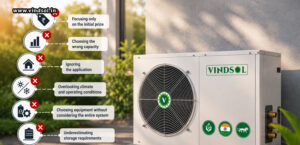

Heat pumps are becoming more prevalent in various sectors, including residential, commercial, hospitality, healthcare, recreational, and industrial applications. Their capability to transfer heat instead of generating it directly positions them as an efficient alternative to traditional heating systems. However, selecting the appropriate heat pump requires more than just comparing models, capacities, or prices. The system must align with the specific application, operating conditions, heating demand, and usage patterns. A model that works well in one setting may not function effectively in another. Additionally, focusing only on the initial cost or advertised capacity can result in poor choices. By understanding these elements, buyers can avoid common pitfalls and choose a system that provides reliable, efficient, and consistent performance.
Mistake 1: Focusing only on the initial price
Price is certainly one of the primary considerations for buyers, but relying on the purchase price as the main criterion can lead to an incomplete evaluation. Two heat pumps might have comparable capacities but can vary significantly in terms of efficiency, controls, construction quality, operating range, and anticipated service life. A more effective strategy is to assess the total cost of ownership, which includes initial equipment cost, installation costs, energy consumption, expected operational lifespan, and routine maintenance. By examining the entire financial landscape, buyers can evaluate systems based on long-term value rather than just the upfront cost at the time of purchase.
Mistake 2: Choosing the wrong capacity
The required capacity is determined by the actual heating demand of the application, not merely by the size of the building or the equipment involved. A system should be chosen based on factors such as the required heating load, usage patterns, operating conditions, desired temperature, and anticipated peak demand. Capacity selection must rely on actual needs and a technical evaluation rather than assumptions or a straightforward comparison of available models.
Mistake 3: Ignoring the application
Not all heat pump applications work same. A system designed for a residential home may not be appropriate for a hotel, hospital, spa, commercial building, or industrial facility. Different applications have different heating requirements, usage patterns, operating schedules, temperature requirements, storage requirements, and load profiles. Understanding the application prior to selecting the equipment ensures that the heat pump is appropriately matched to its expected function.
Mistake 4: Overlooking climate and operating conditions
Heat pumps can work in a variety of climates, but the specific conditions at the installation site must be carefully considered. Ambient temperature, humidity, seasonal changes, water temperature where relevant, and installation conditions can all affect system performance. Therefore, buyers should take into account the dominant climate and operating environment when assessing a heat pump. The system should be chosen based on the conditions it will likely face throughout most of the year, rather than depending solely on standard laboratory specifications. This consideration becomes especially crucial when comparing systems designed for different geographical areas or operating conditions.
Mistake 5: Choosing equipment without considering the entire system
A heat pump does not function independently. Its efficiency is affected by the other components it is connected to and the overall design of the system. Key factors to consider include the storage tank layout, piping configuration, heat distribution methods, flow requirements, control mechanisms, and electrical setup. Even a heat pump with the right capacity may underperform if the surrounding system is inadequately designed. Therefore, it is essential for buyers to assess the entire heating system instead of viewing the heat pump as a standalone unit.
Mistake 6: Underestimating storage requirements
Storage plays a crucial role in scenarios where hot water demand varies throughout the day. For instance, a facility might face times of low demand followed by sharp spikes in usage. An effectively designed storage system can help manage these fluctuations and guarantee that heated water is accessible when needed. Storage requirements are influenced by the expected consumption, peak demand, operating hours, and available space. Not all applications necessitate the same storage approach. The key takeaway is to integrate storage into the overall system design rather than implementing it later without thorough evaluation.
Mistake 7: Comparing systems only by rated performance
Technical specifications are important, but buyers must be cautious not to assess a heat pump based solely on a single specification. Capacity, efficiency, temperature range, sound level, electrical requirements, and other technical details all offer significant insights. However, these metrics must be interpreted in the context of the actual operating conditions of the system. A heat pump that seems highly efficient under specific conditions may not deliver the same level of performance under varying temperatures, loads, or operational demands. A more effective strategy is to assess performance within the framework of the intended application.
Mistake 8: Ignoring installation quality
Even a well-designed heat pump can fail to perform optimally if it is not installed properly. Installation encompasses much more than just placing the equipment in position. It includes ensuring that electrical connections, piping, airflow, insulation, drainage, controls, and other system components are correctly configured. Subpar installation can hinder system performance and lead to unnecessary maintenance issues. Therefore, buyers should take into account the qualifications of the installation team and confirm that the installation adheres to the technical specifications set by the equipment manufacturer. Proper commissioning should also be conducted to ensure the system is functioning correctly before it is put into regular operation.
Mistake 9: Not considering future energy integration
Energy systems are increasingly becoming interconnected. Modern buildings and facilities are now integrating solar, energy storage, smart controls, and energy management systems. When choosing a heat pump, purchasers should evaluate whether the system can effectively align with future energy infrastructure. For instance, a heat pump capable of functioning with solar-generated electricity may offer enhanced flexibility as a building’s energy strategy evolves. Considering future integration does not imply investing in superfluous features. It simply entails assessing whether the chosen system can adapt to changing energy needs throughout its anticipated operational lifespan.
Mistake 10: Overlooking manufacturer expertise
The quality of a heat pump system is not solely determined by the equipment itself. The expertise and experience involved in its design, manufacturing, application support, and service are equally important. Buyers should consider important factors like manufacturing experience, product development capabilities, application knowledge, technical support, installation guidance, and after-sales service. A manufacturer with diverse application experience is better equipped to comprehend the practical requirements that affect system selection and performance. This is especially crucial when the application entails unique operating conditions, continuous demand, or tailored system specifications.
How to make a better heat pump buying decision
Avoiding common buying mistakes starts with asking the right questions before making a purchase. Buyers should identify the system’s purpose, operating frequency, heating demand, and expected conditions. Capacity should be selected based on actual requirements rather than assumptions. The complete system should also be evaluated, including storage, controls, installation, supporting infrastructure, efficiency, and climate suitability. Maintenance requirements and technical support should also be considered before finalizing the purchase. Working with a reliable manufacturer and qualified installation team can help ensure proper system selection, configuration, and commissioning. This structured approach allows buyers to make informed decisions and choose equipment suited to their specific application and requirements.
Why proper selection matters more than simply buying a heat pump
Heat pump technology offers significant efficiency and flexibility, but these advantages can only be fully realized when the equipment is appropriately selected and integrated. The right system is not necessarily the largest, the cheapest, or the model with the highest specification on paper. It is the one that matches the actual requirements of the application and operates effectively within its intended conditions. This is why heat pump selection should be treated as a technical decision rather than a simple product purchase. For buyers looking for a heat pump in India, Vindsol offers solutions designed around specific application requirements, helping customers select appropriately matched systems with dependable performance, efficient operation, and professional technical support.
Buying a heat pump is a long-term investment, so the selection process deserves more attention than simply comparing prices or capacities. Factors such as correct sizing, application requirements, climate conditions, installation, and maintenance can significantly influence system performance. A better approach is to evaluate the complete requirement, including heating demand, operating conditions, storage, controls, installation, maintenance, and future energy integration. Considering these factors together helps buyers make informed decisions and select systems suited to their specific applications. Ultimately, successful heat pump adoption is not just about choosing efficient equipment; it is about choosing the right system for the right requirement, supported by proper engineering, installation, and technical expertise.