
I spent years in embedded finance building a company most of its end users would never actually see by name. Jifiti’s technology sat inside a bank’s app or a retailer’s checkout page, invisible by design. The moment that actually taught me what marketing is for wasn’t a launch or a campaign. It was sitting across the table from a bank’s risk and compliance team, watching them decide whether to let our infrastructure sit inside relationships they’d spent decades building, knowing full well our logo would never appear anywhere their customers could see it. Nothing about that conversation was about features. It was entirely about whether they trusted us enough to stay invisible together.
That’s the moment the cost-center framing of marketing stopped making sense to me.
The brand nobody sees is the brand you fight hardest for
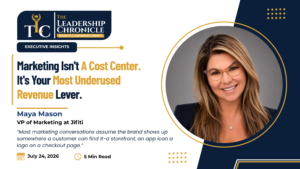
Most marketing conversations assume the brand shows up somewhere a customer can find it: a storefront, an app icon, a logo on a checkout page. White-label businesses don’t get that. The end user never knows Jifiti exists, which means every ounce of trust a bank or a retailer places in you has to be built somewhere else entirely, before the deal, away from the product itself. You don’t get to lean on the brand experience to do the convincing. You have to manufacture credibility from scratch, in rooms the end customer will never sit in.
That’s not a nice-to-have. It’s the whole game. A company selling a visible product can survive mediocre marketing on the strength of the product people actually touch. A white-label company can’t. If nobody outside your sales team has ever heard of you, you’re asking a bank to bet its own customer relationships on a stranger.
Values were the actual pitch
At Jifiti, trust wasn’t a marketing message we layered on top of the product. It was the company’s DNA, in the sense that whoever wrote our content, ran our events, or picked our conference speakers was making the same argument, over and over, in a hundred different forms: you can trust us with this. Not because a slide said so, but because the way we showed up, consistently, credibly, without overselling, was itself the evidence. I’ve come to think that’s what marketing actually is, in a B2B business built on trust: the accumulation of small, repeated proof that you are who you say you are, long before anyone asks you to prove it under pressure.
“The accumulation of small, repeated proof that you are who you say you are, long before anyone asks you to prove it under pressure.
Thought leadership is infrastructure, not decoration
In a category still being defined — embedded lending, in our case — thought leadership isn’t optional polish on top of a real strategy. It’s how you get to define the terms everyone else argues in. Every talk, every article, every panel wasn’t chasing a headline. It was staking out what “trustworthy” looked like in a category before a competitor got to define it for us, or worse, before a bad actor defined it badly enough to make every vendor in the space look risky by association.
None of that shows up cleanly in a pipeline report. It doesn’t get credited in a last-touch attribution model. But by the time our sales team walked into a room, half the trust question had already been answered somewhere upstream: a conference stage, a bylined piece, a conversation a prospect’s colleague had with someone who’d read our work. That’s not brand awareness for its own sake. That’s a shorter sales cycle wearing a different outfit.
“That’s not brand awareness for its own sake. That’s a shorter sales cycle wearing a different outfit.”
The same pattern, in every room I’ve sat in since
I saw the same dynamic before Jifiti, and I saw it much earlier too. At M-Systems, the company behind DiskOnKey, the original USB flash drive, we weren’t just selling a product — we were asking retailers and OEM partners to trust an entirely new category that didn’t have a name yet. Years later, at Equivio, we were asking law firms and corporate legal teams to hand over sensitive, privileged data to a text analytics company they’d never worked with before. In eDiscovery, you don’t get a second chance to be trusted.
That equation isn’t unique to embedded finance. It shows up anywhere a buyer is putting their own reputation on the line to choose you: a general counsel choosing legal software, a CISO choosing a security platform, a CIO choosing an enterprise AI platform. None of them are buying on price alone. They’re buying on whether they trust you enough to put their name next to yours.
Which is why I’ve stopped accepting the premise that marketing’s value has to be provable inside a single dashboard to be real. That distance, between unknown and trusted, is where revenue actually gets made or lost, long before a deal ever reaches a term sheet.
If you’re a CEO or a board member still asking your marketing leader to justify their budget in the same terms you’d use for a paid media buy, you’re measuring the wrong thing. Ask instead how many of your last five enterprise deals closed faster because the buyer already trusted you before your salesperson said a word. That number won’t show up on a dashboard either. It’ll show up in your pipeline.
“Ask instead how many of your last five enterprise deals closed faster because the buyer already trusted you before your salesperson said a word.”
For more details, visit: https://theleadershipchronicle.com/
If you would like to get featured or want to know more, connect with us at contact@theleadershipchronicle.com
LinkedInn : https://www.linkedin.com/company/the-leadership-chronicle/
Twitter : @TLChronicle