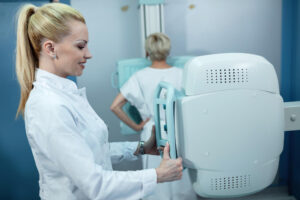

What If the Most Important Scan of Your Year Didn’t Have to Hurt?
For a lot of women, the annual breast imaging appointment sits in a particular category of necessary-but-dreaded healthcare experiences. Not because the outcome is unknown, and not because the technology is unfamiliar — but because of what’s involved. The compression. The positioning. The discomfort that lingers after you’ve driven home and gotten on with your day. And underneath all of that, the quiet anxiety that comes with waiting to find out whether everything is okay.
Most women push through it. They do what they’re told to do, they tolerate what needs to be tolerated, and they tell themselves it’s worth it — because early detection genuinely is worth it, and most of them know it.
But here’s what a lot of women don’t yet know: that trade-off isn’t actually necessary anymore. The discomfort they’ve been accepting as the price of responsible breast health care is no longer a given. Because the technology has changed in a way that most patients haven’t heard about yet — and it’s available right now, in Southern California, through a mobile care unit that comes directly to the community.
The Technology That Changes the Experience
The Koning Vera breast CT is a dedicated breast CT system that produces true 360-degree, isotropic 3D images of the breast. It was built in the United States, it has received FDA Premarket Approval — the highest level of FDA clearance for a medical device — and it delivers diagnostic imaging of exceptional quality. High-contrast, high-resolution images that show every angle of the breast tissue without the overlapping structures that limit what traditional imaging can reveal.
That technical profile matters enormously for diagnostic accuracy. But for the women sitting across from their physician trying to understand what their imaging options are, the part that tends to land first is the experience itself.
The scan takes approximately seven seconds per breast. A bilateral exam — both breasts — is complete in under five minutes. And there is no compression involved, at any point, in any part of the process.
Why Compression Has Always Been the Problem
Traditional mammography requires the breast to be compressed between two plates. The compression is functional — it reduces tissue thickness, which reduces the radiation dose needed and improves image quality by reducing the distance the X-rays have to travel. The physics makes sense. The experience, for many women, does not.
For women with fibrocystic breast tissue, for women who are premenopausal, for women who have had breast surgery, and for women whose pain sensitivity makes compression genuinely difficult to tolerate, the mammogram experience is more than uncomfortable — it’s a reason some of them delay or avoid scheduling the appointment at all. That delay has real consequences. Breast cancer caught early has dramatically better outcomes than breast cancer caught late. Anything that reduces the likelihood of women getting their imaging done on schedule is a public health issue as well as an individual one.
No compression breast imaging removes that barrier entirely. The Koning Vera’s design means the breast is never compressed, never repositioned, never manipulated for additional views. The scan captures the full 3D dataset in a single pass, which also eliminates the need for the callback appointments that can follow a standard mammogram when a particular angle wasn’t captured clearly.
Dense Breast Tissue: Where Standard Imaging Falls Short
Dense breast tissue is one of the most clinically significant limitations of traditional mammography. When breast tissue is dense, it appears white on a mammogram — and so do tumors. That overlap means dense tissue can hide cancers that are present, producing false negatives in exactly the patients who may be at elevated risk.
Millions of women in the United States have been notified by their physicians that they have dense breast tissue, often without a clear explanation of what that means for the quality of their standard imaging or what their follow-up options are. The notification is now required in many states — but the pathway to better imaging isn’t always clearly communicated.
The breast ct scan approach used by Gnosis for Her addresses the dense tissue challenge directly. Because the Koning Vera produces true 3D images across all angles simultaneously, dense tissue cannot hide pathology the way it can on a 2D mammogram. Overlapping structures — which are responsible for many of the false positives and false negatives in standard mammography — are resolved in the 3D dataset.
For women with dense breast tissue who have been told their mammogram results are difficult to interpret, or who have been called back for additional imaging after an inconclusive screening, Koning Vera breast CT offers a meaningful clinical step forward.
Who This Imaging Is For
Gnosis for Her and the physicians who work with the platform are clear that 3D Breast CT is currently used as a diagnostic tool — a complement to mammography rather than a replacement for routine screening. The clinical scenarios where it provides the most value are well established.
It’s appropriate for women who’ve received abnormal mammogram findings and need further evaluation before a definitive clinical decision can be made. It’s well-suited for women with BRCA1 or BRCA2 gene mutations, or other genetic risk factors that elevate lifetime breast cancer risk. Women who’ve had chest radiation before age 30 often benefit from enhanced imaging options. Women with implants, where standard mammography provides limited information, have clear indications for CT-based alternatives. And women who’ve had palpable lumps, persistent pain, nipple changes, or other symptoms that merit thorough investigation are candidates for the more comprehensive view that Koning Vera provides.
A six-month follow-up imaging need — a BI-RADS 3 finding — is one of the most common clinical scenarios Gnosis for Her serves. Rather than waiting and wondering, patients can get a clear, high-resolution 3D picture of the tissue in question and give their physician the information needed to make a confident clinical decision.
Radiation Safety: What the Numbers Actually Say
For women who have concerns about radiation exposure from imaging procedures, the Koning Vera profile is reassuring. Radiation exposure from a non-contrast Gnosis for Her 3D Breast CT scan is approximately 0.7 mSv. The average American is exposed to roughly 3.1 mSv of natural background radiation annually. The Gnosis for Her scan delivers about 75 percent less radiation than what you’re naturally exposed to in a year just by living your daily life.
For guided biopsy procedures, the Koning Vera uses approximately 50 percent less radiation than traditional stereotactic biopsy methods. These are not marginal improvements. They represent a meaningful reduction in cumulative radiation exposure for women who require diagnostic imaging and procedures.
The Mobile Care Unit: Bringing the Technology to You
One of the most significant aspects of Gnosis for Her’s model is the delivery mechanism. The Koning Vera technology comes to the community through a purpose-built mobile care unit, stationed at accessible locations across Southern California each week.
This matters because access to advanced breast imaging has historically been uneven. Proximity to major medical centers, transportation availability, scheduling flexibility during work hours, and the administrative complexity of navigating referrals and appointments all create barriers that affect which women actually get the imaging they need. The mobile unit model is a direct response to those barriers. The technology comes to where patients are — rather than requiring patients to navigate toward it.
The scheduling process is designed to be straightforward. Patients book a scan time at a convenient location, secure a provider referral (Gnosis for Her has partnered with Karis Healthcare to provide telehealth physician evaluation for patients who need a quick pathway to an order), and arrive at their appointment with nothing to organize on the day. Results are read by a board-certified radiologist and delivered securely to both the patient and their physician, typically within 72 hours when prior imaging is available.
Pricing, FSA/HSA, and the Path to Broader Insurance
Gnosis for Her currently offers Koning Vera breast CT at a self-pay price of $499, with a $20 reservation fee collected at booking and applied toward the total. FSA and HSA accounts are eligible for reimbursement, which provides meaningful out-of-pocket relief for many patients.
The American Medical Association assigned dedicated CPT codes for Breast CT in January 2021, and these are increasingly being accepted by insurance payers. Gnosis for Her is actively working toward direct insurance acceptance, which will further expand access as coverage broadens.
What Women Are Actually Saying
The consistent theme in patient feedback about the Koning Vera experience isn’t just relief about the absence of compression — though that is significant and real. It’s the sense of being cared for in a way that feels genuinely different from standard medical imaging. The scan is quick. The results come back with clear explanations. The mobile unit is thoughtfully designed. And the whole experience — from scheduling to results delivery — is built around the patient rather than around the workflow of a large hospital radiology department.
For women who’ve found breast imaging stressful, painful, or difficult to access, that difference is not a small thing.
Take the Next Step in Your Breast Health
If you have dense breast tissue, have received an unclear or abnormal mammogram result, carry elevated genetic risk, or simply want to understand your breast health with the clearest technology currently available, Gnosis for Her is ready to help. Visit gnosisforher.com to book your scan, take the patient eligibility quiz, or connect with the team with any questions. Your breast health deserves the clearest picture possible — and now you can get it without the ouch.