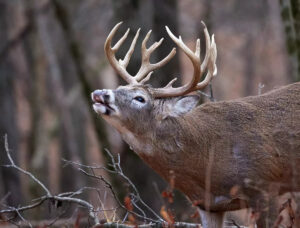

The woods can feel different when the rut begins.
A quiet Kansas morning that seemed empty at sunrise can suddenly come alive with a buck crossing a fence line, nose low, moving like he forgot every cautious habit that kept him alive all year. That is the pull of the Kansas rut season. It does not make mature deer careless, but it does change their priorities.
Food still matters. Cover still matters. Wind still matters. But during peak season, breeding pressure reshapes deer rut behavior and turns familiar trails into moving puzzles. For hunters, the key is not just knowing that the rut is “on.” It is understanding what stage the deer are in, why bucks move the way they do, and how whitetail movement changes from one week to the next.
Key Takeaways
- The rut changes buck priorities from feeding to finding does.
- Wind, access, and pressure still matter during peak season.
- Doe bedding areas and travel corridors become critical.
- Kansas rut hunting rewards patience, scouting, and timing.
What Really Happens During Kansas Rut Season?
The rut is the whitetail breeding season, when bucks increase travel, check doe groups, freshen sign, and compete for breeding opportunities. In much of the Midwest, deer breeding is generally centered around mid-November, and K-State Research and Extension notes that peak breeding is commonly close to November 15.
That does not mean every buck behaves the same way on the same day. Weather, hunting pressure, age structure, food availability, and local doe movement all shape what a hunter sees from the stand.
The rut often feels like one event, but it is better understood in phases:
- Early rut signs
- Seeking and cruising
- Chasing
- Lockdown
- Late rut recovery
This is why hunters planning Kansas whitetail deer hunting trips should think beyond calendar dates. The better question is: what are the deer doing right now?
Can Deer Rut Behavior Push Bucks Into Daylight?
Before peak season, bucks often follow a more predictable rhythm. They bed, feed, use cover, and avoid unnecessary daylight exposure. As does begin approaching estrus, that pattern starts to bend.
A mature buck may begin:
- Walking field edges later in the morning
- Scent-checking doe bedding areas
- Crossing open gaps he normally avoids
- Working scrapes less consistently
- Covering more ground during daylight
- Responding more aggressively to other bucks
The biggest mistake is assuming the rut removes caution. It does not. It only changes the risk-reward balance.
A mature buck may travel farther, but he still prefers cover. He may move at noon, but he still uses wind. He may chase a doe into the open, but he did not suddenly forget how to survive.
That is why guided trophy whitetail hunts often focus on funnels, bedding edges, creek crossings, and terrain features that naturally guide buck movement.
Whitetail Movement Becomes a Moving Puzzle
Whitetail movement increases during the rut because bucks are searching for receptive does. They are not simply wandering. They are checking places where does spend time.
A good rut setup usually connects three things:
- Doe bedding cover
- Safe travel corridors
- Nearby food sources
When those pieces overlap, hunters may see activity at times that feel unusual compared with early season patterns.
This is especially true in eastern Kansas, where crop ground, timber strips, draws, creek bottoms, and small thickets can create natural pinch points. A buck may not walk the most obvious trail. He may swing downwind of it, using scent before sight.
That is where patience matters. The best stand during rut is not always the place with the most tracks. Sometimes it is the quiet trail just off the main trail.
For hunters comparing Kansas whitetail deer hunting trips, access to low-pressure private ground can make a major difference because rut movement is easier to read when deer are not constantly bumped.
Rut Phase Guide for Reading Buck Behavior
|
Rut Phase |
Buck Behavior |
Best Setup |
Common Mistake |
|
Early signs |
Rubs, scrapes, night activity |
Food edges, staging areas |
Hunting too aggressively |
|
Seeking |
Bucks cruise for does |
Travel corridors |
Leaving too early |
|
Chasing |
Fast, visible movement |
Funnels, crossings |
Ignoring wind |
|
Lockdown |
Bucks stay with does |
Thick cover, small pockets |
Thinking the rut is over |
|
Late rut |
Bucks check remaining does |
Food-to-bed routes |
Overlooking recovery feeding |
This table is simple, but it helps hunters avoid one of the biggest rut errors: using yesterday’s plan for today’s deer behavior.
What Do Hunters Get Wrong About Peak Rut?
Many hunters expect the rut to be nonstop action. When the woods go quiet, they assume they missed it.
Often, they are sitting through lockdown.
During lockdown, a mature buck may stay close to one doe for a short period. If that pair is nearby, the hunt can be electric. If they are tucked into a hidden draw or brushy pocket across the property, the woods can feel lifeless.
That does not mean the Kansas rut season has ended. It means movement has tightened.
A better approach is to adjust:
- Hunt near the doe bedding cover.
- Watch secluded openings.
- Glass from a distance when possible.
- Stay ready during midday.
- Avoid overusing calls in pressured areas.
As Aldo Leopold wrote, “There are some who can live without wild things, and some who cannot.” Rut hunting makes that line easy to understand. It is not only about seeing a buck. It is about reading a living landscape.
How Can Scouting Reveal the Rut’s Next Move?
Scouting should not stop once the season starts. In fact, rut scouting may be even more valuable because deer are actively changing patterns.
Good in-season scouting can include:
- Watching fields from a distance
- Checking trail camera timing
- Noting fresh tracks after rain
- Marking new rub lines
- Watching how does enter cover
- Recording wind and sightings after each sit
The goal is not to invade bedding areas every day. The goal is to gather enough information to make cleaner decisions.
A hunter who notices shifting from one food source to another may also discover where bucks will check next. A hunter who sees fresh crossing activity after a cold front may know where to sit the following morning.
That is how whitetail movement becomes more understandable.
Rut Hunting Moves That Kill Big Mistakes
Rut hunting is exciting, but discipline still wins.
Use this checklist before choosing a setup:
- Check the wind for the full sit.
- Plan a quiet entry and exit.
- Stay near doe activity.
- Hunt funnels during cruising periods.
- Sit longer when movement is unpredictable.
- Adjust only when the sign justifies it.
The best rut hunters do not chase every fresh track. They build a plan, observe carefully, and move only when the evidence says to move.
A Kansas Rut Moment Every Hunter Knows
Picture a hunter sitting near a field edge in early November. The first two evenings show does feeding before dark, but no mature buck appears. The easy move is to keep waiting.
The smarter move may be to ask: where would a buck scent-check those does without stepping into the open?
Maybe it is a creek crossing behind the field. Maybe it is a brushy fence gap. Maybe it is a narrow strip of timber connecting two bedding pockets.
On the next sit, that quieter location may reveal the real pattern. Not because the hunter got lucky, but because the setup matched deer rut behavior.
That is the heart of Kansas rut hunting. The action may look random, but the reasons behind it usually are not.
Conclusion: Stay Ready When the Rut Breaks Open
The Kansas rut season can be one of the most exciting times to hunt whitetails, but it is not a free pass. Bucks move more, but they still use cover. They travel farther, but they still care about wind. They may show up at odd hours, but their movement usually connects back to does.
Hunters who understand deer rut behavior and track whitetail movement with patience have a better chance of making the right decision when the moment comes.
For hunters looking for a more personal private-land experience, lodging, processing support, and focused time in the field, Hartland Whitetails offers guided deer and turkey hunts in eastern Kansas, along with a 3-D archery range membership for hunters who want to sharpen their skills before the season.
FAQs
What makes a good Kansas rut setup?
A good rut setup connects doe bedding, travel cover, and a wind advantage. Bucks often cruise these areas while checking for receptive does.
What are best practices for rut hunting?
Best practices include playing the wind, entering quietly, sitting longer, watching doe movement, and avoiding unnecessary pressure.
How to track whitetail movement in the rut?
Track fresh sign, trail camera timing, doe locations, and travel corridors. Focus on what deer are doing now, not only where they moved earlier.
When to hire a guided deer outfitter?
Hire a guide when local land access, scouting time, lodging, or rut timing is limited. A guide can help simplify decisions during a fast-changing hunt.
What is the cost of guided rut hunts?
Cost varies by location, hunt type, lodging, services, and season demand. Hunters should compare what is included, not just the base price.