
When launching a product in the Indian market, one of the biggest compliance questions manufacturers and importers face is whether they need an ISI Mark or a CRS registration. Both fall under the framework of BIS certification, but they serve different purposes and apply to different categories of products. Choosing the wrong certification can lead to shipment delays, regulatory penalties, product recalls, or rejection during market inspections.
Many businesses assume that every product requires an ISI Mark, while others believe a CRS registration is enough for all electronic products. The reality is more complex. The Bureau of Indian Standards (BIS) has created separate certification schemes depending on the product category, applicable Indian Standards, and the level of regulatory control.
Understanding the difference between these two certification schemes can save businesses significant time, money, and compliance challenges. This guide explains everything manufacturers, importers, and brand owners need to know before applying for BIS approval in 2026.
What Is BIS Certification?
BIS certification is the process through which products are evaluated for compliance with Indian Standards established by the Bureau of Indian Standards (BIS). The objective is to ensure that products available in the Indian market meet quality, safety, reliability, and performance requirements.
BIS certification protects consumers by ensuring that regulated products meet prescribed technical standards before they are sold or imported into India.
Depending on the product category, businesses may require:
- ISI Mark Certification
- CRS (Compulsory Registration Scheme)
- FMCS Certification for foreign manufacturers
- Hallmark Certification
- Other BIS approval schemes
Selecting the correct certification depends entirely on the product.
Understanding ISI Mark Certification
ISI mark certification is one of India’s oldest and most recognized product quality certification schemes. The ISI Mark indicates that a product complies with the relevant Indian Standard after undergoing inspection, testing, and certification.
Products commonly covered under the ISI scheme include:
- Cement
- Steel products
- LPG cylinders
- Pressure cookers
- Electrical cables
- Household appliances
- Packaged drinking water
- Gas stoves
- Automotive components
- Various industrial products
The ISI Mark is generally mandatory for products specifically notified by the government under mandatory certification requirements.
What Is CRS?
The Compulsory Registration Scheme (CRS) is another BIS compliance program introduced primarily for electronic and IT products.
Under CRS, manufacturers are required to register eligible products after successful testing from BIS-recognized laboratories.
Products commonly covered include:
- LED lights
- Mobile phones
- Power banks
- Laptops
- Printers
- Smart watches
- CCTV cameras
- USB devices
- Bluetooth speakers
- Electronic accessories
Unlike the traditional ISI scheme, CRS primarily focuses on self-declaration supported by laboratory testing and BIS registration.
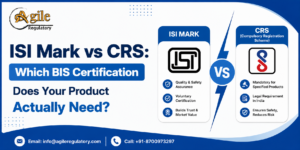
ISI Mark vs CRS: Key Differences
Although both fall under BIS certification, they differ significantly in their application.
| Feature | ISI Mark | CRS |
|---|---|---|
| Product Type | Industrial and consumer goods | Electronics and IT products |
| Certification Method | Factory inspection and testing | Product testing and registration |
| BIS Mark | ISI Mark | Standard BIS Registration Number |
| Factory Audit | Usually required | Generally not required before registration |
| Applicable Products | Government-notified products | Electronic products under CRS |
Understanding these differences helps businesses avoid applying under the wrong certification scheme.
How to Determine Which Certification Your Product Needs
The most important step is identifying whether your product appears under the mandatory ISI list or the CRS product list.
Factors considered include:
- Product category
- Applicable Indian Standard (IS)
- Manufacturing process
- Intended use
- Government notification
- BIS regulatory requirements
Applying for the incorrect certification can delay product launches and increase compliance costs.
Common Mistakes Businesses Make
Many manufacturers and importers encounter delays because they misunderstand BIS requirements.
Some common mistakes include:
- Applying under the wrong scheme
- Incorrect product classification
- Incomplete technical documentation
- Choosing the wrong testing laboratory
- Missing product specifications
- Delayed submission of supporting documents
- Failure to understand import compliance requirements
Proper planning significantly reduces approval time.
BIS Certification Cost: What Businesses Should Know
One of the most frequently asked questions concerns BIS certification cost. The total cost varies depending on several factors rather than following a fixed amount.
These factors include:
- Product category
- Certification scheme (ISI or CRS)
- Number of product models
- Laboratory testing charges
- Factory inspection requirements
- Government fees
- Documentation requirements
- Consultancy support, if required
Since every product has different technical and regulatory requirements, businesses should obtain a proper compliance assessment before estimating costs.
Can You Apply for a BIS Certificate Online?
Yes. Many applications can now be processed through the BIS certificate online system. Digital filing has simplified documentation and improved communication with the authorities.
Benefits of online application include:
- Faster document submission
- Better application tracking
- Reduced paperwork
- Improved transparency
- Easier communication during processing
However, online submission does not eliminate the need for accurate documentation, product testing, or compliance with applicable BIS requirements.
Documents Commonly Required
Although documentation requirements vary depending on the certification scheme, businesses generally require:
- Business registration documents
- PAN Card
- GST Registration
- Manufacturing license
- Product specifications
- Technical drawings
- Test reports
- Factory details
- Quality management information
- Authorization letters
- Brand ownership documents
Submitting complete documentation improves processing efficiency and minimizes clarification requests.
Why BIS Certification Is Essential
Many businesses view certification as merely a legal requirement, but it also provides important commercial advantages.
Some key benefits include:
- Legal compliance
- Improved consumer confidence
- Better product credibility
- Increased market acceptance
- Reduced regulatory risks
- Easier government approvals
- Stronger competitive position
- Enhanced product quality assurance
For manufacturers and importers, BIS certification often becomes an important selling point in competitive markets.
When Should You Hire an ISI Mark Certification Consultant?
The certification process involves technical documentation, laboratory coordination, regulatory compliance, and communication with BIS authorities. Many businesses therefore choose to work with an experienced or other compliance professionals.
A consultant can assist with:
- Product eligibility assessment
- Applicable standard identification
- Documentation preparation
- Laboratory coordination
- Application filing
- Regulatory communication
- Compliance review
- Renewal assistance
Professional guidance is especially valuable for businesses applying for BIS certification for the first time.
Why Manufacturers Trust Agile Regulatory
Navigating the BIS approval process can be challenging because every product category follows different compliance requirements. Agile Regulatory provides comprehensive consultancy services for manufacturers, importers, startups, MSMEs, and multinational companies seeking BIS approvals across India.
The experienced team at Agile Regulatory offers assistance with:
- Product eligibility assessment
- Complete BIS certification support
- Documentation preparation
- Technical compliance review
- Product testing coordination
- BIS certificate online application assistance
- Guidance on BIS certification cost
- ISI and CRS application management
- Renewal and ongoing compliance support
Businesses looking for an experienced ISI mark certification consultant in Delhi can rely on Agile Regulatory for accurate guidance, transparent processes, and end-to-end regulatory assistance.
Tips for Faster BIS Approval
Businesses can improve approval timelines by following a structured compliance strategy.
Some useful recommendations include:
- Identify the correct BIS scheme before applying.
- Verify the applicable Indian Standard.
- Prepare complete technical documentation.
- Conduct product testing through recognized laboratories.
- Review every application before submission.
- Maintain updated manufacturing records.
- Respond promptly to authority communications.
- Work with experienced compliance professionals.
These practices reduce application errors and help businesses complete certification more efficiently.
Future of BIS Certification in 2026
As India continues to strengthen product quality regulations, the scope of BIS certification is expected to expand further. More product categories are likely to come under mandatory certification, while digital compliance systems will continue improving transparency and efficiency.
Manufacturers and importers should regularly monitor regulatory updates to ensure continued compliance with changing standards. Businesses that proactively invest in certification and quality assurance will be better positioned to compete in both domestic and international markets.
Conclusion
Choosing between an ISI Mark and CRS registration is one of the most important compliance decisions for manufacturers and importers. While both are part of the broader BIS certification framework, they apply to different products and follow different regulatory procedures. Applying under the correct scheme helps businesses avoid delays, penalties, and unnecessary expenses.
Understanding BIS certification cost, completing the BIS certificate online process accurately, and seeking guidance from an experienced ISI mark certification consultant in Delhi can significantly simplify compliance. With the expert support of Agile Regulatory, businesses receive end-to-end assistance throughout the certification process, ensuring faster approvals, complete regulatory compliance, and successful product launches in the Indian market.
Frequently Asked Questions (FAQs)
1. What is BIS certification?
BIS certification is a product conformity assessment process conducted by the Bureau of Indian Standards to ensure that products meet applicable Indian quality and safety standards before being sold or imported into India.
2. What is the difference between ISI Mark and CRS?
ISI mark certification generally applies to notified industrial and consumer products requiring factory inspection and certification, while CRS primarily covers specified electronic and IT products through testing and registration.
3. How much does BIS certification cost?
The BIS certification cost depends on factors such as the product category, certification scheme, laboratory testing requirements, government fees, documentation, and the number of product models being certified.
4. Can I apply for a BIS certificate online?
Yes. Eligible businesses can complete the BIS certificate online application process through the designated BIS portal by submitting the required documents and product information.
5. Why should I hire an ISI mark certification consultant in Delhi?
An experienced ISI mark certification consultant in Delhi can help businesses identify the correct certification scheme, prepare documentation, coordinate product testing, file applications accurately, and ensure compliance with BIS regulations. Agile Regulatory provides complete end-to-end support for BIS certification, helping businesses obtain approvals efficiently and remain compliant with Indian standards.