
Introduction
Product quality and safety are important considerations for manufacturers selling goods in the Indian market. The Bureau of Indian Standards (BIS) operates a product certification scheme under which eligible manufacturers can obtain a licence to use the Standard Mark, popularly known as the ISI Mark. The certification confirms that the certified product conforms to the applicable Indian Standard, subject to the conditions of the licence.
Businesses often search for ISI Mark Certification when they need to understand whether their product requires BIS certification, what the application process involves, how much it costs and how the Standard Mark can legally be used. Since certification requirements are product-specific, manufacturers should first identify the applicable Indian Standard and check whether the product is covered by a Quality Control Order (QCO).
ISI Mark Certification
What is ISI Mark Certification?
ISI Mark Certification is the commonly used term for BIS product certification under Scheme-I. Under this scheme, BIS assesses the manufacturer’s manufacturing infrastructure, process controls, quality-control arrangements and testing capabilities and verifies product conformity with the relevant Indian Standard.
The ISI Mark is therefore not simply a quality logo that a business can use voluntarily on any product. A manufacturer must obtain the appropriate BIS licence and comply with its conditions before applying the Standard Mark to a certified product.
BIS states that its product certification scheme is generally voluntary, but certification becomes compulsory for products notified by the Central Government through applicable QCOs.
Why is the ISI Mark Important?
The certification provides value to manufacturers as well as consumers.
Product Quality Assurance
The certification process checks whether the product conforms to the applicable Indian Standard.
Consumer Confidence
The Standard Mark provides an indication that the certified product has undergone the applicable conformity assessment process.
Regulatory Compliance
Where certification is mandatory under a QCO, obtaining the required BIS licence is essential for lawful manufacture, sale or import of the covered product.
Market Credibility
A valid BIS licence can strengthen confidence among distributors, institutional buyers and customers.
Who Needs ISI Mark Certification?
The requirement depends on the product and applicable regulations. Manufacturers should consider certification when:
-
Their product is covered under a mandatory QCO.
-
They want to obtain voluntary BIS product certification.
-
Their customers require BIS certification.
-
Their product is manufactured against an Indian Standard covered by Scheme-I.
For imported products, foreign manufacturers may need to follow the applicable BIS route, such as the Foreign Manufacturers Certification Scheme (FMCS), depending on the product and regulatory framework. BIS notes that FMCS applies to foreign manufacturers for products other than electronics and IT goods notified under the relevant registration scheme.
ISI Mark Certification Eligibility
A manufacturer applying for BIS product certification needs suitable manufacturing and testing capabilities for the relevant product.
The applicant should generally have:
-
Appropriate manufacturing infrastructure
-
Required production facilities
-
Quality-control arrangements
-
Necessary testing equipment or access to permitted testing facilities
-
Competent technical personnel
-
Documented production and quality processes
-
Ability to meet the applicable Indian Standard
BIS specifically states that applicants must have the requisite manufacturing infrastructure, process controls, quality-control and testing capabilities and that the product must conform to all requirements of the applicable Indian Standard.
Documents Required
The exact documentation varies according to the product and applicable product manual. Commonly required information may include:
-
Business registration documents
-
Manufacturing premises details
-
Factory layout
-
List of manufacturing machinery
-
Testing equipment details
-
Calibration records
-
Quality-control information
-
Product technical specifications
-
Raw-material details
-
Test reports, where applicable
-
Authorized signatory information
-
Details of competent technical personnel
Manufacturers should not rely on a generic document checklist because BIS requirements can differ significantly between product categories.
ISI Mark Certification Process
The application process begins by identifying the correct Indian Standard for the product.
Step 1: Identify the Applicable Indian Standard
Manufacturers should first identify the Indian Standard applicable to their product. BIS provides an online facility for searching relevant standards.
Step 2: Review Product Requirements
Once the standard is identified, the manufacturer should study the applicable product manual, testing requirements, Scheme of Inspection and Testing (SIT), marking requirements and other technical conditions.
BIS product manuals provide product-specific information, including testing and inspection requirements.
Step 3: Prepare Manufacturing Facilities
The manufacturer must ensure that the production infrastructure, process controls, quality-control systems and testing arrangements meet the applicable requirements.
Step 4: Submit the Application
BIS accepts product certification applications through its online system, including online payment of applicable fees. BIS identifies Manakonline as the portal for submitting product certification applications.
Step 5: Factory Assessment
BIS assesses the manufacturing premises and evaluates whether the manufacturer has the capability to consistently produce conforming products.
Step 6: Product Testing
Product conformity is established through the applicable testing route, which can involve third-party laboratory testing, testing at the manufacturing premises or a combination of permitted methods.
Step 7: Licence Grant
If the assessment and testing requirements are successfully completed, BIS grants the licence to use the Standard Mark for the specified products and varieties.

ISI Mark Certification Flow Chart
Identify Indian Standard
          ↓
Check QCO / Certification Requirement
          ↓
Review Product Manual
          ↓
Prepare Factory & Testing Facilities
          ↓
Submit Online Application
          ↓
BIS Factory Assessment
          ↓
Product Testing
          ↓
Conformity Evaluation
          ↓
BIS Licence Grant
          ↓
Use ISI Standard Mark as Permitted
ISI Mark Certification Cost
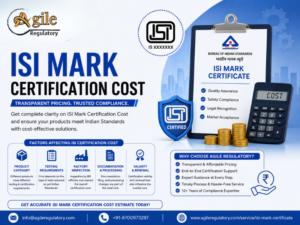
The ISI Mark Certification Cost is not a single fixed amount applicable to every product.
The overall cost can depend on factors such as:
-
Application fee
-
Inspection-related charges
-
Annual licence fee
-
Product-specific marking fee
-
Testing and laboratory charges
-
Number of product varieties
-
Factory inspection requirements
-
Additional testing or compliance work
BIS provides product-specific information regarding applicable fees and marking charges. Applicants should verify the latest fee structure before submitting an application.
Therefore, businesses should be cautious about websites offering a universal “ISI certification price” without first identifying the product and applicable Indian Standard.
ISI Mark Certification Logo
The ISI Mark is the BIS Standard Mark associated with products certified under the applicable product certification scheme.
The mark must be used according to the conditions of the BIS licence. The licence number is also required to be indicated appropriately with the Standard Mark, generally in the prescribed CM/L-XXXXXXXXXX format.
Manufacturers should never copy or modify an ISI logo and place it on products without obtaining the applicable BIS authorization.
ISI Mark Certification Services
Professional support can help manufacturers understand product-specific requirements before filing an application.
An experienced consultant may assist with:
-
Identifying the applicable Indian Standard
-
Reviewing BIS product manuals
-
Preparing documentation
-
Assessing factory readiness
-
Coordinating product testing
-
Preparing online applications
-
Responding to BIS observations
-
Supporting factory inspection
-
Managing licence-related compliance
However, certification is ultimately subject to BIS assessment and the applicable regulatory requirements.
Validity and Renewal
BIS states that a Scheme-I product certification licence may initially be granted for up to two years and applies only to the varieties covered within the licence. Renewal can be granted for up to five years from the last date of validity, subject to the applicable requirements.
Manufacturers should therefore monitor licence validity and begin renewal-related compliance in advance.
Common Mistakes to Avoid
Manufacturers frequently face delays because they:
-
Select the wrong Indian Standard.
-
Ignore the applicable product manual.
-
Submit incomplete technical information.
-
Lack required testing facilities.
-
Provide inconsistent factory details.
-
Fail to meet inspection requirements.
-
Use the ISI Mark before receiving authorization.
-
Ignore renewal and surveillance requirements.
A technical review before filing can help identify many of these issues.
Why Choose Agile Regulatory?
Agile Regulatory provides professional assistance for BIS product certification and regulatory compliance across India. Our team can help manufacturers understand applicable standards, prepare documentation, coordinate testing, complete online applications and manage regulatory communication throughout the certification process.
Our support is particularly useful for businesses that are applying for BIS certification for the first time or dealing with product-specific technical requirements.
Conclusion
Obtaining ISI Mark Certification is an important step for manufacturers whose products require or benefit from BIS product certification. The process involves identifying the applicable Indian Standard, preparing manufacturing and testing capabilities, submitting an online application, completing BIS assessment and demonstrating product conformity. The certification cost varies according to the product and applicable requirements, while the ISI Mark must be used only in accordance with the granted BIS licence. With professional support from Agile Regulatory, manufacturers can approach the certification process with better documentation, technical preparation and regulatory coordination.
Frequently Asked Questions
1. What is ISI Mark Certification?
ISI Mark Certification refers to BIS product certification under Scheme-I, through which eligible manufacturers receive a licence to use the BIS Standard Mark on products conforming to the applicable Indian Standard.
2. Is ISI certification mandatory for every product?
No. BIS certification is generally voluntary, but the Government can make certification compulsory for specific products through applicable Quality Control Orders.
3. How much does ISI Mark Certification cost?
There is no single fixed cost. Fees depend on the product, application, inspection, testing and applicable marking charges. Manufacturers should check the latest BIS fee requirements for their specific product.
4. Can I apply for ISI certification online?
Yes. BIS product certification applications and payments are accepted online through the prescribed BIS system, including Manakonline.
5. Can Agile Regulatory help with ISI certification?
Yes. Agile Regulatory can assist with standard identification, documentation, testing coordination, online application filing, factory assessment preparation and regulatory support for BIS product certification.