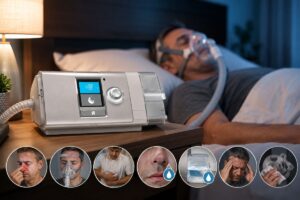

Three nights in, I was ready to throw the whole machine in a closet and take my chances with the snoring. My mouth felt like sandpaper every morning, the mask left a red mark across my nose I was genuinely embarrassed about, and twice I woke up gasping because air was hissing out somewhere near my cheek instead of going where it was supposed to.
Nobody had warned me about any of this. My sleep doctor handed me a prescription, a quick fifteen-minute walkthrough of the equipment, and sent me home. I assumed that meant I was doing something wrong, or worse, that this machine simply wasn’t going to work for me. I spent an embarrassing amount of time googling “can you return a CPAP machine” at 2am.
It turns out the first two to four weeks of CPAP therapy are genuinely rough for almost everyone, and it has nothing to do with willpower or doing it “correctly.” Your body has spent your entire life breathing one specific way, and suddenly there’s pressurized air involved. Of course there’s friction. The dry mouth, the leaks, the mask feeling foreign — none of that means the therapy is failing.
What actually helped wasn’t some dramatic fix. I turned my humidifier up two notches, which solved the sandpaper-mouth problem almost overnight. The mask mark took a bit more trial and error — turns out I had the wrong cushion size, not the wrong mask entirely. Once a friend who’d been on CPAP for years told me to actually measure my face against the sizing chart instead of guessing, that problem disappeared within two nights.
The leak issue was the most frustrating because it felt random — some nights fine, some nights a full symphony of hissing. Eventually I realized I was only adjusting the straps once, right when I put the mask on, and never touching them again even as they loosened through the night. Learning to do a quick middle-of-the-night check (half-awake, barely conscious, but still) made a bigger difference than I expected.
The single biggest shift, though, was mental. Once I understood that these were mechanical problems with mechanical solutions — not a sign my body was rejecting treatment — the whole thing stopped feeling like a fight. I also started wearing the mask for ten minutes while watching TV before actually trying to sleep in it, which sounds silly but genuinely helped my brain stop associating it with panic.
I found a breakdown that mapped specific symptoms to specific causes, and once I read it, I stopped guessing and started troubleshooting like an actual process instead of just hoping things would improve on their own.
If you’re in that same rough patch right now, it’s worth reading a proper explanation of CPAP machine side effects before you decide the machine just isn’t for you. Almost everything is fixable once you know what’s actually causing it.
Give it a real two to four weeks with small, one-at-a-time adjustments before you make any decision. Change one thing, give it a few nights, see if it helps, then move to the next. I’m glad I did it that way instead of giving up in week one.