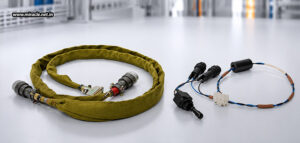

Wire looms serve a purpose beyond simply consolidating multiple wires into a single bundle. The specific design of a wire loom directly impacts its capacity to shield cables from abrasion, thermal damage, moisture infiltration, vibration, flexing, and physical stress, while simultaneously affecting the ease with which cables can be positioned throughout an assembly. Critical design elements including material composition, cross-sectional size, pliability, structural configuration, and fastening mechanism must be carefully matched to the intended use case. An improperly selected design risks creating unwanted compression, limiting cable mobility, or complicating the installation and upkeep processes. By examining how these design characteristics influence cable safeguarding and path management, engineers can create wiring configurations that maintain proper organization, convenient accessibility, and consistent performance across the entire service period.
What is wire loom design?
Wire loom design encompasses the process of choosing, proportioning, fabricating, and positioning a protective layer around wires or cable systems. This process takes into account the quantity and dimensions of cables, the intended routing trajectory, the surrounding environmental factors, anticipated motion, installation specifications, and the degree of protective coverage needed. An effectively designed loom must maintain cable grouping while avoiding unnecessary compression. It must also allow for the flexibility and movement that the specific application demands. Based on the operational environment, the design strategy may incorporate corrugated tubing, woven protective sleeves, segmented loom, or alternative protective systems. The goal extends beyond merely encasing the wiring to establishing a comprehensive protective system that preserves cable durability while ensuring practical availability for assembly, evaluation, and servicing.
Key design factors that influence wire loom performance
Wire loom performance depends on several design factors that determine cable protection, routing efficiency, durability, flexibility, and reliability in demanding applications.
- Loom diameter and cable fill
The diameter of a loom plays a critical role in both safeguarding cables and directing their path. A loom that is undersized risks compressing the cables, complicating insertion procedures, and limiting flexibility within the system. Excessive cable density can further complicate future maintenance, replacement, or system modifications. Conversely, an oversized loom may permit unwanted cable movement and consume more space during installation than required. The internal diameter must therefore be sized to contain the cable bundle while providing adequate clearance for practical assembly and operational movement. Cable fill percentage should be evaluated in conjunction with the quantity, outer diameter, and spatial arrangement of individual conductors. Appropriate sizing ensures a well-balanced protective enclosure that shields cables without unnecessarily expanding the overall harness dimensions.
- Material selection and environmental protection
The composition of a wire loom determines its capacity to resist environmental stressors. Distinct materials offer varying degrees of protection against abrasion, thermal stress, chemical exposure, moisture, mechanical impact, and comparable hazards. For instance, applications subject to continuous mechanical friction may necessitate highly abrasion-resistant materials, whereas high-temperature environments demand materials that preserve their structural integrity under thermal conditions. Industrial settings may additionally expose looms to petroleum products, solvents, chemical substances, or water. Material selection must consequently be driven by the specific operational environment rather than generalized expectations. A loom that performs adequately in a controlled indoor manufacturing setting may prove insufficient in harsh or mechanically intensive applications.
- Flexibility and cable routing
Flexibility plays a critical role when a wire loom must navigate curved or non-uniform routing paths. An inflexible or excessively rigid loom can complicate the installation process and may impose undue stress on the cables when bent around curves. A pliable construction enables the loom to conform to the designated path while preserving cable bundle protection. This consideration becomes increasingly significant in space-constrained assemblies where wiring must navigate around components, traverse confined areas, or adjust to shifting directions. Nevertheless, adaptability must not compromise mechanical safeguarding. The optimal balance varies based on the specific use case. Stationary installations may emphasize structural durability, whereas dynamic assemblies may demand increased adaptability and regulated motion.
- Bend radius and mechanical stress
Every cable routing system has constraints regarding the maximum sharpness of wire bends. Wire loom design must consider the bend radius specifications for both the loom itself and the cables it contains. Directing a loom through excessively tight curves can impose mechanical strain on the protective layer and the cables. Continuous bending can further amplify wear, especially in applications involving dynamic machinery or equipment. An appropriate loom should therefore support the necessary bend radius without deforming, compressing, or impeding the cables. Routing paths should additionally minimize unnecessary abrupt directional shifts. By synchronizing loom adaptability with cable bend specifications, engineers can minimize mechanical strain and establish more dependable cable routing solutions.
- Protection against abrasion and chafing
Abrasion is one of the most prevalent mechanical hazards affecting routed cables. During installation and operation, wires can experience friction against surrounding structures, neighbouring components, or other elements within the harness assembly. An appropriately chosen wire loom establishes a protective shield between the cables and these external surfaces. Its design facilitates the distribution of contact forces and minimizes direct deterioration of cable insulation. The routing strategy of the loom is equally important. Even a highly resilient loom can suffer accelerated degradation if it repeatedly contacts a sharp edge or abrasive surface. Effective protective design must therefore evaluate both the loom’s material composition and the installation pathway. Where applicable, supplementary protection or appropriate routing supports can mitigate concentrated contact points and extend the service life of the assembly.
- Heat management and thermal exposure
Wire loom design must address the thermal conditions surrounding the cable assembly. Temperature fluctuations can compromise both the loom material and the insulation protecting the internal wires. When cables are positioned near heat-generating equipment, the loom must retain its structural and mechanical characteristics across the anticipated temperature spectrum. The installation pathway should also minimize unnecessary proximity to thermal sources whenever feasible. A wire loom alone does not necessarily provide adequate thermal protection. In applications involving substantial heat exposure, material selection and supplementary protective strategies must be evaluated in conjunction. Strategic thermal planning prevents material degradation of the protective covering and preserves the structural reliability of the cable assembly.
How proper loom design improves cable routing
Effective wire loom design integrates protection, organization, flexibility, and accessibility into a cohesive system. When the loom is appropriately sized and tailored to its operational environment, cables can traverse their intended paths while minimizing exposure to mechanical and environmental hazards. This approach maintains proper spacing between cables and adjacent components while preventing tangled or disorganized wiring configurations. In intricate assemblies, this facilitates streamlined inspection and maintenance procedures while enhancing the clarity of the overall wiring structure. The benefits extend beyond visual presentation; well-designed looms establish a cable routing infrastructure that proves simpler to install, service, and safeguard throughout its service life. Every design consideration, including material composition and routing configuration, directly impacts assembly reliability. For applications requiring dependable cable protection and organized routing, choosing an experienced manufacturer is equally important. Miracle Electronics, a trusted looms manufacturer in India, provides loom solutions designed to support reliable cable management across diverse industrial applications.
Wire loom design significantly affects cable protection and routing performance. Diameter, material composition, flexibility, structural design, bend radius capability, and environmental durability must align with the cable assembly’s specifications. Thoughtful design minimizes mechanical strain, enhances cable organization, facilitates installation efficiency, and shields wiring from harsh operating environments. Rather than viewing the loom as merely a protective covering, engineers should recognize it as a fundamental component of the cable management system. Developing the loom with specific application requirements in mind produces a more dependable and maintainable wiring assembly.