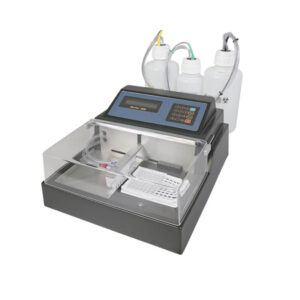

Microplate washers are one of those pieces of lab equipment that people tend to buy based on price and then wish they had spent more time thinking about. Not because the expensive models are always better, but because the wrong washer for your specific workflow creates problems that are annoyingly difficult to pin down. Your ELISA background is higher than expected. Your standard curve shifts between plates. Your coefficient of variation is worse than it should be. You change reagents, you revalidate your protocol, you recalibrate your reader. And the problem was the washing all along.
Choosing a microplate washer that fits your specific workflow is not complicated if you know what to look for. This guide cuts straight to the features and specifications that actually determine whether a washer improves your assay performance or introduces the variability you were trying to eliminate.
Match The Format To Your Plates
Before evaluating any feature on a microplate washer, confirm that the instrument supports the plate format you actually use. Most washers are designed for 96-well plates, but labs running high-throughput assays may need 384-well compatibility. Labs that process smaller sample volumes may need microstrip compatibility so they can wash individual strips of 8 or 12 wells without running a full 96-well plate configuration.
Microstrip compatibility is more important than it might seem for labs that do not always run full plates. Washing a 12-well strip in a washer designed only for full plates wastes wash buffer and assay time. More importantly, it can produce inconsistent wash quality in the occupied wells if the aspiration and dispense manifold is optimized for full-plate density rather than strip configurations. Confirm explicitly that the washer you are evaluating has a microstrip mode that performs at the same accuracy as its full-plate mode.
Programmable Wash Parameters: Non-Negotiable
If a microplate washer offers only fixed wash cycles with no parameter adjustment, eliminate it from consideration for any immunoassay application. ELISA and other microplate-based immunoassays require wash protocols that can be optimized and validated for each specific assay, and then locked in as a saved protocol that every operator applies identically.
The parameters you need to control independently include wash buffer volume per well (typically 200 to 350 microliters for 96-well ELISA), number of wash cycles (standard ELISA protocols use 3 to 5 cycles per wash step), soak time between dispense and aspiration (30 to 60 seconds is common, longer for high-affinity capture systems), aspiration speed (slower aspiration reduces residual volume disturbance in sensitive assays), and aspiration height (the distance between the probe tip and the well bottom, which affects residual volume).
Residual Volume: The Specification That Predicts Elisa Background
The residual volume per well after aspiration is one of the most predictive specifications for ELISA background noise. Residual wash buffer dilutes your next reagent addition, extends reaction equilibration time, and, if it contains any unbound material that was not fully aspirated, contributes directly to background signal.
The industry standard for high-performance ELISA washing is less than 2 microliters of residual volume per well. Washers that achieve this consistently across all 96 wells at their specified aspiration settings are the ones that produce the lowest, most consistent background in your assays. Ask specifically for this specification and ask how it is measured under your working conditions before purchasing.
Double Aspiration: A Feature Worth Having
Some microplate washers perform a second aspiration immediately after the first, repositioning the aspiration head slightly to capture residual liquid that the first pass may have missed. Double aspiration consistently reduces residual volume below the single-aspiration baseline and is particularly valuable in assays where even small amounts of residual liquid affect downstream measurement accuracy.
The Programmable Stat Fax 2600 Microplate/Microstrip Washer incorporates double aspiration as a standard feature, with aspiration position optimized for each well type and software that automatically adjusts for different plasticware formats. For ELISA labs that need consistent, low-residual-volume washing in both full-plate and microstrip configurations, it delivers exactly that.
Anti-Clogging Systems: Protecting Day-To-Day Consistency
Clogged dispense or aspiration needles are the most common source of unexpected day-to-day variability in microplate washer performance. Wash buffer crystallizes inside the needles during idle periods, partially blocking the flow path and producing inconsistent dispense volumes or incomplete aspiration. This problem is invisible unless you are watching for it, but it shows up clearly in your CV values.
Premium microplate washers address this with automatic rinse-and-soak cycles that prevent crystallization when the instrument has been idle for a defined period. This single feature eliminates one of the most common root causes of unexpected ELISA variability that labs spend significant time incorrectly attributing to reagent, sample, or protocol issues.
Protocol Memory And Multi-User Environments
In any lab where more than one person runs assays on the same washer, protocol memory storage is essential. Saved, named protocols ensure that every operator runs every plate under exactly the same wash conditions, regardless of how familiar they are with the specific assay requirements. Protocol memory also eliminates manual parameter entry errors, which are a significant but under-documented source of assay failures in multi-operator settings.
Selecting The Right Microplate Washer For Your Workflow
The right microplate washer for your lab is determined by three practical criteria: the plate formats you use (full 96-well, microstrips, or 384-well), the assay types you run (standard ELISA, competitive immunoassay, cell-based), and the number of plates you process per week. Labs running five or fewer plates per week on a single assay type can manage with a simpler, lower-cost model. Labs running multiple assay types, high plate volumes, or assays with stringent CV requirements need a washer with full parameter programmability, protocol memory, and double aspiration.
Trusted lab suppliers like NE LabSystems carry microplate washers designed for both research and clinical lab environments, backed by extended warranties and engineering support. Browse the full washer range online or call (877) 733-6838 to discuss which model matches your specific plate formats, assay types, and throughput requirements.