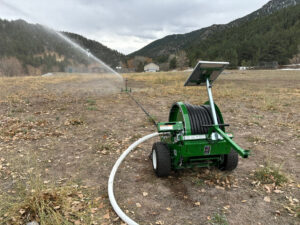

Large irrigation systems depend on one thing before water ever reaches a sprinkler: the pump.
Whether water is being delivered to farmland, athletic fields, pastures, parks, or another large property, the pump must provide enough flow and pressure for the irrigation equipment to work properly.
Choosing a pump based only on price or horsepower can lead to disappointing results. A pump that is too small may not provide enough pressure, while an oversized unit can increase fuel use and operating costs.
The better approach is to look at the complete irrigation system.
Start With the Water Source
Before choosing a pump, determine where the irrigation water will come from.
Common sources include:
- Ponds
- Lakes
- Wells
- Canals
- Storage tanks
- Municipal water systems
- Streams or other approved surface-water sources
The location and characteristics of the water source affect pump selection.
For example, pulling water from a pond may require different suction equipment than supplying a system from an existing pressurized line.
The distance between the water source and the irrigation area should also be measured because longer pipe runs can contribute to pressure loss.
Know How Much Water the System Needs
Flow is usually measured in gallons per minute, or GPM.
Different irrigation applications require different flow rates. A small turf area may need considerably less water than a large agricultural field or a traveling irrigation reel.
Before selecting a pump, identify the flow requirement of the equipment that will be connected to it.
If several sprinklers will operate at once, their combined water demand must be considered.
A pump should be selected to meet the actual operating requirement rather than simply provide the highest possible flow.
Pressure Is Just as Important as Flow
Having enough water is not useful if it reaches the sprinkler at insufficient pressure.
Sprinklers are designed to operate within specific pressure ranges. Pressure affects throw distance, spray pattern, and overall water distribution.
If pressure is too low, the sprinkler may not cover the intended area.
If it is unnecessarily high, the system can use more energy and place additional stress on pipes, hoses, fittings, and other components.
The correct pump needs to provide the required flow while maintaining the pressure needed at the irrigation equipment.
Consider Pressure Loss Through the System
Pressure at the pump is not necessarily the same as pressure at the sprinkler.
As water moves through pipe, hose, valves, fittings, and elevation changes, pressure can be lost.
Several factors affect this loss:
- Pipe diameter
- Pipe length
- Number of fittings and bends
- Flow rate
- Elevation changes
- Hose size
- Valves and filters
Longer runs and smaller pipe diameters generally create greater friction losses.
This is why pump sizing should consider the entire path the water takes from the source to the sprinkler.
Match the Pump to the Irrigation Equipment
Pump selection becomes easier when the equipment being supplied is already known.
Traveling irrigation reels, big-gun sprinklers, fixed irrigation systems, and multiple-sprinkler layouts can all have different requirements.
For larger applications, property managers comparing Caprari pumps can review different centrifugal pump configurations and match the pump to the flow and pressure requirements of the irrigation system.
The important point is to treat the pump and sprinkler equipment as parts of the same system.
Understand Single-Stage and Multi-Stage Pumps
Irrigation pumps are available in different configurations.
A single-stage centrifugal pump uses one impeller stage to move water. These pumps can be suitable for many irrigation applications where the required pressure falls within their operating range.
Multi-stage pumps use more than one stage to increase pressure.
The right choice depends on the required combination of flow and pressure rather than simply whether a pump has one or multiple stages.
Always review the pump performance information for the conditions in which it will actually operate.
PTO Pumps Can Be Practical for Agricultural Use
Power take-off, or PTO, pumps are commonly paired with tractors.
This setup can be useful where a tractor is already available and a separate stationary engine is not required.
PTO-driven systems can also provide flexibility when irrigation equipment needs to be moved between fields or water sources.
However, the tractor must have sufficient power for the selected pump.
Operators should review pump requirements and tractor specifications before connecting the equipment.
Horsepower Should Be Matched Carefully
More horsepower does not automatically mean better irrigation.
Horsepower needs depend on the amount of water being moved, the required pressure, and the efficiency of the pump.
An undersized power source may struggle under load.
An excessively large power source may increase fuel consumption without providing meaningful benefits.
The objective should be to supply enough power for dependable operation within the pump’s intended performance range.
Pay Attention to Suction Conditions
The suction side of a pumping system is particularly important when water is being drawn from a pond, stream, or other open source.
Poor suction conditions can reduce pump performance.
Common concerns include:
- Air leaks
- Excessive suction lift
- Undersized suction lines
- Blocked strainers
- Loose fittings
- Long suction runs
Whenever possible, the pump should be located in a position that minimizes unnecessary suction lift and keeps the suction line straightforward.
A proper intake screen can also help keep debris out of the pump.
Pipe Size Can Affect Pump Performance
Selecting the right pump but using an undersized pipe can restrict system performance.
As flow increases, friction losses in small-diameter piping can increase significantly.
A larger supply line may reduce these losses and allow more of the pump’s available pressure to reach the sprinkler.
Pipe size should therefore be considered during system design rather than after the pump has already been purchased.
Think About Elevation
Moving water uphill requires additional pressure.
If the sprinkler is positioned significantly higher than the pump, that elevation difference needs to be considered when calculating system pressure.
Water traveling downhill can create a different set of pressure conditions.
Large properties with rolling terrain should therefore be evaluated carefully instead of assuming the same pump setup will work equally well everywhere.
Check the Pump Performance Curve
A pump performance curve shows how a pump operates at different combinations of flow and pressure.
This information is valuable because a pump does not deliver its maximum flow and maximum pressure at the same time.
As operating conditions change, pump output also changes.
Instead of choosing a pump from a single advertised number, compare the required operating point with the manufacturer’s performance curve.
This can provide a much clearer picture of whether the pump fits the application.
Consider Portability
Some irrigation operations use one pump in several locations.
In these situations, a trailer-mounted or three-point-mounted configuration may make equipment easier to reposition.
Portability can be particularly useful for farms, temporary irrigation setups, and properties using traveling irrigation reels.
However, transportation routes, ground conditions, equipment weight, and connection points should all be considered.
The pump still needs to be positioned safely and close enough to the water source for reliable operation.
Routine Maintenance Matters
A pump works under demanding conditions, particularly during hot weather when irrigation schedules can be intensive.
Routine inspection can help identify small problems before they cause downtime.
Operators should regularly check:
- Seals
- Bearings
- Connections
- Hoses
- Gauges
- Suction components
- Lubrication points
- Mounting hardware
Any maintenance schedule provided by the equipment manufacturer should also be followed.
Keeping commonly required service parts available can be useful during the irrigation season.
Do Not Ignore Water Quality
Water quality can also affect pump and irrigation performance.
Water containing sand, sediment, plant material, or other debris may require filtration or screening.
Debris can block sprinkler nozzles, damage components, or reduce system efficiency.
If irrigation water comes from an open pond or canal, checking intake conditions regularly can prevent many avoidable problems.
Test the Complete System
After installation, test the irrigation setup under real operating conditions.
Check pressure at relevant points, observe the sprinkler pattern, inspect connections for leaks, and confirm that the pump is operating smoothly.
The system may need small adjustments.
A nozzle change, different pump speed, supply-line adjustment, or sprinkler setting can sometimes improve overall performance considerably.
Testing the complete system is more useful than evaluating each component separately.
Plan for Future Requirements
Irrigation needs can change.
A farm may expand acreage, a sports facility may add another field, or new equipment may require a different flow rate.
It is not necessary to dramatically oversize a pump for possible future needs, but reasonable expansion should be discussed when the system is being planned.
This can help avoid replacing major components earlier than expected.
Conclusion
Selecting an irrigation pump requires more than comparing horsepower ratings.
The right choice depends on water source, required flow, operating pressure, pipe size, elevation, suction conditions, sprinkler requirements, and the type of irrigation equipment being used.
Considering these factors together can help create a system that delivers water more consistently and operates efficiently.
A correctly matched pump does not simply move water. It provides the pressure and flow that allow the entire irrigation system to perform as intended.