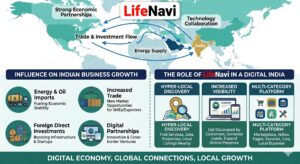

There is a number every Indian business owner has been watching this year, even those who don’t think of themselves as following oil markets. Brent crude has held above $110 a barrel for most of 2026, the rupee has slid past ₹92 to the US dollar, and a 14.2 kg domestic LPG cylinder costs roughly ₹60 more than it did at the start of the financial year. Each of those numbers traces back, in different ways, to the Gulf.
That is the uncomfortable half of the India–Middle East trade relationship in 2026. The other half is far more constructive: Gulf sovereign wealth funds are writing some of the largest cheques India has ever received, the UAE has become India’s third-largest trade partner under the 2022 CEPA, and a new generation of Indian SMEs is exporting into markets — from Riyadh to Doha — that would have been out of reach a decade ago.
Both halves of that relationship are now actively reshaping how Indian businesses operate, market themselves, and find customers at home. And in that quieter, less-talked-about shift, local discovery platforms like Lifenavi have become more important than most operators realize.
Why the Gulf matters more to India in 2026 than at any point in the last 20 years
India’s exposure to the Middle East is no longer just an oil story. Four threads have woven the relationship tightly enough that a move in one almost always shows up somewhere else:
Energy. India still imports over 85% of its crude oil, and the Gulf supplies the majority of that volume.
Every $10/barrel sustained move in Brent costs the Indian economy roughly $15–18 billion in additional import bill, which the country has to fund through reserves, the rupee, or by passing costs through to consumers.
Trade. Under the India–UAE Comprehensive Economic Partnership Agreement (CEPA) signed in 2022, bilateral trade has scaled from around $43 billion at signing to a run-rate well above $100 billion in FY 2026–27. Indian exports of jewellery, refined petroleum, electronics, processed food and textiles all benefit from preferential tariffs. India–Saudi Arabia and India–Qatar trade has grown alongside it, though without a comparable trade agreement.
Capital. Mubadala (UAE), the Public Investment Fund (Saudi Arabia), Qatar Investment Authority and ADIA have collectively committed tens of billions of dollars into Indian infrastructure, renewables, fintech, healthcare and logistics over the last five years. The 2026 vintage of these commitments is the largest annual flow on record.
People. Roughly 9 million Indians live and work in the Gulf, and remittance flows from those workers — particularly into Kerala, Tamil Nadu, Andhra Pradesh and Uttar Pradesh — are a structural support for retail demand and small-business activity in those states.
When all four threads are moving at once, the cumulative effect on Indian business is far larger than any single headline. 2026 is one of those years.
The friction side: how Gulf instability is biting Indian businesses right now
The Middle East crisis that escalated in early 2026 has played out in domestic India through three practical channels.
Higher input costs. Sustained crude prices have lifted diesel, ATF, LPG and the broader logistics base. Trucking rates in north India are up an estimated 8–12% versus the start of the year. For Indian SMEs that operate on 10–15% gross margins, this is a margin event, not a rounding error.
Supply chain disruption. Strait of Hormuz friction and Red Sea routing detours have lengthened freight transit times for India’s western ports. Importers of electronics, chemicals, machinery and metals have all reported delays of 7–14 days versus 2024 baselines. DTI and DGFT have activated programmes for affected exporters, but absorption costs are real.
Rupee weakness. The rupee crossed ₹92/USD as the conflict deepened, which raised the cost of every imported input — from semiconductors to specialty raw materials to imported branded inventory. Domestic CPI inflation has stayed sticky on the back of these import-price pass-throughs.
For most Indian businesses, the net effect is a 2026 in which top-line growth is still available, but unit economics are under genuine pressure. Marketing budgets, in particular, are being scrutinized harder than they have been since the 2020–21 pandemic period.
The upside: where the Gulf is actually feeding Indian growth
Headlines focus on the oil story because it shows up at every pump. But the constructive side of the relationship is, in 2026, just as significant.
Gulf capital into Indian infrastructure. The PIF–GIP joint venture for Indian renewables, Mubadala’s healthcare and fintech positions, and QIA’s broader India allocations are all funding multi-year build-outs that translate into procurement contracts, services demand and employment for Indian firms.
Indian SMEs going global through the UAE. CEPA has made the UAE a credible springboard, not just a destination. A growing number of Indian SMEs — particularly in lifestyle, food, jewellery, IT services and engineering — are using a UAE entity to access the wider GCC, Africa and even Europe with lower tariff and tax friction than direct export.
Tech and startup partnerships. Riyadh’s Vision 2030 and the UAE’s national AI strategy have created demand for Indian engineering, SaaS, and digital transformation services that did not exist at this scale even three years ago.
Remittances. Inflows are above $125 billion at the all-India level in 2026, with Gulf-employed Indians making up the largest cohort. Those flows translate directly into retail demand for property, vehicles, consumer durables, jewellery and local services — particularly in tier-2 and tier-3 cities where they constitute a meaningful share of household income.
Why this dual reality is changing how Indian SMEs market themselves
Here is the part most macro analyses miss. The Gulf relationship — both its frictions and its tailwinds — is quietly reshaping how Indian small and medium businesses acquire customers at home.
A few patterns are now visible:
Performance marketing CPMs are up. Higher input costs and tighter budgets across the board have made paid digital channels more competitive, not less. Indian SMEs are paying more for clicks while seeing softer conversion in segments exposed to inflation.
Local intent matters more. When budgets tighten, businesses move spend away from broad branding and toward channels that deliver clearly intent-led leads — searches like plumber near me, property in Pune, car dealer in Hyderabad, yellow pages near me.
Customers research more before buying. Higher prices on big-ticket items — cars, property, appliances, services — have lengthened consideration cycles. Buyers in 2026 spend more time comparing on classifieds and local discovery platforms before they commit.
Tier-2 and tier-3 demand is structurally strong. Remittance inflows and lower cost-of-living absorb inflation better in smaller cities. SMEs that can reach buyers in Indore, Lucknow, Coimbatore, Surat, Jaipur and Vishakhapatnam are out-performing peers stuck in metro-only distribution.
Each of these patterns rewards the same kind of platform: one that surfaces local supply to high-intent local demand, cheaply, and across the categories that small businesses live in — services, jobs, property, cars, marketplace, restaurants, business directories.
Where Lifenavi fits in this 2026 reality
Lifenavi.com positioning is straightforward, but the timing is what makes it useful.
The platform is organized around the categories where Indian SMEs genuinely do business, whether that’s blue-collar hiring, finding properties in India, cars for sale, needed services nearby, restaurants, or required beauty service & used products form the marketplace. Individuals and businesses can list for free, and it’s designed with a local-first approach across cities, neighborhoods, and tier-2/tier-3 markets where buyer activity continues to grow.
For SMEs operating in a tighter 2026 environment, that combination matters in three concrete ways:
- A free, India-wide listing channel to extend reach without further stretching paid media budgets that are already absorbing higher CPMs.
- Local intent capture — buyers searching services near me, properties in [city], jobs in [area] — that converts more efficiently than top-of-funnel branding spend.
- Multi-category presence for businesses that operate across services, marketplace listings and yellow-pages discovery, without having to maintain a separate profile on three different platforms.
This is not a “platform of the future” story. It is a fit-to-the-current-environment story: a 2026 Indian SME, operating with thinner margins and a more research-heavy customer, needs cheap and intent-led visibility. Local discovery platforms — and Lifenavi specifically — are designed for exactly that brief.
What this means for Indian businesses watching the Gulf
A few practical implications stand out for the rest of FY 2026–27.
- Plan for sustained input cost pressure. Crude is unlikely to return to 2024 averages this fiscal year. Build pricing flexibility into customer contracts where possible.
- Diversify supply where you can. Even partial substitution of Middle East–routed inputs reduces single-point-of-failure risk.
- Lean into the Gulf opportunity deliberately. CEPA, Saudi Vision 2030 and Gulf SWF allocations are real, multi-year tailwinds. Indian SMEs that can structure a UAE entity or a Gulf B2B sales motion will see disproportionate upside.
- Spend marketing budgets on intent, not impressions. With CPMs elevated and customer research cycles longer, channels that capture buyers in active comparison mode — local discovery, classifieds, intent-led search — will outperform broad-funnel spend.
- Cover tier-2 and tier-3 distribution. Remittance-supported demand is one of the strongest secular trends in the Indian retail and services economy in 2026.
The Middle East is not just a macro variable for Indian businesses. It is a daily input — into costs, into capital, into customer behaviour, and into how SMEs need to market themselves at home. The businesses that read both halves of the relationship clearly, and adapt their distribution accordingly, will be the ones that compound through this cycle.
Get discovered locally on Lifenavi
If you run a business, service practice, or local trade in India, listing on Lifenavi is free and takes under five minutes.
- Browse and post in Jobs in India
- List your property in Properties in India
- Reach buyers and sellers in Find used cars in India
- Connect with customers in Local Services in India
- Get found in the Yellow Pages business directory