
Human Activity Recognition (HAR) has become one of the most important capabilities in modern artificial intelligence. From fitness trackers and smart healthcare systems to workplace safety monitoring and autonomous robotics, AI models are increasingly expected to understand human movement with remarkable accuracy. However, achieving reliable activity recognition requires more than powerful algorithms—it depends on high-quality training data.
This is where skeletal annotation plays a transformative role. By accurately labeling human joints and body keypoints across images and videos, skeletal annotation enables AI systems to interpret posture, gestures, and movement patterns instead of relying solely on appearance. As organizations continue building computer vision solutions, partnering with a trusted data annotation company for high-quality skeletal labeling has become essential for creating robust Human Activity Recognition (HAR) models.
In this article, we’ll explore how skeletal annotation enhances HAR, its applications across industries, common challenges, and why professional data annotation outsourcing delivers superior AI performance.
Understanding Human Activity Recognition (HAR)
Human Activity Recognition refers to the process of enabling AI systems to identify and classify human actions from visual or sensor data. Activities may include:
- Walking
- Running
- Sitting
- Jumping
- Falling
- Dancing
- Exercising
- Working
- Lifting objects
- Hand gestures
Traditional HAR models often relied on wearable sensors. Today, computer vision has become the preferred approach because cameras can observe movement without requiring users to wear specialized devices.
However, video frames alone cannot always capture movement effectively. Clothing variations, lighting conditions, camera angles, and background clutter frequently reduce recognition accuracy.
This is precisely why skeletal annotation has become an industry standard for modern HAR systems.
What Is Skeletal Annotation?
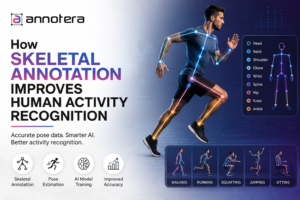
Skeletal annotation is the process of labeling key anatomical landmarks on the human body, including joints such as:
- Head
- Neck
- Shoulders
- Elbows
- Wrists
- Spine
- Hips
- Knees
- Ankles
These connected keypoints form a digital skeleton representing the person’s pose.
Unlike object detection, skeletal annotation focuses on body posture rather than appearance. Whether a person wears formal clothing, sportswear, or heavy protective equipment, the skeletal structure remains consistent, making activity recognition significantly more reliable.
An experienced image annotation company ensures every joint is accurately placed across thousands or even millions of images, creating high-quality datasets for pose estimation and activity recognition models.
How Skeletal Annotation Improves Human Activity Recognition
1. Captures Human Motion More Accurately
Human activities are defined by movement rather than appearance.
For example:
- Walking involves alternating leg movements.
- Squatting bends the knees and hips.
- Jumping extends the body upward.
- Waving depends primarily on arm motion.
Skeletal annotation records these joint positions frame by frame, allowing AI models to learn movement patterns with far greater precision.
Instead of analyzing colors or clothing, the model focuses on body mechanics.
2. Reduces Background Noise
One of the biggest challenges in computer vision is environmental variation.
HAR systems often encounter:
- Busy streets
- Crowded factories
- Hospitals
- Gyms
- Warehouses
- Homes
Background objects can confuse image-based recognition systems.
Skeleton-based datasets isolate human posture, allowing models to ignore irrelevant visual information and concentrate solely on body movement.
This improves recognition accuracy across diverse environments.
3. Improves Pose Estimation
Human Activity Recognition often begins with pose estimation.
Pose estimation identifies body joints before classifying the activity being performed.
High-quality skeletal annotation trains pose estimation models to:
- Detect body joints accurately
- Track movement continuously
- Estimate body orientation
- Handle multiple individuals simultaneously
Better pose estimation directly improves activity recognition performance.
4. Handles Clothing and Appearance Variations
Traditional vision models sometimes struggle with:
- Uniforms
- Loose clothing
- Jackets
- Safety equipment
- Cultural attire
Because skeletal annotation focuses on joint locations instead of visual appearance, AI models remain effective regardless of clothing style or color.
This greatly enhances model generalization.
5. Enables Temporal Motion Analysis
Human activities are dynamic.
A single frame rarely provides enough information to distinguish:
- Standing
- Beginning to walk
- Sitting down
- Falling
Skeletal annotation across sequential video frames allows AI to understand motion over time.
Temporal analysis enables recognition of complex activities that cannot be identified from individual images alone.
Applications of Skeletal Annotation in Human Activity Recognition
Healthcare
Healthcare AI uses HAR for:
- Patient monitoring
- Fall detection
- Rehabilitation tracking
- Physical therapy assessment
- Elderly care
Accurate skeletal annotation enables systems to recognize abnormal movement patterns while preserving patient privacy better than appearance-based analysis.
Fitness and Sports Analytics
Fitness applications analyze:
- Exercise form
- Yoga poses
- Strength training
- Running posture
- Athletic performance
Skeleton-based AI provides real-time feedback by comparing body joint positions with ideal movement patterns.
Workplace Safety
Manufacturing facilities use HAR to detect:
- Unsafe lifting posture
- Worker fatigue
- Hazardous movements
- Restricted area violations
These systems reduce workplace injuries while improving operational safety.
Robotics
Robots equipped with HAR capabilities learn to:
- Understand human actions
- Collaborate safely
- Predict movement
- Assist workers
Accurate skeletal annotation helps robots interpret human intentions more effectively.
Smart Surveillance
Modern surveillance systems recognize activities such as:
- Fighting
- Falling
- Trespassing
- Suspicious behavior
- Emergency situations
Skeleton-based recognition minimizes false alarms caused by lighting changes or clothing differences.
Challenges in Skeletal Annotation
Although highly effective, skeletal annotation requires considerable expertise.
Common challenges include:
Occlusion
Body parts may be hidden behind furniture, vehicles, or other people.
Complex Poses
Sports, dance, martial arts, and gymnastics involve unusual body positions that require precise labeling.
Motion Blur
Fast-moving subjects often create blurred frames, making joint placement difficult.
Multiple People
Crowded scenes require separate skeleton tracking for each individual.
Annotation Consistency
Even small variations in joint placement across annotators can reduce model accuracy.
Professional quality assurance processes help maintain consistency across large datasets.
Why Businesses Choose Data Annotation Outsourcing
Building large HAR datasets internally requires skilled annotators, quality reviewers, project managers, and scalable infrastructure.
This is why many AI companies choose data annotation outsourcing.
A specialized annotation partner offers:
- Experienced skeletal annotation teams
- Scalable workforce
- Faster turnaround
- Multi-level quality assurance
- Consistent annotation guidelines
- Cost-effective project delivery
Similarly, image annotation outsourcing enables organizations to accelerate AI development while reducing operational overhead and maintaining dataset quality.
Why Choose Annotera for Skeletal Annotation?
At Annotera, we combine domain expertise, scalable annotation teams, and rigorous quality control to deliver high-quality skeletal annotation datasets for computer vision applications.
As a trusted data annotation company and image annotation company, we support AI teams developing Human Activity Recognition, pose estimation, robotics, healthcare, sports analytics, autonomous systems, and surveillance solutions. Our annotation workflows are tailored to each project’s unique requirements, ensuring consistency, accuracy, and scalability from pilot datasets to enterprise-scale deployments.
Whether you’re looking for reliable data annotation outsourcing or image annotation outsourcing, Annotera provides precise skeletal labeling that helps train AI models capable of recognizing complex human activities with greater accuracy and reliability.
Conclusion
Human Activity Recognition is transforming industries by enabling AI systems to understand human movement with increasing precision. However, the success of these systems depends heavily on the quality of the underlying training data.
Skeletal annotation provides structured, accurate representations of human posture and motion, allowing AI models to recognize activities more effectively across varying environments, clothing styles, and movement patterns. From healthcare and fitness to robotics and workplace safety, skeleton-based datasets are becoming the foundation of next-generation HAR solutions.
Organizations seeking to build high-performing AI applications can accelerate development and improve model accuracy by partnering with an experienced data annotation company that specializes in skeletal annotation. With expert data annotation outsourcing and image annotation outsourcing services, businesses can create scalable, high-quality datasets that power reliable Human Activity Recognition systems and unlock the full potential of computer vision AI.