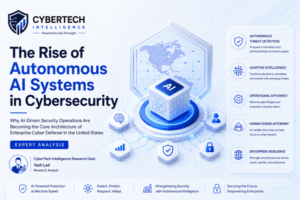

Enterprise cybersecurity is undergoing a structural transformation driven by advances in artificial intelligence, escalating operational pressure, and the rapid rise of identity-based threats. Over the past year, U.S. enterprises have sharply increased investment in autonomous AI cybersecurity platforms to address the growing limitations of traditional Security Operations Centers (SOCs).
This shift is no longer theoretical.
According to Microsoft’s 2024 Digital Defense Report, the company now processes more than 78 trillion security signals daily while tracking over 600 million cyberattacks every day worldwide. Microsoft also reported that password attacks have surged to approximately 7,000 attempts per second globally.
These figures reveal a critical operational challenge for enterprise security teams.
Traditional SOC architectures were designed for an era in which analysts manually reviewed alerts, correlated incidents, and coordinated remediation using disconnected security tools. That model is becoming increasingly unsustainable in environments where cyberattacks now operate at machine speed.
To close this gap, enterprises are turning to autonomous AI systems.
Unlike conventional automation, autonomous AI platforms can continuously analyze telemetry, prioritize threats, correlate attack patterns, recommend responses, and in some cases execute defensive actions with minimal human intervention.
The transition from reactive security operations to AI-driven autonomous defense is fundamentally reshaping how American enterprises approach cybersecurity.
Enterprise SOCs Are Reaching Operational Saturation
Modern enterprise environments now span highly distributed ecosystems that include:
- Multi-cloud infrastructure
- SaaS platforms
- Hybrid workforces
- APIs and microservices
- Machine identities
- Operational technology (OT)
- IoT-connected systems
- AI-enabled enterprise applications
Each of these environments generates massive volumes of telemetry that must be analyzed in near real time.
The result is unprecedented operational pressure on enterprise SOCs.
Recent cyber resilience research indicates that more than half of security professionals identify alert fatigue as a major operational challenge. At the same time, approximately 60% of organizations report that fragmented security tools negatively impact SOC performance, while over 55% continue to struggle with cybersecurity staffing shortages.
Meanwhile, the financial consequences of cyber incidents continue to escalate.
IBM’s 2024 Cost of a Data Breach Report found that:
- The average cost of a data breach in the United States reached $9.36 million, the highest globally
- The global average breach cost rose to $4.88 million
- Organizations extensively using automation reduced breach costs by an average of $2.22 million
- Security staffing shortages increased breach costs by roughly $1.76 million
- The average breach lifecycle remained approximately 258 days
Healthcare organizations once again experienced breach costs exceeding $10 million for the 14th consecutive year, underscoring the direct relationship between operational inefficiencies and enterprise risk exposure.
As a result, enterprise leaders are being forced to rethink the economics and scalability of cybersecurity operations.
Autonomous AI Is Redefining Security Operations
Cybersecurity automation itself is not new. Enterprises have relied on SOAR platforms and scripted workflows for years. However, traditional automation systems still depend heavily on predefined rules and significant human oversight.
Autonomous AI operates differently.
Modern AI-powered cybersecurity platforms increasingly combine:
- Large Language Models (LLMs)
- Behavioral analytics
- Reinforcement learning
- Graph intelligence
- Threat intelligence correlation
- Generative AI copilots
- Continuous telemetry reasoning engines
These systems can dynamically understand enterprise context, detect anomalies, adapt to evolving threats, and make decisions in near real time.
According to Accenture’s 2025 cybersecurity resilience research:
- Only 10% of organizations demonstrate strong readiness for AI-driven cybersecurity adoption
- 63% remain vulnerable to AI-enabled attacks due to modernization gaps
- 77% lack sufficient AI governance and data security maturity
At the same time, organizations with mature AI-powered cybersecurity strategies were found to be 69% less likely to experience successful cyberattacks.
The implications extend far beyond operational efficiency.
AI-driven cybersecurity is increasingly becoming a strategic resilience differentiator that influences regulatory readiness, cyber insurance posture, business continuity, and enterprise trust.
Identity Security Has Become the Primary AI Battlefield
Identity compromise has emerged as the dominant attack vector across enterprise environments.
Microsoft’s 2024 threat intelligence findings revealed that more than 99% of enterprise identity attacks remain password-based, while cloud identity targeting continues to rise sharply across ransomware and nation-state campaigns.
This trend is reshaping enterprise defense priorities.
Autonomous AI systems are particularly effective in identity-centric environments because they continuously analyze:
- Authentication behavior
- Device trust signals
- Behavioral anomalies
- API activity
- Privilege escalation attempts
- Lateral movement indicators
- Access deviation patterns
Recent cloud threat intelligence reports further reinforce this trend. Nearly 80% of cloud security incidents in 2025 were linked to identity or permission-related weaknesses, while compromised credentials were involved in almost half of all cloud attacks analyzed.
At the same time, AI-assisted phishing campaigns continue to grow in sophistication and scale.
As zero-trust architectures mature, AI-driven identity protection is rapidly evolving into the central operational control layer for enterprise cyber defense.
The Economic Case for Autonomous Cybersecurity Is Becoming Overwhelming
The rapid adoption of autonomous cybersecurity is being driven not only by threat escalation, but also by economics.
Enterprise security leaders are simultaneously managing:
- Rising attack volumes
- Expanding compliance requirements
- Increased cyber insurance scrutiny
- Persistent talent shortages
- Board-level pressure for operational efficiency
- Higher expectations for resilience maturity
Traditional SOC expansion models are becoming financially difficult to sustain.
Autonomous AI platforms offer organizations a way to scale cybersecurity capabilities without proportionally increasing headcount.
Generative AI and autonomous systems are now among the fastest-growing enterprise investment categories. Current estimates suggest that generative AI could contribute between $2.6 trillion and $4.4 trillion annually to the global economy by 2030.
Cybersecurity represents one of AI’s highest-value enterprise applications because of its direct impact on:
- Financial protection
- Business continuity
- Regulatory compliance
- Operational scalability
- Enterprise trust
Additional threat intelligence findings highlight the urgency of this shift.
CrowdStrike reported a 26% increase in cloud-focused threat activity in 2025, while average breakout times dropped to just 48 minutes. Identity-based attacks and AI-driven social engineering campaigns also accelerated significantly.
Google Cloud and Mandiant have similarly observed growing use of AI-assisted reconnaissance and credential exploitation across cloud-native enterprise environments.
These trends are rapidly accelerating enterprise investment in machine-speed cybersecurity systems.
The Future SOC Will Operate Through Human-Guided Autonomy
Despite increasing automation, autonomous cybersecurity will not eliminate human analysts.
Instead, it will redefine their responsibilities.
Enterprise security operations are evolving toward a “human-guided autonomy” model in which:
- AI systems manage large-scale telemetry analysis
- Analysts supervise autonomous workflows
- Humans validate critical remediation decisions
- Security teams focus on strategic investigations
- Analysts oversee governance, escalation, and resilience management
AI-assisted SOC environments are already improving:
- Investigation speed
- Threat prioritization
- Operational efficiency
- Analyst productivity
- Incident response scalability
Future SOC teams are expected to focus increasingly on:
- Adversarial simulation
- Threat modeling
- AI governance
- Resilience engineering
- Executive cyber advisory
- Strategic risk management
This transition may become one of the defining workforce shifts in enterprise cybersecurity over the next decade.
Autonomous AI Also Introduces New Enterprise Risks
While autonomous AI improves scalability and operational speed, it also creates entirely new categories of cyber risk.
Threat actors are increasingly experimenting with:
- Prompt injection attacks
- Model poisoning
- AI evasion techniques
- Autonomous malware adaptation
- Generative phishing campaigns
- AI-assisted reconnaissance
As a result, AI is becoming both a defensive capability and a new attack surface.
Federal AI governance initiatives now emphasize the importance of:
- Explainability
- Auditability
- Transparency
- Human oversight
- AI validation
- Operational accountability
AI governance is rapidly becoming essential for securing critical infrastructure, maintaining resilience, and preserving organizational trust.
Simultaneously, new SEC cybersecurity disclosure requirements and government-led AI governance initiatives are increasing expectations around enterprise transparency and cyber resilience.
Autonomous cybersecurity is therefore evolving from a purely technical initiative into a governance and board-level priority.
Autonomous Cybersecurity Is Becoming Core Enterprise Infrastructure
Cybersecurity discussions are increasingly moving beyond IT departments and into executive strategy and board governance conversations.
More than 75% of enterprise executives now plan to increase cybersecurity spending, with AI-enabled modernization ranking among the top resilience priorities for large organizations.
Organizations making substantial investments in cyber resilience also report greater confidence in operational continuity and regulatory preparedness.
Autonomous cybersecurity systems are increasingly becoming foundational infrastructure for:
- Operational resilience
- Digital trust
- Regulatory preparedness
- Cloud security
- Identity governance
- Enterprise continuity
The question is no longer whether AI will transform cybersecurity operations.
The real question is how quickly organizations can deploy autonomous defense models before traditional SOC architectures become operationally obsolete.
Conclusion
The rise of autonomous AI systems represents one of the most significant structural transformations in modern cybersecurity.
Traditional security models are struggling to keep pace with:
- AI-powered adversaries
- Expanding cloud ecosystems
- Identity-centric attacks
- Operational overload
- Machine-speed threats
Autonomous AI platforms offer enterprises a fundamentally different cybersecurity model built around:
- Adaptive intelligence
- Continuous learning
- Contextual threat analysis
- Real-time operational reasoning
- Machine-speed response
- Scalable resilience
However, the future of cybersecurity will not be entirely autonomous nor entirely human-driven.
Instead, enterprise defense will increasingly rely on collaborative intelligence, where autonomous AI systems and human expertise work together to secure highly complex digital environments.
Organizations that establish this balance early are likely to gain significant advantages in:
- Cyber resilience
- Operational scalability
- Regulatory readiness
- Incident response maturity
- Enterprise trust
- Long-term competitive resilience
About Us
CyberTechnology Insights (CyberTech) is a trusted repository of high-quality IT and security news, insights, and trends analysis, founded in 2024. We curate research-based content across 1,500-plus IT and security categories to help CIOs, CISOs, and senior security professionals navigate the evolving cybersecurity landscape. Our mission is to empower enterprise security decision-makers with actionable intelligence, deliver in-depth analysis across risk management, network defense, fraud prevention, and data loss prevention, and build a community of ethical, compliant, and collaborative IT and security leaders committed to safeguarding digital organizations and online human rights.
Contact Us
1846 E Innovation Park Dr, Suite 100, Oro Valley, AZ 85755
Phone: +1 (845) 347-8894, +91 77760 9266