
In today’s competitive manufacturing landscape, businesses are constantly looking for ways to improve efficiency while controlling production costs. Whether it’s the automotive, oil & gas, power generation, railways, aerospace, or heavy engineering sector, manufacturers are under increasing pressure to deliver high-quality components with minimal material waste and maximum productivity.
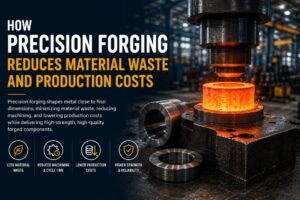
One manufacturing process that has consistently helped industries achieve these goals is precision forging. Unlike conventional manufacturing methods that remove large amounts of material through machining, precision forging shapes metal closer to its final dimensions. This near-net-shape manufacturing approach minimizes waste, reduces machining operations, shortens production time, and improves overall cost efficiency.
This article explains how precision forging contributes to sustainable manufacturing by reducing material waste, optimizing production processes, and lowering overall manufacturing costs.
What Is Precision Forging?
Precision forging is a manufacturing process in which heated metal is shaped using specially designed dies under controlled pressure to produce components with highly accurate dimensions and excellent mechanical properties.
Because the forged part is produced close to its final shape, only minimal machining is required after forging. This not only conserves raw material but also reduces manufacturing time and operational costs.
Precision forging is widely used to manufacture critical components for industries where strength, reliability, and dimensional accuracy are essential.
Why Material Waste Matters in Manufacturing
Material costs account for a significant portion of total manufacturing expenses. Every kilogram of excess material removed during machining represents additional cost—not only for raw materials but also for machining time, tooling wear, energy consumption, and scrap handling.
Reducing material waste offers several advantages:
- Lower raw material consumption
- Reduced machining requirements
- Lower energy usage
- Less industrial scrap
- Improved manufacturing efficiency
- Reduced environmental impact
- Better profitability
Precision forging addresses these challenges by producing components that require minimal material removal.
Near-Net Shape Manufacturing Reduces Material Waste
One of the biggest advantages of precision forging is its ability to produce near-net shape components.
Instead of machining a large steel block into the desired component, precision forging forms the material close to its final geometry during the forging process.
As a result:
- Less raw material is required.
- Machining allowances are minimized.
- Scrap generation is significantly reduced.
- Material utilization improves considerably.
For manufacturers producing high volumes of components, even small reductions in material waste can result in substantial cost savings over time.
Reduced Machining Operations
Machining is often one of the most expensive stages in component manufacturing.
Precision forging significantly reduces the amount of machining required because components are produced with accurate dimensions and tighter tolerances.
This leads to:
- Shorter machining cycles
- Reduced cutting tool wear
- Lower tooling costs
- Lower labor requirements
- Faster production turnaround
Manufacturers can therefore increase production capacity while keeping operational costs under control.
Improved Material Utilization
During conventional machining, a considerable percentage of the original material is converted into chips or scrap.
Precision forging makes better use of the raw material by directing metal flow into the required shape rather than removing excess material.
Higher material utilization results in:
- Better yield from each billet
- Reduced steel consumption
- Lower purchasing costs
- More efficient inventory management
This is particularly beneficial when working with high-value alloy steels and specialty materials.
Lower Energy Consumption
Every manufacturing operation consumes energy, from machining and heat treatment to material handling.
Since precision forging reduces the amount of machining and processing required, manufacturers also benefit from lower energy consumption.
Reduced energy usage contributes to:
- Lower operating costs
- Improved manufacturing efficiency
- Reduced carbon emissions
- More sustainable production practices
For organizations pursuing environmental and sustainability goals, precision forging supports greener manufacturing operations.
Shorter Production Cycles
Precision forging streamlines production by minimizing secondary operations.
Because components are forged close to their final dimensions, fewer manufacturing steps are required before the product is ready for assembly or finishing.
Shorter production cycles provide several business advantages:
- Faster order fulfillment
- Increased production capacity
- Reduced work-in-progress inventory
- Better delivery performance
- Improved customer satisfaction
These efficiencies are particularly valuable for OEMs and industrial buyers operating under tight production schedules.
Better Dimensional Accuracy
Precision forging delivers consistent dimensional accuracy across large production volumes.
Accurate components reduce:
- Rework
- Assembly issues
- Inspection time
- Manufacturing variations
- Product rejection rates
Consistent quality ultimately lowers production costs while improving customer confidence.
Enhanced Mechanical Properties Reduce Lifecycle Costs
Cost savings are not limited to manufacturing alone.
Precision-forged components feature:
- Higher strength
- Better fatigue resistance
- Improved wear resistance
- Superior impact toughness
- Longer service life
These enhanced mechanical properties reduce maintenance requirements, minimize equipment downtime, and extend component lifespan, resulting in lower total cost of ownership for end users.
Industries That Benefit from Precision Forging
Precision forging is widely used across industries where reliability and cost efficiency are critical.
Automotive
- Transmission gears
- Axles
- Steering components
- Engine parts
Oil & Gas
- Valve bodies
- Flanges
- Pressure equipment
- Drilling components
Power Generation
- Turbine components
- Generator shafts
- Boiler equipment
Railways
- Couplings
- Axles
- Suspension components
Heavy Engineering
- Hydraulic cylinders
- Industrial machinery
- Forged rings
- Hollow components
Renewable Energy
- Wind turbine shafts
- Flanges
- Structural forged components
Why Choose a Precision Forging Partner?
Selecting the right forging manufacturer plays a crucial role in maximizing cost savings and product quality.
When evaluating a supplier, consider:
- Advanced forging technology
- Precision die design capabilities
- Experienced engineering team
- Strict quality management systems
- In-house machining facilities
- Heat treatment capabilities
- Comprehensive inspection and testing
- Proven industry experience
- On-time delivery performance
An experienced manufacturing partner can help optimize component design, reduce production costs, and improve long-term product performance.
How CHW Forge Delivers Cost-Effective Precision Forging Solutions
At CHW Forge, we combine advanced forging technology with robust manufacturing processes to produce high-quality precision-forged components for global industries.
Our capabilities include:
- Precision closed-die and open-die forging
- Advanced process control
- Near-net shape manufacturing
- In-house machining and heat treatment
- Comprehensive quality inspection
- Custom-engineered forging solutions
- Material traceability
- Reliable delivery schedules
By focusing on process optimization and quality, we help customers reduce material waste, improve manufacturing efficiency, and lower overall production costs without compromising performance.
Conclusion
Precision forging is more than just a manufacturing process—it is a strategic solution for improving productivity, reducing waste, and lowering production costs. By producing near-net shape components with superior mechanical properties, manufacturers can minimize material consumption, reduce machining operations, shorten production cycles, and deliver higher-quality products.
For businesses seeking cost-effective, reliable, and sustainable manufacturing solutions, precision forging offers significant long-term value. Partnering with an experienced manufacturer like CHW Forge ensures that every component is engineered for performance, efficiency, and durability, helping customers stay competitive in today’s demanding industrial markets.
CHW Forge offers advanced forging capabilities, stringent quality control, in-house machining and heat treatment, and customized manufacturing solutions to deliver precision-forged components that meet the highest industry standards while helping customers optimize cost and performance.