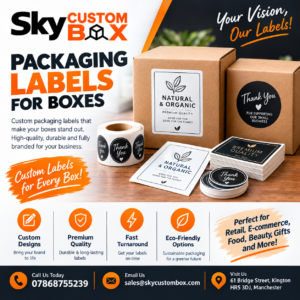

Packaging is often the first physical interaction a customer has with a product. Before opening a box, examining the product, or reading detailed information, shoppers may notice the colour, typography, shape, and messaging printed or attached to the package. Among these elements, labels play an important role because they combine visual communication with practical product information.
Well-planned packaging labels can help products appear organised, recognisable, and consistent with a brand’s identity. They can also communicate essential details such as product names, ingredients, instructions, warnings, care information, or recycling guidance. For retailers and product manufacturers, understanding how labels affect presentation can therefore contribute to a more consistent customer experience.
Why Packaging Labels Matter for Product Presentation
Product presentation is influenced by more than the physical shape of a package. Small details, including the label, can change how a box or container is perceived on a retail shelf, during delivery, or when photographed for an online store.
A carefully designed label can provide a visual focal point while helping customers quickly understand what is inside the package. This becomes particularly important when several competing products are displayed together.
Effective labels generally balance three elements:
- Clarity: Important information should be easy to identify and read.
- Consistency: Colours, fonts, logos, and design elements should support the overall brand identity.
- Relevance: The information displayed should be appropriate for the product and its intended audience.
For example, a premium skincare product may use restrained typography and a minimal label design, while a children’s product may use brighter colours and more expressive graphics. The label does not need to be complicated; it needs to communicate the right information in a way that fits the product.
Packaging Labels as a Branding Tool
Branding is fundamentally about recognition and consistency. When customers repeatedly encounter similar visual elements across products, websites, advertisements, and packaging, those elements can become associated with the brand.
Labels can support this process by incorporating recognisable brand assets such as:
- Logo placement
- Brand colours
- Typography
- Taglines
- Product ranges
- Icons and graphic elements
- Consistent information hierarchy
This is especially useful for small and growing businesses that may sell products through multiple channels. A consistent label can help create continuity between physical packaging and digital marketing.
For businesses using packaging labels for boxes, the label can also serve a practical purpose beyond branding. It may identify the product, provide handling information, communicate batch or product details, or help distinguish different product variations.
However, branding should not compromise readability. A label filled with decorative elements but lacking a clear hierarchy can make important information difficult to find. Effective packaging design usually gives priority to the information customers need most.
How Label Design Influences Customer Perception
Consumers make quick observations when evaluating products. Although a label alone cannot determine whether a product is successful, its presentation can influence initial perceptions of organisation, quality, and relevance.
Several design factors deserve particular attention.
Typography and Readability
The choice of typeface affects how easily customers can read a label. Decorative fonts can work for selected headings or brand elements, but essential product information generally benefits from clear typography.
Text size also matters. Information that looks readable on a computer screen may become difficult to read when printed on a small package. Designers should therefore assess the physical label rather than relying only on a digital preview.
Colour Selection
Colour can create visual associations and help customers identify different product categories or variants. For example, a company might use a consistent base colour across its packaging while assigning different accent colours to different product lines.
Colour should also be considered from an accessibility perspective. Sufficient contrast between text and background improves readability and reduces confusion.
Information Hierarchy
Not every piece of information needs the same visual emphasis. A strong label design establishes a hierarchy so customers can quickly locate the product name, brand, key features, and other relevant information.
A useful hierarchy might follow this order:
- Brand or product identity
- Product type or name
- Key benefit or characteristic
- Supporting information
- Regulatory, handling, or supplementary details
The exact structure depends on the product and market, but the principle remains the same: important information should be immediately understandable.
Current Trends in Packaging Labels
Packaging continues to evolve alongside consumer expectations, e-commerce, sustainability initiatives, and advances in printing technology.
One noticeable trend is the increasing interest in sustainable packaging. Businesses are exploring recyclable materials, reduced packaging components, and more responsible production methods. Labels can support these efforts by communicating recycling instructions, material information, or sustainability claims where appropriate.
Another development is the use of QR codes. A small code on a package can connect physical packaging with digital information such as product instructions, authentication pages, recipes, company information, or detailed product specifications.
Variable-data printing is also useful for businesses producing multiple versions of a product. Instead of creating completely separate packaging systems, manufacturers may use adaptable printing processes to change product names, colours, batch information, or other details.
For smaller businesses, these developments can make packaging more flexible. Providers such as Sky Custom Box, for example, operate within the broader custom packaging sector where businesses can consider how boxes, printed elements, and labels work together as one presentation system.
Common Packaging Label Challenges and Practical Solutions
Despite their relatively small size, labels can create several practical challenges.
Problem: Too Much Information
A common mistake is trying to place every possible detail on the front of a package.
Solution: Separate essential information from supplementary content. Use the primary panel for the information customers need immediately and place additional details elsewhere when appropriate.
Problem: Poor Print Quality
Small text, thin lines, or intricate graphics may not reproduce as expected during printing.
Solution: Review artwork at its intended physical size and request a proof when necessary. Consider the printing method, material, finish, and viewing distance before approving final artwork.
Problem: Inconsistent Branding
Using different colours, fonts, or logo treatments across product lines can make a brand appear fragmented.
Solution: Establish basic packaging guidelines covering logo usage, typography, colour palettes, spacing, and information hierarchy.
Problem: Labels That Do Not Suit the Packaging Material
A label designed for one surface may not perform equally well on another. Texture, curvature, moisture, temperature, and handling can all affect adhesion and appearance.
Solution: Select label materials and adhesives based on the actual packaging environment. Testing is particularly important for products exposed to refrigeration, moisture, oils, or frequent handling.
Choosing the Right Approach for Packaging Labels
Before finalising a label, businesses should consider the complete customer journey rather than viewing the label as an isolated design element.
Ask several practical questions:
- Where will the product be displayed?
- Will customers see it primarily in a shop or online?
- How much information must legally or practically appear on the package?
- Will the packaging be exposed to moisture, heat, or friction?
- Does the design remain recognisable across different product sizes?
- Can customers read the most important information quickly?
- Does the label complement the box, pouch, bottle, or other packaging format?
These questions help connect visual design with real-world performance.
For online retailers, packaging also has an additional role. Products may be photographed for websites and social media before customers ever encounter the physical package. A distinctive and uncluttered label can therefore contribute to consistent visual presentation across both physical and digital environments.
The Relationship Between Labels and the Overall Package
A label should not be designed independently from the rest of the packaging. The box structure, material, printing, colour, finish, inserts, and label should work together.
For instance, a highly detailed label may conflict with a minimalist box design. Conversely, a simple label can provide useful balance when the packaging already contains extensive graphics.
This integrated approach is particularly relevant for custom boxes. Businesses can plan the package and label as part of the same customer experience, ensuring that branding remains coherent from the outside of the package to the product inside.
It is also worth considering how packaging looks after transportation. A design that appears attractive when photographed in a studio may look different after shipping, handling, or storage. Durability and practical testing should therefore form part of the packaging development process.
Final Takeaway
Packaging labels are more than decorative additions. They can combine brand recognition, product information, navigation, compliance details, and visual communication within a relatively small space.
Read More: