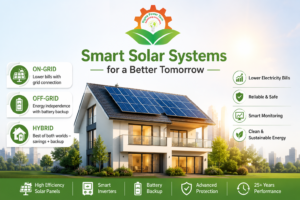

A newly completed residential township is preparing to welcome its first homeowners. Although the buildings are ready, one final task remains before handover—commissioning the rooftop solar systems that will help reduce electricity costs and improve long-term energy independence. Similar installation projects are taking place across commercial offices, hospitals, factories, schools, and government facilities throughout India. Understanding the installation process of a solar system for home helps homeowners appreciate the engineering, planning, and safety measures required to build a reliable renewable energy system.
Planning a Solar System for Home Installation
Installing a solar system for home begins long before the first solar panel is placed on the roof. Every successful project starts with a detailed engineering assessment that evaluates electricity consumption, roof conditions, shading, structural strength, and future energy requirements.
The objective is to design a solar system that delivers maximum energy generation while ensuring long-term reliability, electrical safety, and regulatory compliance.
Step 1: Site Survey and Energy Assessment
Engineers first conduct a detailed site inspection to collect essential project information.
The survey includes:
- Roof orientation and available installation area
- Structural loading capacity
- Existing electrical infrastructure
- Daily and seasonal electricity consumption
- Shading analysis from nearby buildings or trees
- Future expansion requirements
This assessment forms the basis for selecting the appropriate system capacity and equipment.
Step 2: Selecting Solar Panels and Inverters
Once the energy assessment is complete, engineers select components that match the project’s performance goals.
The best solar panels are chosen based on efficiency, durability, warranty, and available roof space.
Common panel technologies include:
- Monocrystalline panels for maximum efficiency
- Polycrystalline panels for balanced performance
- Thin-film panels for specialized commercial applications
The inverter is then sized according to expected solar generation and household electrical demand to ensure efficient power conversion.
Step 3: Choosing the Right System Configuration
The next stage involves selecting the most suitable installation type.
Homeowners generally choose between:
- On-grid systems connected to the utility network through net metering.
- Off-grid systems operating independently with battery storage.
- Hybrid systems combining battery backup with grid connectivity.
The choice depends on local grid reliability, backup power requirements, and long-term energy objectives.
Step 4: Mounting Structure Installation
Engineers install corrosion-resistant mounting structures designed to withstand wind loads, temperature changes, and long-term outdoor exposure.
Proper panel spacing, orientation, and tilt angle are carefully maintained to maximize annual solar energy production while allowing adequate airflow beneath the modules.
Step 5: Electrical Wiring and Safety Systems
After panel installation, electrical wiring connects the photovoltaic modules to the inverter and distribution board.
Safety measures include:
- DC and AC isolators
- Surge protection devices
- Earthing and grounding systems
- Circuit breakers
- Lightning protection where required
- Fire safety compliance
Proper cable routing and electrical protection are essential for long-term operational safety.
Step 6: Monitoring, Testing, and Commissioning
Before the system begins operation, engineers perform comprehensive testing.
Commissioning includes:
- Electrical continuity checks
- Insulation resistance testing
- Inverter configuration
- Grid synchronization
- Net metering verification
- Performance validation
- Safety inspections
Modern systems also include cloud-based monitoring platforms that allow homeowners to track energy production, receive fault notifications, and monitor system health using mobile applications.
Features of a Modern Solar Installation
Today’s residential solar installations incorporate advanced engineering features that improve efficiency and simplify long-term operation.
These include:
- High-efficiency photovoltaic technology
- Modular system architecture
- Smart inverter controls
- Remote monitoring
- Real-time energy generation tracking
- Automated performance alerts
- Predictive maintenance support
- Grid synchronization capability
- Low maintenance requirements
- Weather-resistant construction
- Operational life exceeding 25 years
- Flexible expansion capability
These technologies help maintain consistent energy production under varying operating conditions.
Applications of Solar Installations
Solar energy systems are now widely deployed across multiple sectors.
Typical applications include:
- Residential rooftop solar system installations
- Apartment complexes
- Commercial office buildings
- Manufacturing plants
- Hospitals and healthcare facilities
- Educational campuses
- Shopping malls
- Hotels and hospitality properties
- Agricultural irrigation systems
- Warehouses and logistics parks
- Government buildings
- Smart city infrastructure
Each installation follows a customized engineering approach based on energy demand and site conditions.
Factors Affecting Solar Panel System Cost
Although many homeowners focus primarily on Solar panel system cost, overall project value depends on several engineering considerations.
Important factors include:
- Available rooftop area
- Household electricity consumption
- Solar panel technology
- Inverter capacity
- Battery storage requirements
- Roof accessibility
- Installation complexity
- Net metering approvals
- Monitoring platform features
- After-sales support
- Lifecycle operating costs
- Expected return on investment
Similarly, solar system for home price varies according to system capacity, component quality, engineering complexity, and project location rather than a standard fixed price.
Choosing the Right Installation Company
Selecting an experienced engineering company is critical for long-term performance.
Before making a decision, evaluate:
- Industry experience
- EPC capabilities
- Engineering design expertise
- Installation quality
- Compliance with MNRE and BIS standards
- Equipment testing procedures
- Warranty coverage
- Technical support
- Solar panel maintenance services
- AMC availability
- Documentation and subsidy assistance
Organizations providing integrated renewable energy solutions, including a Sigma Power Tech solar panel system, generally emphasize engineering quality, regulatory compliance, and lifecycle performance throughout the project.
Common Installation Mistakes to Avoid
Avoiding common planning and installation errors improves both safety and long-term energy production.
Common mistakes include:
- Skipping detailed site assessment
- Ignoring roof shading analysis
- Choosing equipment based only on initial cost
- Installing undersized or oversized inverters
- Neglecting grounding and surge protection
- Delaying preventive maintenance
- Ignoring net metering approvals
- Poor cable management
- Improper commissioning procedures
- Failing to train users on monitoring software
Educational activities such as a solar system model or classroom solar system project help explain photovoltaic principles, but professional installations require detailed engineering calculations, electrical safety practices, and regulatory compliance.
Conclusion
A successful solar system for home installation is the result of careful engineering, quality equipment selection, professional commissioning, and ongoing maintenance. Every stage—from site assessment and system design to electrical testing and real-time monitoring—plays an important role in ensuring long-term performance and operational reliability. By prioritizing engineering quality, regulatory compliance, and lifecycle value instead of focusing solely on upfront costs, homeowners can build a dependable clean energy system that reduces electricity expenses, improves energy independence, and supports a more sustainable future for decades to come.