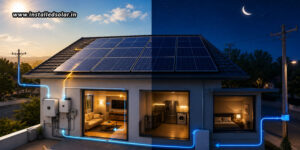

Solar panels are designed to generate electricity from sunlight, but understanding how a residential solar system works throughout the day is equally important. During daylight hours, solar energy can power household appliances, while excess generation may be exported to the grid or stored in batteries, depending on the system configuration. After sunset, homes can rely on grid electricity or stored solar energy to meet their requirements. The way electricity is generated, consumed, stored, and supplied therefore depends on whether the home uses an on-grid, off-grid, or hybrid system. Understanding these energy flows helps homeowners choose the right residential solar solution for their needs.
What happens during the daytime?
During the daytime, solar panels receive sunlight and convert it into electricity through the photovoltaic effect. During a typical sunny day, electricity generated by the residential solar system can directly power appliances such as fans, refrigerators, lights, washing machines, pumps, and air conditioners. For homeowners, this is one of the biggest advantages of generating solar power during the day: the home can consume its own renewable electricity instead of purchasing as much power from the grid. However, the amount of electricity generated depends on factors like sunlight intensity, panel orientation, shading, weather conditions, system capacity, and the efficiency of the equipment.
What happens to unused solar power?
Solar panels generally generate more electricity than the home requires, particularly around midday when the sunlight is strong. If the system has no battery storage, this excess electricity can potentially be exported to the grid in an eligible grid-connected installation. This is where net metering becomes valuable. Under a net-metering arrangement, a bidirectional electricity meter records electricity flowing from the grid to the home as well as surplus electricity flowing from the home back to the grid. The applicable billing mechanism determines how these electricity flows are accounted for. For example, if a home consumes less electricity during the afternoon while the solar system is producing strongly, the surplus can be sent to the grid. Later, when the home requires more electricity than the solar system is producing, power can be drawn from the grid.
What happens during nighttime?
Solar panels cannot generate electricity from sunlight after sunset; however, homeowners can still have access to electricity during the nighttime. What happens at night depends on the type of residential solar system.
With a conventional on-grid system, the home draws electricity from the utility grid when the solar panels are not producing enough power. During the night, this generally means the household depends on grid electricity.
With a hybrid solar system, electricity generated during the day can be stored and used later. This allows homeowners to use some of their solar-generated electricity after sunset instead of purchasing all of their nighttime electricity from the grid.
An off-grid system works differently because it is designed to operate without dependence on the utility grid. Such systems require adequate battery storage and careful system sizing to meet household requirements when solar generation is unavailable.
Understanding the role of batteries in residential solar
Battery storage has changed the way homeowners can use solar energy. Without a battery, solar electricity is generally consumed as it is generated, with surplus power potentially exported to the grid in a suitable grid-connected system. With a battery, excess electricity can be stored and used when solar generation falls. Battery storage can therefore increase the amount of solar electricity a household is able to consume directly over a 24-hour period. However, batteries add to the cost and complexity of a residential solar system. The appropriate battery capacity depends on the home’s energy consumption, backup requirements, critical loads, expected outage duration, and budget.
What happens during a power cut?
A standard grid-connected solar system generally shuts down when the utility grid goes down. This is an important safety feature that prevents electricity from being fed into the grid while utility personnel may be working on the network. Therefore, simply having solar panels does not automatically mean that a home will have electricity during a power cut. If backup power during outages is important, homeowners need a suitable battery-backed or hybrid system designed to provide backup power. Such systems can isolate the home from the grid and supply selected loads using stored energy and, when available, solar generation. The backup capacity depends on the system design and battery size. A homeowner may choose to support essential loads such as lights, fans, Wi-Fi equipment, refrigerators, and selected appliances rather than attempting to operate every appliance in the house simultaneously.
A smarter way to use solar energy
The advantage of residential solar is not simply generating electricity from sunlight; rather, it is the ability to change how a home produces, consumes, stores, and manages energy. During the day, solar panels can generate electricity for household consumption. Excess generation can potentially be exported to the grid or stored in batteries. At night, homes can rely on the grid, stored solar energy, or a combination of both, depending on the system configuration. This flexibility makes rooftop solar suitable for a wide range of residential energy needs. For homeowners focused primarily on reducing electricity bills, an on-grid system may provide an effective solution. Those looking for backup power may consider hybrid solar with battery storage, while properties without reliable grid access may require an appropriately designed off-grid system. Ultimately, the right residential solar solution depends on how a home uses electricity, ad not simply how much sunlight falls on its roof.
A rooftop solar system does more than generate electricity during the day; it helps homeowners manage energy throughout the day and night. For homeowners exploring residential solar in Banashankari, iNSTALLED provides professionally designed solar solutions tailored to household energy requirements. Solar power can be used directly, stored in batteries, or exported to the grid, depending on the system configuration. As residential solar technology continues to evolve, rooftop systems are becoming practical home energy solutions that give homeowners greater control over electricity generation, consumption, storage, and long-term energy costs.