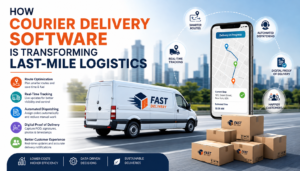

The courier and logistics industry is changing rapidly as businesses face increasing parcel volumes, tighter delivery schedules, rising operational costs, and higher customer expectations. Customers now expect fast delivery, accurate estimated arrival times, real-time shipment visibility, and convenient communication throughout the delivery journey. Traditional methods based on spreadsheets, phone calls, and manual dispatching can make these expectations difficult to meet. Courier delivery software provides a smarter way to manage modern delivery operations by connecting orders, drivers, routes, tracking, and customer communication in one centralized system.
The Growing Need for Smarter Courier Management
Managing deliveries becomes increasingly complicated as a courier business expands. Dispatchers may need to coordinate multiple drivers, hundreds of delivery locations, changing priorities, traffic conditions, and customer requests at the same time. Manual processes can create communication gaps, inefficient routes, delayed deliveries, and unnecessary administrative work.
A modern courier management platform helps automate these activities while giving managers better visibility into daily operations. Businesses can monitor active deliveries, coordinate drivers, manage delivery schedules, and access important operational information through a centralized dashboard.
Route Optimization Improves Delivery Performance
Efficient route planning is one of the most important parts of successful courier operations. Poorly planned routes can increase fuel consumption, driving time, and vehicle wear while reducing the number of deliveries a driver can complete.
Modern courier delivery software can use route optimization technology to identify more efficient routes based on delivery locations, multiple stops, priorities, and changing road conditions. Better route planning can help businesses reduce unnecessary mileage and improve delivery productivity.
Real-Time Tracking Creates Greater Visibility
Real-time GPS tracking has become an important feature for courier businesses. Dispatchers need to know where drivers are, while customers want visibility into their shipments after an order has been dispatched.
With real-time tracking, businesses can monitor delivery progress and identify potential delays earlier. Customers can also receive tracking updates and estimated delivery information, reducing uncertainty and unnecessary “Where is my order?” enquiries.
Greater visibility benefits both the courier company and the customer because everyone involved has access to more accurate delivery information.
Automated Dispatch Reduces Manual Work
As delivery volumes increase, manually assigning every order can become time-consuming and inefficient. Courier delivery software can automate dispatch by considering factors such as driver availability, location, delivery priority, vehicle capacity, and route efficiency.
Automated dispatch helps ensure that delivery jobs are assigned to suitable drivers while reducing the workload of dispatch teams. It can also improve response times for same-day, express, and on-demand deliveries.
Digital Proof of Delivery Improves Accountability
Delivery disputes can create additional costs and customer service challenges. Digital proof of delivery helps businesses maintain reliable records for completed shipments.
Through a driver mobile application, businesses can capture electronic signatures, delivery photographs, GPS information, and timestamps. These records provide stronger delivery verification and make it easier to resolve disputes when they occur.
Driver Apps Connect Field Teams With Dispatchers
A dedicated driver application can place essential delivery information directly in the hands of drivers. Drivers can access delivery schedules, customer details, navigation, route updates, and proof-of-delivery tools from their mobile devices.
This improves communication between drivers and dispatch teams while reducing dependence on phone calls and manual paperwork. It also gives businesses better insight into driver activity and delivery performance.
Better Customer Communication
Customer experience has become an important competitive factor in the courier industry. Automated notifications can keep customers informed about order confirmation, dispatch, estimated delivery times, tracking updates, and successful delivery.
Consistent communication helps build trust and gives customers greater control over their delivery experience. When customers know what to expect, they are more likely to have a positive perception of the courier service.
Analytics Support Better Business Decisions
Modern courier platforms can collect valuable operational data, including delivery completion rates, route performance, driver productivity, delivery times, and fleet activity. Managers can use these insights to identify inefficiencies and improve daily planning.
Instead of making decisions based only on assumptions, businesses can use operational data to understand where resources are being used effectively and where improvements may be required.
Building a More Scalable Delivery Operation
Courier businesses need technology that can support growth rather than create additional complexity. A scalable delivery management platform can help companies manage increasing numbers of orders, drivers, vehicles, and customers without depending entirely on manual processes.
Integration capabilities are also important. Courier systems may need to connect with eCommerce platforms, warehouse management systems, transportation management systems, CRM platforms, payment systems, and other business applications.
Conclusion
Courier delivery software is becoming an essential technology for businesses that want to improve speed, visibility, accuracy, and operational efficiency. Features such as route optimization, real-time GPS tracking, automated dispatch, digital proof of delivery, driver applications, customer notifications, and analytics can transform the way courier operations are managed.