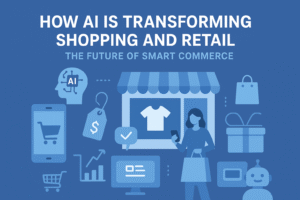

The retail industry is undergoing a massive transformation — and at the heart of this evolution lies Artificial Intelligence (AI). From personalized recommendations to automated checkouts, AI is not just enhancing how people shop but redefining how brands engage, operate, and compete.
As we enter 2025, smart commerce is no longer a futuristic concept — it’s a strategic necessity. Retailers leveraging AI are achieving higher sales, better customer experiences, and more efficient supply chains. Let’s explore how AI is revolutionizing shopping and retail and what this means for the future of commerce.
Read More:– How is Artificial Intelligence Transforming Every Industry?
🤖 1. Personalization: AI’s Cornerstone in Retail
Personalization has become the new standard in customer experience — and AI is its driving force.
AI-powered recommendation engines analyze massive volumes of customer data — browsing history, purchase behavior, demographics, and even social media activity — to deliver hyper-personalized product suggestions.
For example:
-
Amazon’s AI algorithms recommend products based on what users have previously viewed or purchased.
-
Netflix and Spotify’s recommendation systems have trained customers to expect the same personalized experience everywhere — including retail.
AI enables brands to move beyond simple segmentation. Instead of targeting groups, businesses can now tailor offerings to each individual shopper, increasing engagement, loyalty, and average order value.
🛒 2. AI-Driven Customer Insights and Predictive Analytics
Retailers have long collected customer data — but AI transforms this information into actionable intelligence.
Using predictive analytics, AI can forecast future buying behavior and market trends. Retailers can anticipate what customers will need before they even realize it themselves.
For instance:
-
Walmart uses AI to predict stock requirements based on weather, local events, and shopping patterns.
-
Target employs predictive models to identify when a customer might be expecting a baby, helping them send relevant offers at the right time.
By understanding customer intent, AI helps brands stay ahead of the curve — optimizing pricing strategies, product placements, and inventory management.
📱 3. Conversational AI and Virtual Shopping Assistants
AI-powered chatbots and voice assistants have redefined customer service in retail.
Conversational AI tools such as ChatGPT, Google Bard, and custom in-store bots can engage customers in real time, answer questions, provide recommendations, and help with purchases — all while learning from every interaction.
Modern virtual shopping assistants do much more than support inquiries; they can:
-
Help users find specific products based on preferences.
-
Recommend outfits or complementary items.
-
Offer instant discounts or loyalty rewards.
Retail giants like Sephora and H&M use AI chatbots to guide online shoppers and boost conversions. In physical stores, AI kiosks and voice-enabled assistants are improving in-store navigation and reducing customer frustration.
🧠 4. AI in Inventory Management and Supply Chain Optimization
AI doesn’t just enhance customer experience — it also strengthens backend operations.
One of the most critical applications of AI in retail is supply chain optimization. AI systems can predict demand fluctuations, identify potential supply disruptions, and automate restocking processes.
Key benefits include:
-
Demand forecasting: Reduces overstocking and understocking issues.
-
Automated procurement: AI can reorder items before stock runs low.
-
Route optimization: AI algorithms help logistics teams find the fastest, most cost-effective shipping routes.
Companies like Zara and Nike are already using AI for real-time inventory tracking and production management, resulting in faster product rollouts and fewer inefficiencies.
🛍️ 5. Visual Search and Image Recognition
AI-powered visual search is changing the way customers discover products. Instead of typing what they’re looking for, users can simply upload an image or take a photo — and AI finds visually similar products instantly.
Retailers like ASOS, IKEA, and Pinterest Lens are leading this innovation. For example, if you see someone wearing shoes you like, you can snap a photo and find similar options in seconds.
Image recognition technology also helps retailers with shelf management, product tagging, and counterfeit detection — creating a more efficient and trustworthy ecosystem.
💳 6. Frictionless Payments and AI-Powered Checkouts
Long checkout lines are becoming a thing of the past, thanks to AI-powered solutions like Amazon Go and Walmart’s Scan & Go.
These stores use computer vision, sensors, and AI algorithms to automatically detect items picked up by customers and charge them through a mobile app — eliminating traditional checkout processes entirely.
Additionally, AI-driven fraud detection systems analyze transaction patterns in real time, preventing fraudulent activities before they occur. This blend of convenience and security is setting new benchmarks for the retail industry.
📦 7. AI in Pricing and Promotions
Dynamic pricing — once reserved for airlines — is now an integral part of retail.
AI-powered systems analyze competitor pricing, demand trends, customer preferences, and market conditions to determine optimal prices in real time. This ensures that businesses remain competitive without compromising margins.
Similarly, AI tools help personalize promotions based on customer behavior. Instead of sending generic discount codes, retailers can send personalized offers that align with customer intent and purchase history — improving conversion rates dramatically.
🧾 8. Enhancing In-Store Experience with AI
While e-commerce dominates discussions, AI is also enhancing brick-and-mortar shopping experiences.
Some examples include:
-
Smart mirrors: Allow customers to virtually try on outfits in different colors and styles.
-
Heat maps and sensors: Track in-store traffic to optimize product placement.
-
Facial recognition: Used (with customer consent) to personalize greetings or recommend products.
AI-powered analytics also help retailers understand how customers move through stores, identifying hotspots and bottlenecks to improve layout efficiency.
🌍 9. Sustainability and Ethical Shopping with AI
Modern consumers care about sustainability — and AI is helping brands meet these expectations.
AI tools can track supply chain transparency, reduce waste through precise demand forecasting, and recommend eco-friendly alternatives to customers.
Retailers like H&M and Patagonia are using AI to optimize sustainable sourcing and reduce carbon footprints — making ethical shopping easier and more accessible.
🔮 10. The Future of AI in Retail: Towards Smart Commerce
AI in retail is no longer a trend — it’s a revolution shaping the future of smart commerce.
In the coming years, we’ll see deeper integrations of AI with IoT, AR/VR, and blockchain, enabling immersive and transparent shopping experiences. Smart stores will predict customer needs, restock automatically, and offer fully personalized shopping environments — both online and offline.
Retailers who embrace AI today are not just staying competitive — they’re building the foundation for a data-driven, customer-first, and sustainable retail ecosystem.
Read More:– The Impact of Artificial Intelligence on Business and Society
🚀 Final Thoughts
AI is redefining retail from every angle — improving personalization, optimizing operations, and creating seamless shopping experiences. The future of retail isn’t about technology replacing humans; it’s about AI empowering human creativity and decision-making to deliver smarter, faster, and more meaningful interactions.
As we step into an era of smart commerce, one thing is clear: the retailers that leverage AI effectively will lead the market — and redefine the way the world shops.