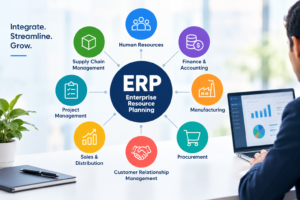

Businesses today manage enormous amounts of data across finance, inventory, human resources, supply chains, and customer operations. Yet, many organizations still struggle to turn that data into timely decisions. Traditional Enterprise Resource Planning (ERP) systems help connect business functions, but they often rely on manual processes, predefined rules, and historical reporting.
Artificial intelligence (AI) is changing this approach. By introducing predictive analytics, intelligent automation, and natural-language interactions, AI is helping businesses make ERP systems more responsive and efficient. Understanding how AI is reshaping enterprise resource planning can help organizations identify opportunities to reduce operational friction, improve decision-making, and prepare for future growth.
What Is AI-Powered ERP?
Enterprise Resource Planning software brings essential business processes together in one system. It allows departments to share information, coordinate activities, and maintain consistent records.
AI-powered ERP builds on these capabilities by using technologies such as machine learning, natural-language processing, and generative AI to analyze information, recognize patterns, and support business decisions.
For example, a traditional ERP system may record inventory levels and generate a report when stock falls below a predefined threshold. An AI-enabled system may also analyze historical sales, seasonal demand, supplier lead times, and current orders to forecast potential shortages.
This shift moves ERP beyond recording what has already happened toward helping businesses anticipate what may happen next.
5 Ways AI Is Reshaping Enterprise Resource Planning
1. Automating Repetitive Business Processes
Many ERP-related tasks involve repetitive activities, including invoice processing, purchase order management, data entry, expense categorization, and financial reconciliation.
AI can help extract information from documents, classify transactions, identify discrepancies, and recommend actions. When combined with workflow automation, these capabilities can reduce manual effort and allow employees to focus on work requiring judgment and expertise.
For example, an AI-enabled finance workflow could extract invoice details, compare them against purchase orders, and flag mismatched amounts for review.
However, automation should not eliminate necessary oversight. High-value transactions, unusual exceptions, and sensitive financial decisions may still require human approval.
Business benefit: Reduced administrative workload, fewer avoidable errors, and more consistent workflows.
2. Improving Forecasting and Business Planning
Accurate forecasting is essential for managing inventory, staffing, budgets, and production schedules. Traditional forecasting methods may struggle when demand changes quickly or several variables influence business performance.
AI models can analyze historical transactions alongside relevant operational data to identify patterns and generate forecasts.
A manufacturer, for instance, could use AI to estimate future demand based on past sales, current orders, seasonal trends, and supplier performance. Planning teams can use these insights to adjust purchasing and production schedules before shortages or excess inventory become significant problems.
Forecasts are not guaranteed predictions. Their reliability depends on data quality, model suitability, and changing market conditions. Businesses should regularly compare predictions with actual outcomes and update their models when necessary.
Business benefit: Better-informed planning, more effective resource allocation, and improved responsiveness to demand changes.
3. Strengthening Supply Chain Management
Supply chains are affected by supplier delays, changing transportation costs, inventory fluctuations, and unexpected disruptions. Limited visibility across these activities can make it difficult to respond quickly.
AI can help ERP systems identify unusual patterns, assess potential risks, and highlight operations that require attention.
For example, if a supplier repeatedly delivers materials later than expected, an AI system could flag the pattern and help purchasing teams evaluate alternative suppliers or adjust delivery schedules.
AI can also support inventory optimization by estimating appropriate stock levels for different products, locations, and demand conditions.
These recommendations become more useful when the ERP system has reliable, up-to-date information from suppliers, warehouses, purchasing teams, and sales operations.
Business benefit: Improved supply chain visibility, earlier risk detection, and more informed inventory decisions.
4. Making Business Data Easier to Understand
ERP systems often contain valuable information, but accessing it can require navigating dashboards, building reports, or asking technical teams to extract data.
Natural-language interfaces can make this process more accessible. Depending on the platform, users may be able to ask questions such as, “Which products had the highest sales last quarter?” or “Which suppliers have the most overdue purchase orders?”
The system can then generate a response or report based on available business data.
Generative AI may also help summarize financial reports, explain operational trends, and identify areas for further investigation. However, generated answers must be checked against reliable source records, especially when they influence financial or operational decisions.
Business benefit: Faster access to relevant information and improved collaboration between technical and nontechnical teams.
5. Supporting More Proactive Decision-Making
Traditional reporting generally explains what happened. Predictive and prescriptive AI capabilities can help organizations explore what may happen next and which actions could be worth considering.
For example, an ERP system may detect that production costs are rising while output remains unchanged. AI-assisted analysis could help managers investigate energy usage, material costs, machine downtime, or changes in production schedules.
The system may recommend possible actions, but managers must evaluate those recommendations against business priorities, operational constraints, and real-world conditions.
This combination of data-driven insights and human judgment can make decision-making more structured and responsive.
Business benefit: Earlier identification of operational issues and better-supported strategic decisions.
Challenges Businesses Should Consider Before Adopting AI in ERP
Although AI offers significant opportunities, implementing it successfully requires more than adding a new feature to existing software.
Data Quality and Integration
AI systems depend on reliable information. Duplicate records, inconsistent product codes, outdated supplier details, and disconnected applications can reduce the quality of AI-generated insights.
Organizations should review their data before implementation and establish clear ownership of important records.
Security and Data Privacy
ERP platforms often contain confidential financial, employee, supplier, and customer information. Businesses should evaluate access controls, data retention practices, encryption, and how AI providers process sensitive information.
AI access should follow the principle of least privilege, ensuring that users and systems can access only the information required for their roles.
Employee Training and Adoption
Employees may be uncertain about how AI will affect their responsibilities or whether they can trust automated recommendations.
Businesses should explain the purpose of new tools, provide practical training, and involve employees in testing workflows. Starting with a limited use case can help teams build confidence before expanding implementation.
Cost and Return on Investment
AI adoption may involve software licensing, integration, infrastructure, training, and ongoing monitoring costs.
Before investing, organizations should define measurable objectives, such as reducing invoice processing time, improving forecast accuracy, or lowering inventory carrying costs. Comparing these indicators before and after implementation helps determine whether the investment is delivering value.
How to Implement AI in ERP Successfully
Businesses can approach AI adoption through a structured process:
- Identify a specific problem: Choose a process where delays, manual work, or poor forecasting create measurable business challenges.
- Assess data readiness: Review data quality, availability, integration, and access permissions.
- Select a suitable use case: Prioritize applications with clear benefits and manageable risks.
- Run a pilot project: Test the solution with a limited team, department, or workflow before expanding it.
- Measure performance: Track relevant metrics, including processing time, error rates, forecast accuracy, and total implementation costs.
- Maintain human oversight: Establish approval processes, audit trails, and escalation procedures for important decisions.
- Expand gradually: Use pilot results and employee feedback to refine the approach before introducing additional AI capabilities.
This method helps organizations avoid investing in technology without a clear understanding of the business problem it needs to solve.
The Future of AI in Enterprise Resource Planning
AI-enabled ERP systems are likely to become more conversational, predictive, and increasingly capable of coordinating tasks across business functions. AI agents may eventually handle more multistep workflows, such as preparing purchase recommendations or coordinating routine approvals, subject to the permissions and controls established by the organization.
However, greater automation will also increase the importance of transparency, security, accountability, and reliable data governance.
Businesses that approach AI as a long-term operational capability rather than a quick technology upgrade will be better positioned to identify meaningful opportunities and manage implementation risks.
Conclusion
AI is reshaping enterprise resource planning by helping businesses automate routine work, improve forecasts, strengthen supply chains, and access operational insights more easily. These capabilities can support better decisions, but their effectiveness depends on reliable data, appropriate technology, employee adoption, and human oversight.
The best starting point is not to automate every ERP process at once. Instead, identify one meaningful business challenge, test an appropriate AI solution, and measure the results before expanding further.
As organizations evaluate ways to modernize their operations and digital infrastructure, exploring the technology and solutions available through Sync Origins can be a starting point for understanding how digital capabilities align with evolving business needs.
SEO Details
SEO Title: How AI Is Reshaping Enterprise Resource Planning
Meta Description: Discover how AI is reshaping enterprise resource planning through automation, smarter forecasting, supply chain optimization, and better business decisions.
Suggested URL Slug: how-ai-is-reshaping-enterprise-resource-planning
Primary Keyword: AI Is Reshaping
Suggested Secondary Keywords:
- AI in enterprise resource planning
- AI-powered ERP systems
- Artificial intelligence in ERP
- ERP automation
- AI-driven business planning
Frequently Asked Questions
1. How is AI reshaping enterprise resource planning?
AI is enhancing ERP systems through intelligent automation, predictive analytics, improved forecasting, natural-language interfaces, and data-driven recommendations that help businesses manage operations more effectively.
2. What are the main benefits of AI-powered ERP systems?
Key benefits include reduced manual work, faster access to business insights, better inventory management, improved demand forecasting, and more informed operational decisions.
3. Can AI be integrated into existing ERP systems?
Yes. Depending on the ERP platform, businesses may be able to integrate AI through built-in features, application programming interfaces, third-party applications, or custom solutions. Compatibility, data access, security, and integration costs should be evaluated first.
4. What challenges can businesses face when implementing AI in ERP?
Common challenges include poor data quality, integration complexity, security concerns, employee resistance, implementation costs, and the need to validate AI-generated recommendations.
5. Is AI-powered ERP suitable for small businesses?
Yes. Small businesses may benefit from AI-enabled invoice processing, inventory forecasting, and reporting tools. Starting with an affordable, clearly defined use case can help them assess value before making a larger investment.