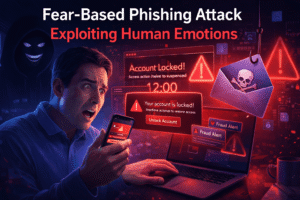

Phishing attacks are no longer just about fake emails or suspicious links—they are carefully crafted psychological traps designed to manipulate human emotions. While organizations invest heavily in firewalls, encryption, and advanced threat detection, cybercriminals continue to succeed by targeting the weakest link in cybersecurity: human behavior. Among the many tactics used, fear stands out as one of the most powerful emotional triggers driving users to click, respond, and unknowingly compromise sensitive information.
The Role of Emotion in Cyber Attacks
Cybercriminals understand that humans are emotional decision-makers. When faced with urgency or panic, people tend to act quickly rather than think critically. Phishing emails often exploit this by creating scenarios that evoke fear, anxiety, or stress. Whether it’s a warning about a compromised bank account, a job termination notice, or a legal threat, these messages are designed to push recipients into immediate action.
Fear works because it overrides rational thinking. Instead of verifying the authenticity of the message, users focus on resolving the perceived threat. This emotional response creates the perfect opportunity for attackers to trick individuals into clicking malicious links, downloading malware, or sharing confidential information.
Common Fear-Based Phishing Tactics
Phishing campaigns leveraging fear often follow recognizable patterns. One common tactic is impersonating trusted institutions such as banks, government agencies, or IT departments. Messages may claim that an account has been suspended or that suspicious activity has been detected, urging users to act immediately to avoid consequences.
Another approach involves creating a sense of urgency. Phrases like “Your account will be locked within 24 hours” or “Immediate action required” are designed to pressure users into responding without thinking. Cybercriminals also exploit authority by posing as senior executives or officials, making the message appear credible and difficult to ignore.
In some cases, attackers combine fear with curiosity. For example, an email might claim to contain important information about a security breach or personal data leak, prompting users to click on a link to learn more. This combination of emotional triggers increases the likelihood of success.
Why Even Smart Users Fall Victim
It’s easy to assume that only inexperienced users fall for phishing scams, but the reality is quite different. Even highly educated and tech-savvy individuals can be deceived when emotions come into play. Fear creates a sense of urgency that disrupts logical thinking, making it harder to identify red flags such as suspicious URLs or unusual email formatting.
Additionally, attackers continuously refine their techniques. Modern phishing emails are highly sophisticated, often mimicking legitimate communications with accurate branding, professional language, and realistic scenarios. This level of detail makes it increasingly difficult for users to distinguish between genuine and malicious messages.
The Impact on Organizations
The consequences of fear-driven phishing attacks can be severe. A single click can lead to data breaches, financial losses, or ransomware infections. For organizations, this not only affects operations but also damages reputation and customer trust.
Employees under pressure are particularly vulnerable. In fast-paced work environments, individuals may prioritize quick responses over careful verification. Cybercriminals exploit this by targeting employees with messages that appear work-related, such as urgent requests from management or IT support alerts.
Building a Human-Centric Defense
To combat phishing effectively, organizations must go beyond traditional security measures and focus on human-centric strategies. Awareness and education play a critical role in helping users recognize emotional manipulation tactics. Training programs should emphasize the importance of staying calm, verifying sources, and questioning urgent requests.
Simulated phishing exercises can also help employees identify and respond to threats in a controlled environment. By experiencing these scenarios firsthand, users become more aware of how emotions influence their decisions.
Another key strategy is implementing multi-layered security measures such as multi-factor authentication (MFA) and email filtering. While these technologies cannot eliminate phishing entirely, they provide an additional layer of protection that reduces the risk of successful attacks.
Staying One Step Ahead
As cyber threats continue to evolve, understanding the psychological aspect of phishing is more important than ever. Fear, urgency, and trust are powerful tools in the hands of cybercriminals, but awareness can neutralize their impact.
By recognizing how emotions influence behavior, individuals and organizations can take proactive steps to strengthen their defenses. The next time an urgent or alarming message appears, taking a moment to pause and verify could make all the difference. In cybersecurity, staying calm is not just good advice—it’s a critical line of defense.