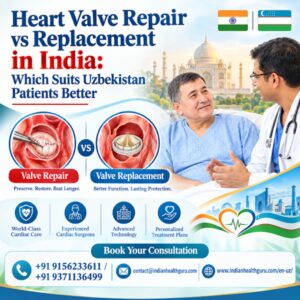

When a heart valve becomes severely narrowed or starts leaking, patients from Uzbekistan may be advised to consider either valve repair or valve replacement. Choosing between the two is not simply a matter of selecting the more advanced procedure. The decision depends on which valve is affected, the cause and severity of the disease, the valve’s anatomy, the patient’s age and health, and whether a durable repair can realistically be achieved.
For international patients travelling to India, understanding this distinction is particularly important. A patient may arrive expecting a replacement only to learn that repair could be possible, or may be told that replacement offers a more predictable solution because the valve is too damaged to repair effectively.
There is no single procedure that suits every patient. The goal is to select the treatment that provides the best balance between safety, durability, heart function and long-term quality of life.
What Is Heart Valve Repair?
Valve repair preserves the patient’s own valve while correcting the structural problem that is preventing it from functioning properly. Depending on the valve involved, the surgeon may reshape valve tissue, repair supporting structures, remove excess tissue or use a ring or other technique to improve the valve’s function.
Repair is particularly important in some forms of mitral and tricuspid valve disease. When a durable repair is technically feasible, preserving the patient’s own valve can have important advantages.
One major benefit is that repair avoids implanting a prosthetic valve. It may also reduce the need for lifelong anticoagulation that would be required with many mechanical replacement valves. However, repair is not suitable for every patient, and the possibility of achieving a durable result depends heavily on the valve’s anatomy and the surgeon’s expertise.
What Is Heart Valve Replacement?
Replacement removes the diseased valve and substitutes it with a prosthetic valve. The two broad categories are mechanical valves and biological or tissue valves.
Mechanical valves are highly durable but generally require lifelong anticoagulation with warfarin and regular monitoring. Biological valves do not usually require lifelong anticoagulation solely because of the prosthesis, but they can deteriorate over time and may eventually require another intervention.
Replacement may be recommended when the valve is severely damaged, calcified, infected or otherwise unsuitable for a reliable repair. The patient’s age, health, lifestyle and ability to manage long-term medication are also considered when selecting the type of replacement valve.
Repair vs Replacement: What Is the Difference?
|
Consideration |
Valve Repair |
Valve Replacement |
|
Patient’s own valve |
Preserved |
Diseased valve is replaced |
|
Prosthetic valve |
Not normally required |
Mechanical or biological valve used |
|
Anticoagulation |
May not be required long term solely because of the repair |
Usually lifelong with mechanical valves |
|
Durability |
Depends on the quality of the repair and valve disease |
Depends on prosthesis type and patient factors |
|
Future procedures |
May still be required if repair fails or disease progresses |
Biological valves may eventually require reintervention |
|
Suitability |
Depends strongly on valve anatomy |
Often used when durable repair is not feasible |
|
Key consideration |
Whether a stable repair can be achieved |
Choosing the appropriate replacement valve |
This is a general comparison. The treating cardiac team must determine which option is appropriate for the individual patient.
Read More Here:- Heart valve repair vs replacement in India for Uzbekistan
When Repair May Be Preferred
Repair may be attractive when the valve can be reconstructed successfully and the expected result is durable. This is especially relevant for certain forms of degenerative mitral valve disease, where preserving the patient’s own valve may be possible.
A successful repair can preserve the patient’s natural valve structure and avoid some of the long-term considerations associated with prosthetic valves.
However, patients should not assume that repair is automatically better. An unsuccessful or unstable repair may leave significant valve disease and could lead to another operation. The surgeon must therefore assess whether repair is likely to provide a satisfactory long-term result.
When Replacement May Be More Appropriate
Replacement may be preferable when the valve is too extensively damaged to repair reliably. Severe calcification, advanced structural destruction, certain forms of valve infection and some complex valve abnormalities may make replacement a more appropriate option.
Replacement also provides a predictable prosthetic valve function in situations where reconstruction would be technically difficult or unlikely to remain durable.
The choice between a mechanical and biological prosthesis then becomes another important discussion. Younger patients may place greater emphasis on durability, while older patients or those for whom long-term anticoagulation presents difficulties may consider a tissue valve. These are general considerations rather than fixed rules.
Why the Type of Valve Matters
If replacement is required, the patient and cardiac surgeon must decide which prosthesis is appropriate.
A mechanical valve is designed for long-term durability but generally requires lifelong warfarin therapy and INR monitoring. This means the patient must have reliable access to anticoagulation management after returning to Uzbekistan.
A biological valve may reduce the need for lifelong anticoagulation solely related to the prosthesis, but tissue valves have a limited structural lifespan. Younger patients may therefore face a greater possibility of future valve deterioration.
Pregnancy plans, bleeding risk, age, lifestyle and access to regular medical monitoring should all be discussed before choosing a replacement valve.
How Indian Cardiac Surgeons Assess Uzbekistan Patients
For international patients, treatment planning should begin with a detailed review of medical records and cardiac imaging. Recent echocardiograms are particularly important because they show how the valve is functioning and can provide information about heart chambers and overall cardiac performance.
Depending on the condition, the cardiac team may recommend additional imaging, ECG, cardiac catheterisation or other tests before finalising the treatment plan.
The surgeon then considers whether the valve can be repaired, whether replacement would be safer or more durable, and whether another intervention could be appropriate.
In complex cases, discussion among cardiac surgeons, cardiologists, imaging specialists and other members of the heart team can provide a broader assessment.
Preparing Before Travelling From Uzbekistan
Patients should collect their medical records before travelling. These may include echocardiogram reports, ECGs, angiography or CT reports, blood tests, previous hospital summaries and a complete list of medicines.
Patients who have already undergone heart surgery or another valve procedure should also provide previous operative records.
If the patient is taking anticoagulants, the exact medicine, dosage and recent monitoring information should be documented. This can help the Indian team understand the patient’s current treatment and plan safely for any procedure.
What Should Patients Expect in India?
After arriving in India, the patient normally undergoes an in-person cardiac evaluation. Additional tests may be recommended before surgery, particularly if the available reports are old or incomplete.
The surgeon should explain the proposed procedure, why it is recommended, the expected benefits, important risks and available alternatives. If repair is possible, the patient should also ask about the likelihood of a durable repair and what would happen if repair is not technically successful.
For replacement, the discussion should cover the type of prosthetic valve being considered and its long-term implications.
Read More Here:- Affordable Heart valve Surgery India for Uzbekistan
Recovery and Follow-Up
Recovery varies according to the procedure and the patient’s general health. Major valve surgery usually requires a period of hospital recovery followed by gradual physical activity and, where appropriate, cardiac rehabilitation.
International patients should plan their return to Uzbekistan around medical recovery rather than simply the expected discharge date. Before travelling home, they should receive a treatment summary, operative report, medication list, valve details and follow-up recommendations.
Long-term follow-up remains important after both repair and replacement. Patients may need periodic echocardiography and cardiology reviews to monitor valve function and heart performance.
Questions Uzbekistan Patients Should Ask
Before choosing repair or replacement, patients can ask their cardiac surgeon:
- Can my valve be repaired safely and durably?
- Why is replacement being recommended instead?
- What are the expected benefits and risks of each option?
- How experienced is the surgical team with this particular valve problem?
- If replacement is required, should I consider a mechanical or biological valve?
- Will I need lifelong anticoagulation?
- How long will recovery take?
- What follow-up will be needed after returning to Uzbekistan?
These questions help the patient understand the reasoning behind the recommendation.
Final Takeaway
Heart valve repair and replacement are both established treatment options, but they serve different clinical situations. Repair preserves the patient’s own valve when a good and durable reconstruction is possible. Replacement provides a prosthetic valve when repair is unsuitable or unlikely to provide an adequate result.
For patients from Uzbekistan seeking treatment in India, a detailed review by an experienced cardiac team is essential. Patients should understand not only the operation itself but also the long-term implications of their decision, including medication, monitoring, recovery and future follow-up.
The right approach is the one that offers the most appropriate balance of safety, durability and long-term heart function for the individual patient.
Official Indian Government References
National Medical Commission (NMC)
The National Medical Commission is India’s statutory medical regulator and establishes professional standards for medical practice and medical education. Its regulatory framework is relevant to international patients seeking specialist cardiac treatment and surgery in India.
Official website: https://www.nmc.org.in/
Ministry of Health and Family Welfare (MoHFW), Government of India
The Ministry of Health and Family Welfare is the Government of India’s central ministry responsible for national health policies and programmes. Its official resources provide information about India’s healthcare system and public-health framework.
Official website: https://www.mohfw.gov.in/
Our Commitment to Patients
Our mission is to place patients at the centre of every healthcare decision by providing trustworthy, evidence-based, and unbiased medical information. We believe that informed patients make better decisions. Backed by personalised guidance from our experienced advisory team, we help patients understand their treatment options, compare them objectively, and confidently choose the path that best aligns with their medical needs, personal preferences, and long-term health goals.
Dr. Dheeraj Bojwani
Medical Travel Advisor for International Patients Seeking Treatment in India
📍 New Delhi, India
🏆 24+ Years of Experience | Assisted 5,000+ International Patients
🌐 Website: www.indianhealthguru.com/en-uz/
📧 Email: contact@indianhealthguru.com
📞 Phone: +91 9156233611 | 📞 Alternate Phone: +91 9371136499
Disclaimer
This article is intended for educational and informational purposes only and should not be considered medical, legal, or visa advice. Medical recommendations, treatment plans, and procedures may vary from one patient to another based on individual health conditions and circumstances. Readers are strongly advised to consult qualified healthcare professionals before making any medical-related decisions.