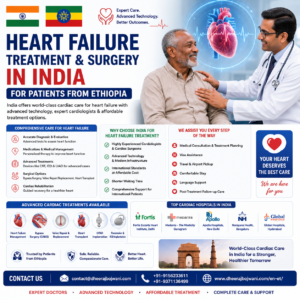

Heart failure does not mean that the heart has completely stopped working. It means the heart cannot pump blood effectively enough to meet the body’s needs. Some patients develop symptoms gradually, while others experience a sudden worsening that requires urgent hospital care.
For patients travelling from Ethiopia to India offers access to cardiologists, cardiac surgeons, electrophysiologists, intensive-care teams, and rehabilitation specialists within the same hospital network. Treatment may involve medicines and lifestyle changes, procedures such as angioplasty or pacemaker implantation, heart valve surgery, coronary bypass surgery, or advanced mechanical support.
The correct treatment depends on why the heart has weakened, how severe the symptoms are, and whether other organs have been affected.
Common Causes of Heart Failure
Heart failure may develop because of:
- Coronary artery disease or a previous heart attack
- Long-standing high blood pressure
- Heart valve disease
- Cardiomyopathy or weakened heart muscle
- Congenital heart disease
- Abnormal heart rhythms
- Infections affecting the heart
- Diabetes, kidney disease, or thyroid disorders
- Certain medicines or cancer treatments
Identifying the underlying cause is essential because heart failure treatment is not the same for every patient.
Also Read: Heart Failure Treatment in India for Ethiopian Patients
Symptoms Families Should Not Ignore
Common symptoms include:
- Breathlessness during activity or while lying down
- Swelling of the feet, ankles, legs, or abdomen
- Persistent tiredness and weakness
- Rapid or irregular heartbeat
- Reduced ability to exercise
- Sudden weight gain caused by fluid retention
- Persistent coughing, particularly at night
- Poor appetite, nausea, or abdominal discomfort
- Confusion or reduced alertness in advanced cases
Severe breathlessness, chest pain, fainting, bluish lips, or sudden confusion requires emergency medical attention.
Evaluation Before Treatment
Patients travelling from Ethiopia should send recent medical reports before finalising their journey. The Indian cardiology team may initially review echocardiograms, angiography images, blood test reports, hospital discharge summaries, and a list of current medicines.
After arrival, the evaluation may include:
|
Investigation |
Why It Is Performed |
|
Echocardiogram |
Measures pumping function and assesses heart valves |
|
Electrocardiogram |
Identifies rhythm and electrical abnormalities |
|
Blood tests |
Evaluates kidney, liver, thyroid, electrolyte, and anaemia status |
|
Chest imaging |
Checks heart size and fluid accumulation in the lungs |
|
Coronary angiography |
Detects blocked coronary arteries |
|
Cardiac MRI |
Provides detailed information about the heart muscle |
|
Stress testing |
Assesses heart function during physical activity |
|
Holter monitoring |
Records the heartbeat over an extended period |
The treating team also determines whether the patient has reduced or preserved pumping function because this influences the treatment plan.
Medical Treatment for Heart Failure
Many patients can be managed without open-heart surgery. Treatment may include medicines that:
- Reduce excess fluid
- Control blood pressure
- Improve heart function
- Slow an excessively fast heartbeat
- Reduce strain on the heart
- Prevent blood clots in selected patients
- Treat diabetes, high cholesterol, or abnormal rhythms
Patients must take medicines exactly as prescribed. Stopping treatment after symptoms improve can cause the condition to worsen again.
Doctors may also recommend limiting salt, monitoring daily weight, controlling fluid intake when appropriate, stopping tobacco use, and beginning supervised cardiac rehabilitation.
Procedures That May Be Recommended
Coronary angioplasty
Angioplasty may be performed when narrowed coronary arteries are contributing to poor blood supply to the heart. A balloon and stent are used to reopen the affected artery.
Pacemaker implantation
A pacemaker may help when the heartbeat is abnormally slow or the heart’s electrical signals are not being transmitted correctly.
Cardiac resynchronisation therapy
Some patients with a weakened heart and electrical conduction delay may benefit from a specialised pacemaker that helps both sides of the heart contract in a more coordinated way.
Implantable cardioverter-defibrillator
An implantable defibrillator may be advised for selected patients who are at increased risk of dangerous heart rhythms.
When Is Heart Surgery Required?
Surgery is not necessary for every patient with heart failure. It may be considered when a correctable structural problem is responsible for the condition.
Coronary artery bypass grafting
Coronary bypass surgery may improve blood supply when several important coronary arteries are severely narrowed or blocked.
Heart valve repair or replacement
A damaged mitral, aortic, or tricuspid valve can place excessive pressure on the heart. Depending on the condition, the valve may be repaired or replaced.
AIIMS New Delhi reports providing mitral, aortic, and tricuspid valve procedures as part of its cardiothoracic surgical services.
Congenital heart surgery
Adults or children with structural heart defects may require corrective or palliative surgery.
Ventricular assist devices
A ventricular assist device may support blood circulation in carefully selected patients with advanced heart failure. It may be used while awaiting transplantation or as longer-term support when transplantation is unsuitable.
Heart transplantation
Heart transplantation may be considered when heart failure is advanced, irreversible, and no longer responds adequately to other treatments. Patients require extensive evaluation to assess the lungs, kidneys, liver, infection risk, psychological readiness, caregiver support, and suitability for long-term anti-rejection medicines.
Typical Hospital and Recovery Journey
|
Stage |
Approximate Experience |
|
Initial evaluation |
Two to five days, depending on investigations |
|
Angioplasty or device procedure |
Short admission in uncomplicated cases |
|
Open-heart surgery |
Usually requires intensive-care monitoring followed by ward recovery |
|
Early rehabilitation |
Begins during hospitalisation |
|
Stay in India |
Depends on the procedure and medical stability |
|
Long-term follow-up |
Continues after returning to Ethiopia |
Recovery time varies greatly. A patient receiving medication adjustment or a pacemaker will have a different recovery journey from someone undergoing bypass surgery, valve replacement, or transplantation.
Choosing a Cardiac Hospital in India
Families should evaluate:
- Experience of the heart-failure cardiologist
- Availability of cardiac surgery and intensive care
- Expertise in angioplasty, rhythm management, and device implantation
- Advanced imaging and catheterisation laboratories
- Infection-control practices
- Cardiac rehabilitation services
- Clear written treatment estimates
- Support for international patients and attendants
Hospitals from the approved partner network that may be considered include:
- Fortis Memorial Research Institute, Gurugram
- Medanta – The Medicity, Gurugram
- BLK-Max Super Speciality Hospital, New Delhi
- Kokilaben Dhirubhai Ambani Hospital, Mumbai
- Aster CMI Hospital, Bengaluru
- KIMS Hospitals, Hyderabad
The best hospital should be selected according to the patient’s diagnosis rather than reputation alone.
Preparing to Travel from Ethiopia
Patients should carry:
- Recent echocardiogram and angiography images
- Medical summaries and prescriptions
- Blood test reports
- Details of allergies and previous procedures
- A sufficient supply of prescribed medicines
- Medical and attendant visa documents
- Contact details of the treating doctor in Ethiopia
Patients with severe breathlessness, low oxygen levels, unstable blood pressure, or recent intensive-care admission must obtain medical clearance before flying.
Final Thoughts
Heart failure is a serious condition, but it can often be controlled when the cause is identified and treatment begins early. Some patients improve with medicines and lifestyle changes, while others require angioplasty, implanted devices, bypass surgery, valve surgery, or advanced heart-failure care.
For patients from Ethiopia, India provides access to multidisciplinary cardiac teams and a broad range of medical and surgical treatments. A detailed review of medical reports before travel can help families understand the likely treatment pathway, expected hospital stay, and possible recovery needs.
Official Indian Government References
- All India Institute of Medical Sciences, New Delhi – Cardiothoracic and Vascular Surgery
Information on coronary, valve, congenital, and other advanced cardiac surgical services.
https://www.aiims.edu/index.php/en/2014-12-17-05-21-02/inpatient - VMMC and Safdarjung Hospital – Department of Cardiology
Official information on cardiology facilities and cardiac-care services provided by a central government hospital.
https://vmmc-sjh.mohfw.gov.in/cardiology
Our Commitment to Patients
Our mission is to place patients at the centre of every healthcare decision by providing trustworthy, evidence-based, and unbiased medical information. We believe that informed patients make better decisions. Backed by personalised guidance from our experienced advisory team, we help patients understand their treatment options, compare them objectively, and confidently choose the path that best suits their medical needs and personal circumstances.
Dr. Dheeraj Bojwani
Medical Travel Advisor for International Patients Seeking Treatment in India
📍 New Delhi, India
🏆 24+ Years of Experience | Assisted 5,000+ International Patients
🌐 Website: www.dheerajbojwani.com/en-et/
📧 Primary Email: contact@dheerajbojwani.com
📞 Phone: +91 9156233611
📞 Alternate Phone: +91 9371136499
Disclaimer
This article is intended for educational and informational purposes only and should not be considered medical, legal, or visa advice. Medical recommendations, treatment plans, and procedures may vary from one patient to another based on individual health conditions and circumstances. Readers are strongly advised to consult qualified healthcare professionals before making any medical-related decisions.
Learn More: Medical Travel from Ethiopia to India for Heart Treatment