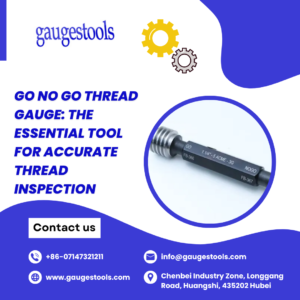

In the world of manufacturing, engineering, and precision machining, maintaining quality and consistency is critical. Even the smallest deviation in thread dimensions can lead to assembly failures, leakage, reduced product life, or safety hazards. This is where the GO NO GO Thread Gauge becomes an indispensable inspection tool. It plays a vital role in ensuring threaded components meet specified tolerances and standards before they are approved for use.
This blog explores what a GO NO GO thread gauge is, how it works, its types, applications, benefits, and best practices for effective use.
What is a GO NO GO Thread Gauge?
A GO NO GO Thread Gauge is a precision inspection instrument used to verify whether threaded parts such as nuts, bolts, pipes, or threaded holes conform to predefined dimensional standards. It helps manufacturers quickly determine if a threaded component is acceptable or defective.
The gauge consists of two ends:
- GO End – Checks the maximum material condition of the thread.
- NO GO End – Checks the minimum material condition of the thread.
The principle is simple:
- The GO end must pass completely through or into the thread.
- The NO GO end must not pass completely.
If the threaded part satisfies these conditions, it is considered within tolerance and approved for use.
Importance of Thread Inspection
Threaded components are used in almost every industry, including automotive, aerospace, oil and gas, medical equipment, and heavy machinery. Improper threads can create serious operational issues such as:
- Loose fittings
- Leakage in piping systems
- Reduced load-bearing capacity
- Vibration failures
- Difficulty in assembly
- Increased maintenance costs
A GO NO GO thread gauge ensures consistency, reliability, and interchangeability of threaded parts. It acts as a fast and efficient quality control method during production.
Working Principle of GO NO GO Thread Gauges
The gauge works on the principle of limit gauging. It verifies whether the thread dimensions lie within acceptable tolerance limits.
GO Gauge
The GO gauge checks the lower limit or maximum material condition of the thread.
- For internal threads, the GO plug gauge should enter fully.
- For external threads, the GO ring gauge should screw on smoothly.
This confirms that the thread is not oversized and can assemble correctly.
NO GO Gauge
The NO GO gauge checks the upper limit or minimum material condition.
- It should not enter or pass more than a specified number of turns.
- If it passes completely, the thread exceeds tolerance and is rejected.
This ensures the thread is not undersized or too loose.
Types of GO NO GO Thread Gauges
Different thread gauges are available depending on the application and thread type.1. Thread Plug Gauge
Used for checking internal threads such as nuts or threaded holes.
Components:
- GO plug end
- NO GO plug end
Applications:
- Engine blocks
- Hydraulic components
- Pipe fittings
- Industrial machinery
2. Thread Ring Gauge
Used for inspecting external threads like bolts and screws.
Features:
- Circular ring structure
- Precision internal threading
Applications:
- Fastener manufacturing
- Automotive bolts
- Aerospace components
3. Snap Gauge
Designed for checking external thread dimensions quickly in mass production environments.
Benefits:
- Fast inspection
- Easy handling
- High productivity
4. Taper Thread Gauges
Used for tapered threads commonly found in pipe systems.
Industries:
- Oil and gas
- Plumbing
- Petrochemical plants
Materials Used in Thread Gauges
GO NO GO thread gauges are manufactured from high-quality materials to ensure wear resistance and dimensional stability.
Common materials include:
- Hardened alloy steel
- High-speed steel
- Tungsten carbide
- Stainless steel
These materials undergo heat treatment to achieve high hardness and longer service life.
Standards for Thread Gauges
Thread gauges are manufactured according to international standards to ensure accuracy and compatibility.
Some widely used standards include:
- ISO (International Organization for Standardization)
- ANSI/ASME
- DIN standards
- BS standards
- IS standards
These standards define:
- Thread dimensions
- Tolerance limits
- Gauge design
- Inspection methods
Advantages of GO NO GO Thread Gauges
1. Quick Inspection
The gauge provides rapid pass/fail results without complex measurements.
2. High Accuracy
It ensures threads meet precise dimensional requirements.
3. Cost-Effective Quality Control
Reduces rejection rates and production errors.
4. Easy to Use
Minimal operator training is required.
5. Increased Productivity
Suitable for high-volume manufacturing environments.
6. Reliability
Provides consistent inspection results across batches.
Applications of GO NO GO Thread Gauges
GO NO GO thread gauges are widely used in multiple industries.
Automotive Industry
Used to inspect:
- Engine parts
- Transmission components
- Wheel bolts
- Fuel systems
Oil and Gas Industry
Checks threaded pipe connections for leak-proof sealing.
Manufacturing Industry
Used in:
- CNC machining
- Tool rooms
- Production lines
Medical Equipment
Ensures precision threading in surgical instruments and implants.
Difference Between GO and NO GO Gauges
| Feature | GO Gauge | NO GO Gauge |
|---|---|---|
| Purpose | Checks minimum limit | Checks maximum limit |
| Result | Must pass fully | Must not pass fully |
| Function | Ensures assembly capability | Prevents oversize/undersize defects |
| Usage | Confirms proper fit | Confirms tolerance control |
Proper Usage of Thread Gauges
To achieve accurate inspection results, proper handling is essential.
Cleaning
Ensure both the gauge and threaded component are free from:
- Dust
- Oil
- Metal chips
- Burrs
Correct Alignment
Avoid forcing the gauge into the thread. Proper alignment prevents damage.
Controlled Pressure
Apply gentle pressure during inspection.
Calibration
Regular calibration ensures continued accuracy.
Storage
Store gauges in protective cases to prevent corrosion and wear.
Common Causes of Thread Gauge Failure
Thread gauges may fail prematurely due to improper handling or environmental factors.
Common reasons include:
- Excessive force during inspection
- Poor storage conditions
- Lack of lubrication
- Exposure to moisture
- Frequent use without calibration
Regular maintenance significantly extends gauge life.
Calibration of GO NO GO Thread Gauges
Calibration is crucial for maintaining accuracy and compliance.
Why Calibration Matters
Over time, gauges experience wear that may affect measurement precision.
Calibration Frequency
Depends on:
- Usage frequency
- Industry standards
- Environmental conditions
High-production environments may require frequent calibration.
Calibration Methods
Performed using:
- Master gauges
- Coordinate measuring machines (CMM)
- Optical measuring systems
Choosing the Right Thread Gauge
Selecting the appropriate thread gauge depends on several factors.
Thread Type
Determine whether the thread is:
- Metric
- Unified
- BSP
- NPT
- ACME
Thread Size
Ensure the gauge matches the exact thread dimensions.
Tolerance Class
Choose according to required tolerance standards.
Application Environment
Consider:
- Temperature
- Humidity
- Production volume
Future Trends in Thread Inspection
As manufacturing technology evolves, thread inspection methods are becoming more advanced.
Digital Thread Gauging
Modern electronic systems provide:
- Real-time data
- Automated inspection
- Statistical process control
Smart Manufacturing Integration
Thread gauges are increasingly integrated into Industry 4.0 systems for automated quality monitoring.
Advanced Materials
New wear-resistant materials improve durability and reduce calibration frequency.
Conclusion
The GO NO GO Thread Gauge is one of the most essential tools in quality control and precision engineering. Its simple yet highly effective inspection method ensures threaded components meet exact dimensional standards, reducing production defects and improving product reliability.
From automotive manufacturing to aerospace engineering and oil pipeline systems, thread gauges play a critical role in ensuring safety, efficiency, and compatibility. Their speed, accuracy, and ease of use make them indispensable in modern industrial operations.
By selecting the correct gauge, following proper inspection practices, and maintaining regular calibration, manufacturers can achieve consistent product quality and long-term operational success.
In today’s competitive manufacturing environment, investing in reliable thread inspection tools like Gaugestools GO NO GO thread gauges is not just a quality requirement—it is a necessity for achieving precision and excellence.