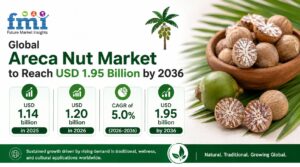

The global areca nut market is undergoing a structural realignment, moving from informal commodity trade toward certified, quality-verified processing and industrial supply, according to latest insights by Future Market Insights. Driven by deep-rooted cultural habits across South Asia, stricter import safety checks, and emerging applications in pharmaceutical alkaloid extraction (arecoline) and eco-friendly leaf sheath packaging, the commercial Areca catechu trade is formalizing.
The global market, valued at USD 1.14 billion in 2025, is estimated to reach USD 1.20 billion in 2026. Advancing at a Compound Annual Growth Rate (CAGR) of 5.0% over the ten-year forecast period, total market valuation is projected to achieve USD 1.95 billion by 2036, delivering an absolute incremental opportunity of USD 750 million.
Request a Sample Report: https://www.futuremarketinsights.com/reports/sample/rep-gb-6070
Market Performance Overview (2026–2036)
To map out the key nut varieties, physical trade formats, core end-use application channels, and regional growth vectors guiding this USD 750 million market scale-up, key segment allocations highlight where global commercial demand is concentrated:
- Red Areca Nut Type Segment (55.0% share): Commands market volume in 2026, favored over white varieties for long-distance trade due to its boiling/curing process, which significantly lowers moisture content, hardens nut texture, and improves shelf-life resistance against fungal decay.
- Whole Form Segment (45.0% share): Leads physical trade formats over split and ground options, as bulk importers prioritize whole nuts to verify quality, prevent adulteration, and navigate tariff classifications.
- Food & Confectionery End-Use Segment (65.0% share): Represents the primary end-use application, driven by traditional use in pan masala, mouth fresheners, and recreational masticatory products across South Asia.
- Pharmaceuticals & Biodegradable Packaging: Form high-value emerging secondary segments, leveraging extracted arecoline for therapeutic research and palm leaf sheaths for plastic-free eco-friendly dinnerware.
- India Regional Leadership (8.8% CAGR): Serves as the fastest-growing national market through 2036, driven by a domestic agricultural crop value exceeding ₹58,664 crore, government irradiation processing investments, and protective import tariff benchmarks.
Technical Drivers and Supply Chain Shifts
The commercial evolution of the areca nut industry across domestic and export channels is propelled by three primary catalysts:
Shift Toward Quality Verification and Cured Processing
Rising border scrutiny and import rejections (such as strict aflatoxin and novel food testing in Europe and Japan) are compelling suppliers to replace loose, sun-dried trade with controlled, cured red nut processing. Food irradiation units and moisture-control facilities ensure consistent alkaloid levels and long-term shelf stability.
Industrial Diversification: Pharmaceutical Extraction and Leaf Sheath Packaging
To counter oral health warnings associated with raw masticatory chewing, processing firms are diversifying. Isolating arecoline alkaloids for central nervous system (CNS) therapeutic applications and upcycling Areca palm leaf sheaths into biodegradable tableware allow growers to monetize non-consumptive byproducts.
Tariff Protections and Modernization of Domestic Processing
Major producing countries (such as India) enforce strict import tariffs (locking tariff values at over $6,242 per metric ton) to shield domestic growers from low-cost smuggling. Concurrently, government grants for Mega Food Parks are modernizing primary drying, curing, and sachet-packing infrastructure.
Industrial Constraints & Regulatory Risks
Areca nut processors and commercial exporters navigate specific operational and regulatory hurdles:
- Oral Health Advisory Restrictions: Established health links between excessive raw betel nut chewing and oral submucous fibrosis (OSF) have triggered municipal public chewing bans and mandatory warning labels in several regions.
- Smuggling and Unorganized Shadow Trade: Undocumented cross-border trade in raw nuts creates spot price volatility, undercutting formal, quality-certified processors who invest in regulatory compliance.
Regional Growth Profile
Regional demand reflects massive agricultural supply and cultural consumption in South Asia alongside compliance-first diaspora trade in Western economies:
- India (8.8% CAGR): The global growth frontrunner and production powerhouse (producing over 1.4 million tonnes annually), supported by organized processing hubs, irradiation technology investments, and strong domestic demand.
- France (5.7% CAGR) & United Kingdom (5.2% CAGR): Lead European import growth, catering to South Asian diaspora enclaves and specialized nutraceutical research under strict EU aflatoxin thresholds.
- Sri Lanka (5.4% CAGR): Driven by an export-oriented agricultural policy across 12,500+ hectares supplying high-grade nuts to South Asian trading partners.
- Philippines (4.9% CAGR) & Japan (4.9% CAGR): Experiencing controlled growth shaped by municipal chewing ordinances in the Philippines and stringent customs novel-food clearance protocols in Japan.
- United States (4.6% CAGR): Sustained by diaspora demand and FDA safety evaluations regarding areca palm leaf food-contact materials.
Competitive Landscape
The global areca nut landscape is characterized by agricultural cooperatives, regional primary processors, and specialized spice/nut exporters.
Key market participants profiled in the report include GM Group, Swastik International, Biotropics Malaysia, Sri Vinayaka Betel Nut, and Trishul Areca Granules. Leading companies compete by establishing modern irradiation and drying plants, securing track-and-trace export certifications, and expanding into value-added alkaloid and leaf sheath product lines.
Exclusive Discounts on Full Report: https://www.futuremarketinsights.com/reports/areca-nut-market
Frequently Asked Questions
What is the projected valuation of the global areca nut market by 2036?
The global areca nut market is projected to reach USD 1.95 billion by 2036, expanding from an estimated baseline valuation of USD 1.20 billion in 2026 at a CAGR of 5.0%.
Why does Red Areca Nut hold a 55.0% market share?
Red areca nut leads because it undergoes a boiling and curing process that hardens the nut, reduces moisture, prevents mold decay during storage, and provides a stable texture for automated grinding into commercial confectionery products.
What main end-use application dominates areca nut sales?
Food & Confectionery holds a 65.0% market share in 2026, as deep-rooted cultural habits across South Asia sustain steady demand for masticatory products, pan masala, and traditional breath fresheners.
Explore More Related Studies Published by FMI Research
Europe Energy Gel Market : https://www.futuremarketinsights.com/reports/europe-energy-gel-market
Australia Fermented Ingredients Market : https://www.futuremarketinsights.com/reports/australia-fermented-ingredients-market
Explore In-Depth Food & Beverage Market Insights: https://www.futuremarketinsights.com/industry-analysis/food-and-beverage
FMI Custom Research: Strategic Intelligence for Confident Decision-Making
In today’s rapidly evolving business environment, leadership teams need clear, actionable intelligence tailored to their strategic objectives. FMI’s Custom Research solutions are designed around specific business questions, enabling executives to evaluate growth opportunities, validate investments, assess competitive dynamics, and reduce uncertainty before making critical decisions.
Key Executive Benefits
- Decision-Ready Insights: Research tailored to your specific business challenges, growth plans, and investment priorities.
- Reduced Strategic Risk: Validate market opportunities, customer demand, and competitive positioning before committing resources.
- Market Entry Confidence: Assess opportunity size, regulatory barriers, channel dynamics, and competitive landscapes with precision.
- Competitive Advantage: Gain proprietary intelligence unavailable through syndicated reports or internal datasets.
- Faster Growth Decisions: Accelerate expansion, product development, portfolio optimization, and investment planning.
- Primary Market Validation: Access real-world customer, buyer, and stakeholder insights that support high-confidence decision-making.
Business Impact
FMI helps organizations transform market complexity into strategic clarity, enabling leadership teams to identify growth opportunities faster, optimize resource allocation, strengthen competitive positioning, and make high-stakes business decisions with confidence.
To explore how FMI Custom Research can support your strategic priorities, connect with our team at – sales@futuremarketinsights.com
About Future Market Insights (FMI)
Future Market Insights (FMI) delivers actionable, decision-focused market intelligence that goes beyond traditional research reports. The company provides:
- In-depth pricing and cost benchmarking analysis
- Demand forecasting based on real industry inputs
- Procurement and buyer behavior insights
- Supply chain and trade flow intelligence
- Technology and application trend analysis across industries
FMI follows a robust bottom-up research methodology, combining insights from industry experts, procurement leaders, manufacturers, and technical professionals to ensure accurate and practical market intelligence.