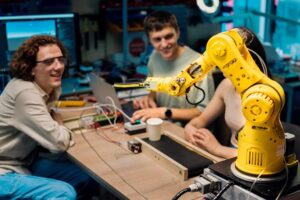

It was a campus placement interview at a mid-sized automation company in Pune. The student had a B.Tech in mechatronics, decent grades, and a long list of subjects on his transcript. The interviewer asked one question: “Have you ever programmed a robotic arm, even in simulation?” The answer was no. The interview was over in fifteen minutes.
This happens more often than most engineering colleges admit. India’s manufacturing and automation sector is hiring robotics engineers right now, with over 480 active industrial robotics job listings visible on LinkedIn and Glassdoor as of mid-2025. But the people getting those jobs are the ones who’ve done the work, not just studied the theory.
That’s the real reason robotic courses in India have been growing so fast. Not because robotics is trendy, but because the gap between a standard engineering degree and what companies actually need has become impossible to ignore.
Why is India’s job market for robotics moving faster than most people expect?
Manufacturing, logistics, healthcare, and agriculture in India are all adding automation faster than the available talent pool can keep up with. That’s not a future prediction. It’s the current reality.
Automation engineers and robotics integration specialists are consistently among the most in-demand roles in Indian manufacturing right now. The skills companies keep asking for include PLC programming, robot integration, sensor systems, and industrial automation tools. These are learnable skills. None of them requires a PhD. What they do require is structured, hands-on practice.
Most general engineering degrees don’t provide that. Four years of coursework in mechanics and electronics doesn’t translate automatically into knowing how to program an ABB or KUKA arm, configure a sensor network, or troubleshoot an automated cell on a live production floor. That’s what specialized robotic courses in India are designed to do.
What good robotics programs actually teach you versus what textbooks cover?
A robotics textbook will teach you kinematics equations. A good robotics program will make you apply those equations to move an actual robot arm and then fix it when the result doesn’t match what you expected.
That difference matters enormously. IIT Madras’s Interdisciplinary Dual Degree program in Robotics, for example, runs across five semesters and allocates 85 credits to project and internship work alone. The curriculum covers kinematics, control systems, AI and reinforcement learning, hardware systems, and field robotics in a sequence designed around building real capability.
IISc Bangalore’s Robotics: Basics and Selected Advanced Concepts program on SWAYAM covers direct and inverse kinematics, the Jacobian matrix, model-based control, mobile robots, and cable-driven micro-robots across 12 weeks, with hardware experiments and software simulations running alongside the theory.
IISc also offers a Certificate Programme in NextGen Robotics with AI through TimesPro, which goes into feedback control for nonlinear systems, reinforcement learning applications, and AI-driven robotic capabilities.
These are not introductory programs. They assume you’re serious and they treat you accordingly.
What to look for when comparing programs?
The number of robotic courses in India available today can make the choice genuinely confusing. Some are excellent. Some will take your money and give you a certificate that means nothing.
A few things that actually matter:
Hands-on access: Does the program give you time with actual hardware or industry-standard simulation environments like ROS? Reading about sensor integration is not the same as wiring one up and debugging the output.
Curriculum depth: Look at the syllabus carefully. Programs that cover kinematics, control theory, perception, and software together give you a more complete picture than those that stop at Arduino projects. There’s a place for beginner-level content, but if you’re aiming for an industry role, you need the next level.
Institution credibility: IITs, IISc, and BITS Pilani have established industry relationships that matter when you’re looking for internships or placements. An executive programme at IIT Delhi, for instance, combines theory and practical applications specifically for industry roles.
Project output: What do you leave with? A project you built and can explain in an interview carries more weight than a completion badge. L&T EduTech’s Fundamentals of Robotics and Industrial Automation, available through Coursera, is structured around practical application outcomes, which is why it appears consistently in industry training comparisons.
What skills actually get you hired in robotics roles?
Hiring managers in Indian automation and manufacturing companies tend to ask about the same set of skills across interviews. Based on current job listings and role requirements:
- PLC programming and industrial robot programming (RAPID, KRL, or similar manufacturer-specific languages)
- Robot kinematics and basic control systems
- Sensor integration and data handling
- ROS (Robot Operating System) for research or advanced roles
- Troubleshooting automated systems in real environments
The last one on that list is underrated. The ability to look at a robot that isn’t behaving correctly, isolate whether the problem is in the mechanical system, the sensor input, or the control logic, and then fix it without shutting everything down, is what separates someone with theoretical knowledge from someone who’s actually useful in a plant.
Robotic courses in India that include lab components, simulation exercises, and live fault-diagnosis scenarios build this skill. Classroom-only programs generally don’t.
Picking a path that matches where you actually are
Not everyone is starting from the same place, and the right program depends on your current level.
If you’re in your second or third year of an engineering degree, adding a SWAYAM or NPTEL robotics course alongside your studies builds the foundation you’ll need before applying for specialized programs later. IISc’s 12-week Swayam certification is accessible to active students and provides e-verified credentials.
If you’ve graduated and want to move quickly into industry roles, the IIT Delhi Executive Programme in Robotics and the IISc NextGen Robotics with AI program are worth the investment. Both are designed specifically for people trying to cross from education into professional practice.
If you’re exploring the field before committing to a specialization, platforms like IITM Pravartak’s digital skills portal offer introductory courses that cover enough ground to help you make a more informed decision.
The student who got the job
Back to that placement interview. Six months later, the same student enrolled in a structured robotics course in India that included simulation work with ROS and a project building a pick-and-place automation sequence. He went back to the same company for a lateral opening. Different interview, same interviewer.
This time, when asked if he’d ever programmed a robotic arm, he opened his phone and showed a video of his project running.
He got the offer.
Robotic courses in India aren’t a shortcut. They’re the work that most engineering programs skip, and most companies are desperate for someone to have already done. The gap is real. The people closing it are the ones getting hired.