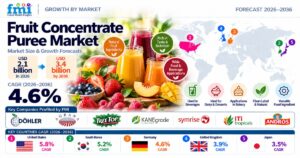

The global Fruit Concentrate Puree Market is valued at USD 2.1 billion in 2026 and is projected to reach USD 3.4 billion by 2036, expanding at a compound annual growth rate (CAGR) of 4.6% from 2026 to 2036, according to the latest market intelligence report published by Future Market Insights (FMI). Market growth is supported by rising demand for concentrated fruit ingredients, increasing interest in no-added-sugar formulations, and expanding applications across beverages, dairy, bakery, snacks, and other processed food categories.
Food and beverage manufacturers are increasingly using fruit concentrate purees to deliver intense fruit flavor, color, and body while reducing the amount of water transported and stored. Reformulation initiatives and changing labeling requirements are also influencing ingredient selection and creating opportunities for suppliers with reliable sourcing networks and strong application expertise.
Get detailed market forecasts, competitive benchmarking, and industry insights:
https://www.futuremarketinsights.com/reports/sample/rep-gb-102
Market Size & Growth Forecasts
- 2026 Estimated Market Size: USD 2.1 billion
- 2036 Projected Market Value: USD 3.4 billion
- Growth Rate:6% CAGR (2026–2036)
- Absolute Market Value Increase: USD 1.3 billion between 2026 and 2036
- Leading Fruit Family Segment: Exotic fruit, with a projected 28.5% share in 2026
- Leading Type Segment: No-added-sugar concentrates, accounting for 65.3% of type revenue in 2026
The market covers industrial sales of fruit concentrate purees within defined fruit-family and type categories. These products are made by removing part of the water from fruit or vegetable puree. The market definition excludes single-strength puree, fruit juice concentrate, not-from-concentrate (NFC) juice, fruit powders, frozen whole or cut fruit, and finished-product revenue.
Key Market Segments
By Fruit Family
- Exotic Fruit: Expected to capture 5% of the fruit-family category in 2026. Mango, passion fruit, pineapple, and guava profiles are supporting demand across beverage, dairy, and snack applications.
- Other Fruit Categories: Tomato, citrus fruit, orange, orchard fruit, berry fruit, apricot, and other fruit varieties provide additional opportunities for industrial ingredient suppliers.
Manufacturers value exotic fruit concentrates for their distinctive flavor and color intensity. Suppliers with dependable access to tropical fruit origins are positioned to serve customers seeking consistent ingredient specifications.
By Type
- No-Added-Sugar Concentrates: Projected to account for 3% of type revenue in 2026, supported by manufacturers seeking greater control over formulation and added-sugar labeling.
- With-Sugar Concentrates: Continue to serve applications where sweetness, flavor balance, and formulation requirements determine ingredient selection.
Sugar-reduction initiatives are influencing product development decisions across several markets. In the United Kingdom, draft legislation published by HM Revenue & Customs in July 2026 proposed reducing the Soft Drinks Industry Levy threshold from 5 grams to 4.5 grams of sugar per 100 milliliters from January 1, 2028, subject to parliamentary approval.
Country and Regional Growth Outlook
FMI projects varying growth rates across five profiled countries through 2036:
- United States: Expected to grow at a 8% CAGR, the fastest rate among the profiled countries, supported by formulation changes and growing attention to added-sugar reduction.
- South Korea: Forecast to expand at a 2% CAGR, with imported intermediate ingredients playing an important role in food processing.
- Germany: Projected to record a 6% CAGR, matching the global market growth rate amid demand for convenient and healthier food products.
- United Kingdom: Expected to grow at a 9% CAGR, with soft-drink labeling and sugar-levy policies influencing ingredient decisions.
- Japan: Forecast to advance at a 5% CAGR, reflecting measured demand across its established food-processing industry.
The report also covers North America, Latin America, Western Europe, Eastern Europe, East Asia, South Asia and Pacific, and the Middle East and Africa, encompassing more than 30 countries.
Major Market Trends and Growth Drivers
- Sugar Reduction and Reformulation: Food manufacturers are evaluating no-added-sugar concentrates to manage formulation requirements while retaining fruit flavor, color, and texture.
- Expanding Food and Beverage Applications: Demand from juices, smoothies, functional beverages, dairy products, bakery goods, snacks, and nutritional products is creating opportunities for concentrated fruit ingredients.
- Exotic Fruit and Premium Product Development: Mango, passion fruit, pineapple, and other distinctive fruit profiles support product differentiation, while organic and specialty varieties provide opportunities for premium positioning.
- Supply Chain Resilience: Weather-related crop variability and fluctuations in fruit prices can affect production costs and ingredient availability. Multi-origin sourcing, reliable supplier relationships, and consistent Brix specifications remain important considerations for buyers.
- Emerging Market Opportunities: Growth in processed food and beverage production across Asia-Pacific, Latin America, and parts of the Middle East offers additional avenues for market expansion.
Competitive Landscape
Competition in the Fruit Concentrate Puree Market centers on fruit sourcing, processing integration, portfolio breadth, formulation support, and geographic reach. Suppliers are working to maintain consistent ingredient quality while responding to customers’ technical requirements and changing product-development priorities.
Key Companies Profiled Include: Döhler Group, AGRANA Beteiligungs-AG, Tree Top, Kanegrade Limited, Symrise AG, iTi Tropicals, and Andros Group.
Recent developments demonstrate ongoing investment in sourcing and processing capabilities. Symrise AG completed major upgrades at its Pasaje, Ecuador, facility in June 2025. In September 2025, SVZ announced the integration of tropical fruit specialist Netra Agro into its portfolio, with the process expected to conclude in early 2026. AGRANA Beteiligungs-AG completed the acquisition of RWA’s 49.99% stake in AUSTRIA JUICE in October 2025.
These developments highlight the importance of sourcing networks, processing capabilities, and application expertise in serving industrial customers.
Analyst Perspective / Insight: “In my opinion, suppliers with several sourcing regions and application teams close to the customer will secure the next round of reformulation projects.” — Nandini Roy Choudhury, Principal Consultant, Future Market Insights
For detailed market forecasts, form and end-use segmentation, country-level growth rates and competitive analysis, read Future Market Insights :
https://www.futuremarketinsights.com/reports/global-fruit-concentrates-puree-market
About Future Market Insights (FMI)
Future Market Insights, Inc. (FMI) is an ESOMAR-certified, ISO 9001:2015 market research and consulting organization, trusted by Fortune 500 clients and global enterprises. With operations in the U.S., UK, India, and Dubai, FMI provides data-backed insights and strategic intelligence across 30+ industries and 1200 markets worldwide.
For Press & Corporate Inquiries
Rahul Singh AVP – Marketing and Growth Strategy
Future Market Insights, Inc.
+91 8600020075
For Sales: sales@futuremarketinsights.com
For Media: Rahul.singh@futuremarketinsights.com
For Web: https://www.futuremarketinsights.com/