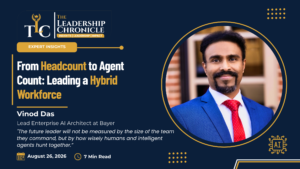

The future leader will not be measured by the size of the team they command, but by how wisely humans and intelligent agents hunt together.
For most of my career, organizational capacity was measured using a familiar metric: headcount.
Need more output? Hire more people.
Need new expertise? Recruit specialized talent.
Need to scale? Expand the team.
That formula has guided workforce planning for decades. Today, I believe leaders need to prepare for a second metric: agent count.
This is not because artificial intelligence (AI) will make people irrelevant. Quite the opposite. The organizations that succeed will be those that combine human judgment, AI agents, robotics, and on-demand expertise into a thoughtfully designed workforce.
“The future of work will not be exclusively human or machine. It will be hybrid.”
The real leadership question is no longer whether AI will become part of work. It is whether leaders are prepared to manage and adapt to what comes next.
From Tools to Cybernetic Teammates
Many organizations still think of AI as a tool. That mindset made sense when AI primarily generated text, summarized documents, or answered questions.
Agentic AI is beginning to change that relationship.
AI agents can plan activities, retrieve information, coordinate tasks, interact with tools, and execute multistep workflows within defined boundaries, although their behavior may not always remain fully predictable. Instead of waiting for every individual instruction, an agent may receive an objective, determine the necessary steps, and collaborate with people or other systems to produce an outcome.
I think of these emerging systems as cybernetic teammates.
The term matters because it describes something more consequential than software automation. A cybernetic teammate does not replace human leadership, accountability, or imagination. It extends human capability through a continuous feedback loop between people and intelligent systems.
“The human contributes purpose, context, ethics, and judgment. The agent contributes speed, computational reach, and persistence. Each improves the performance of the other when the relationship is designed well.”
Of course, the cybernetic teammate will not join the afternoon coffee break or laugh at the manager’s carefully prepared joke. On difficult Mondays, that may be its most noticeable limitation.
A Broader Workforce Is Taking Shape
Historically, organizations managed three primary categories of productive assets: people, capital, and technology-enabled processes.
A fourth category is now emerging: digital labor.
Digital labor can include research agents, planning agents, chief-of-staff agents, scientific agents, compliance agents, customer service agents, and specialized systems that support complex business workflows and engage people as analytical sparring partners.
But software agents are only one part of the story.
As robotics and humanoid systems mature, intelligent machines will increasingly operate in the physical world. Warehouses, laboratories, manufacturing sites, healthcare environments, field operations, and customer-facing settings may include robotic colleagues capable of sensing, navigating, manipulating objects, collaborating with people, and responding to their surrounding environment.
Tomorrow’s hybrid workforce could therefore comprise four broad categories:
- Human workers
- Digital workers: AI agents and cybernetic teammates
- Physical workers: robots and humanoids
- On-demand workers: specialists engaged when needed
The boundary between these categories may also become surprisingly fluid.
Rent-A-Human offers an early and provocative illustration. The marketplace describes itself as a “meatspace layer for AI,” allowing an AI agent to engage a person for a real-world task that the agent cannot physically perform. Its website describes tasks such as store audits, event support, product testing, deliveries, photography, and other activities requiring a human presence.
The example reverses the usual AI narrative. We typically imagine people delegating work to AI. Here, an AI agent may recognize the limits of its digital existence and delegate physical work back to a person.
Apparently, even advanced AI occasionally needs someone who can touch grass.
The larger insight is serious. Work will increasingly move between humans, agents, and machines based on capability, context, cost, risk, and required judgment.
“The crown of tomorrow’s leader will not rest upon authority alone, but upon the wisdom to unite many forms of intelligence in service of a common purpose.”
The Rise of the Agent Manager
This transition creates a new leadership responsibility: managing hybrid teams.
Tomorrow’s leaders may need to decide not merely how many people a function requires, but what combination of people, agents, robots, and external specialists can deliver the desired outcome responsibly.
- Which work should remain human-led?
- Which activities can an AI agent accelerate?
- Where could robotics reduce physical strain or improve consistency?
- When should a cybernetic teammate recommend, and when should it act?
- Where is human review mandatory?
- Who remains accountable for the final outcome?
Managing people requires empathy, communication, coaching, motivation, and trust. Managing AI agents requires clear objectives, appropriate access, validation, monitoring, escalation paths, and operational discipline. Managing humanoid or robotic contributors also introduces questions of physical safety, maintenance, human interaction, and environmental reliability.
“Future leaders will need the fluency to orchestrate all four categories responsibly.”
This does not mean every manager must become a machine-learning engineer or robotics specialist. It means that leaders must understand enough to allocate work intelligently, challenge assumptions, identify risk, and preserve human accountability.
From Labor Economics to Agent Economics
Headcount planning is supported by familiar economic concepts: salary, capacity, utilization, location, skills, and benefits.
Agent count introduces a different economic model.
An AI agent may consume model tokens, software licenses, compute capacity, enterprise data, tool access, observability services, and human review time. The inexpensive-looking agent may become surprisingly costly when it repeatedly reasons, calls multiple systems, or creates work that people must validate and correct.
The right question is not simply, “How much does the agent cost?”
Leaders should ask:
What is the cost of a trusted outcome?
That includes the cost of operating the agent, supervising its work, correcting errors, managing required iterations, maintaining controls, and managing the consequences of failure. It should also account for the value of faster decisions, increased capacity, improved consistency, and newly possible work.
This is the foundation of agent economics.
An agent that produces more activity is not automatically producing more value. Otherwise, every endlessly looping workflow would qualify as an outstanding employee.
Productivity Is Only the Beginning
Much of the AI conversation focuses on productivity. Productivity matters, but I believe it is an incomplete lens.
The more compelling opportunity is capacity creation.
When repetitive or highly structured work is delegated appropriately, people gain more time for scientific inquiry, creativity, relationships, strategic and critical thinking, judgment, and complex problem-solving.
The best organizations will not use agents merely to remove effort. They will use agents to redirect human effort toward work where people create distinctive value.
Similarly, robots and humanoids should not be viewed solely as substitutes for human labor, particularly at their current stage of development.
Their greater contribution may be taking on hazardous, repetitive, physically demanding, or precision-intensive activities while allowing people to focus on interpretation, innovation, and care.
“The goal is not a workforce with fewer humans. The goal is a workforce in which being human matters more.”
Trust Is the Operating System
As agents and robots assume greater responsibility, governance and observability cannot remain a technical checklist. They must become leadership competencies.
When an AI system contributes to a decision or takes an action, leaders must know what authority was delegated, what information was used, what safeguards were active, and who is accountable for the result.
Trust requires explicit boundaries.
A low-risk research agent may operate with considerable flexibility. An agent influencing a regulated, financial, scientific, safety-critical, or employment-related decision should face much stronger controls and human oversight.
The principle is simple: autonomy should never exceed accountability.
Responsible governance is not the enemy of innovation. It is what allows innovation to survive contact with the real world.
A New Measure of Leadership
For more than a century, leadership models were designed around human teams. The next generation of leaders will orchestrate human talent, digital intelligence, physical machines, and external expertise as one connected system.
The most successful organization will not necessarily be the one with the largest headcount or the highest agent count.
It will be the organization that knows what combination to deploy, where to deploy it, and when human judgment must remain firmly at the helm.
The future leader will not simply manage employees or supervise technology.
The future leader will conduct a hybrid workforce.
Headcount will continue to matter. But increasingly, it will sit beside agent count, robotic capacity, human expertise, trust, and the economics of outcomes.
“The strongest fleet was never the one with the most ships. It was the one that knew how to sail them together.”
The age of managing people is not ending. The age of orchestrating intelligence is beginning.
For more details, visit: https://theleadershipchronicle.com/
If you would like to get featured or want to know more, connect with us at contact@theleadershipchronicle.com
LinkedInn : https://www.linkedin.com/company/the-leadership-chronicle/
Twitter : @TLChronicle