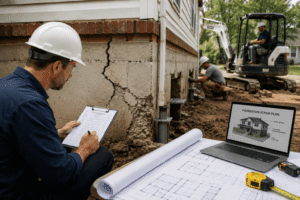

Sometimes a homeowner does not discover a foundation or structural problem while specifically looking for one.
It happens in the middle of another project.
A homeowner may be replacing flooring and find damaged subflooring. A contractor may open a wall during a renovation and discover deteriorated framing. Someone repairing a plumbing leak may notice unusual moisture beneath the house. What started as a fairly simple repair suddenly raises a much bigger question:
Is there a structural problem that needs to be addressed before the project can continue?
This situation is more common than many homeowners realize. Existing buildings can hide problems behind finished walls, beneath floors, or inside crawl spaces. In Alabama, moisture, heavy rainfall, changing weather conditions, and the age of many properties can add to the challenges of maintaining a home’s structural components.
Finding a problem does not necessarily mean the entire project needs to be stopped or that the home requires major reconstruction. It means the newly discovered condition needs to be understood before deciding what happens next.
Why Structural Problems Are Sometimes Discovered by Accident
Most homeowners see the finished surfaces of their property every day.
They see the floor, walls, ceilings, doors, and windows. They do not normally see the joists beneath the floor, framing inside the walls, beams in a crawl space, or the portions of the foundation below the structure.
A problem can therefore remain unnoticed until another project exposes it.
For example, removing old flooring may reveal:
- Soft or deteriorated subflooring
- Damaged floor joists
- Previous repairs
- Moisture staining
- Unexpected gaps or movement
Opening a wall may reveal damaged framing.
Working in a crawl space may reveal deteriorated supports or signs that moisture has been present for an extended period.
The discovery itself is not necessarily a sign of catastrophic failure. It is simply a reason to stop and understand what has been uncovered.
The First Step Is Not Always Repair
When something unexpected is found, the natural reaction is to fix it immediately.
That can sometimes be the wrong approach.
Before permanent work begins, the condition should be evaluated carefully.
A professional may want to understand:
- What material is damaged?
- How extensive is the damage?
- Is the problem isolated?
- Is there evidence of ongoing movement?
- Is moisture contributing to the condition?
- Has the area been repaired before?
- Does the damage affect a structural component?
- Could nearby components also be affected?
This information helps separate a localized repair from a larger structural concern.
Without that evaluation, there is a risk of repairing the visible problem while leaving the underlying cause untouched.
How One Problem Can Lead to Another
Buildings work as connected systems.
A moisture problem, for example, can affect wood components over time. A damaged support can influence the floor above it. Movement in one area can sometimes create cracks or gaps elsewhere.
That does not mean every building problem causes a chain reaction.
But it does mean the surrounding area deserves attention when a significant structural issue is discovered.
Consider a homeowner who finds a damaged floor joist while replacing flooring.
The immediate temptation may be to replace the joist and continue.
But what caused the damage?
If moisture entered the crawl space because of poor drainage or a plumbing leak, replacing the wood without addressing the moisture source may leave the property vulnerable to additional deterioration.
The repair needs to address both the damaged component and the conditions that contributed to the damage.
Alabama Weather Can Play a Role
Alabama homes experience conditions that can put stress on building materials over time.
Heavy rainfall can expose drainage weaknesses. Humidity can contribute to persistent moisture in enclosed areas. Storms can introduce water through damaged roofs or exterior openings.
Homes with crawl spaces can be particularly sensitive to moisture conditions beneath the living area.
These conditions do not automatically create structural problems, but they can contribute to deterioration when moisture remains unresolved.
That is why a structural repair discovered during another project may also lead to questions about drainage, leaks, ventilation, or other moisture sources.
What Happens When a Foundation Issue Is Suspected?
A foundation concern requires a different level of attention than a damaged finish.
A crack in a wall, uneven floor, or sticking door may have many possible explanations. Normal settlement, material movement, moisture, previous modifications, and other conditions can all play a role.
If the pattern suggests possible foundation movement, the property may need a more focused evaluation.
The assessment may consider:
- Foundation walls
- Slabs or footings
- Crawl space conditions
- Floor levels
- Drainage around the property
- Related wall or framing movement
- Previous foundation repairs
The goal is to understand whether there is meaningful movement or deterioration and what may be contributing to it.
Not every foundation crack means the foundation is failing. Context matters.
When structural adequacy or foundation performance is uncertain, an appropriately qualified structural professional may be needed.
Repairing the Structure Before Finishing the Project
Discovering structural damage in the middle of a renovation can be frustrating because the homeowner may already have materials ordered and workers scheduled.
However, continuing with cosmetic work before resolving a significant structural concern can create more problems.
Imagine installing new flooring over a floor system that has not yet been properly evaluated.
If structural repairs are later required, the new flooring may have to be removed again.
The same principle applies to drywall, cabinets, trim, tile, and other finished surfaces.
It is usually more practical to resolve important underlying problems before completing the finishes that depend on them.
Repair Does Not Always Mean Complete Replacement
Homeowners sometimes hear the words “structural damage” and immediately imagine a massive construction project.
That is not always the case.
Depending on the condition, repairs may involve:
- Reinforcing an existing component
- Replacing a localized section
- Repairing damaged framing
- Supporting or strengthening a floor system
- Replacing deteriorated wood
- Correcting moisture-related deterioration
- Addressing drainage or water-entry problems
The appropriate solution depends on the actual condition of the property.
Sound materials do not necessarily need to be removed simply because another nearby component is damaged.
A thoughtful repair plan should focus on the affected areas and the cause of the problem.
What Homeowners Should Ask When a Problem Is Found
When an unexpected condition appears during construction, homeowners should not be afraid to ask questions.
Useful questions include:
- What exactly was discovered?
- Is it cosmetic or structural?
- How extensive does the damage appear to be?
- What caused it?
- Could other areas be affected?
- Does moisture need to be addressed?
- Can the existing material be repaired or reinforced?
- Does the condition require further structural evaluation?
- Will the original project need to change?
- What work should happen before the finished surfaces are installed?
Clear answers can make an unexpected discovery much easier to manage.
A Real-World Example
Imagine a homeowner in Alabama planning to replace old flooring throughout part of the house.
During removal, several areas of the subfloor appear deteriorated. A closer inspection finds that one section of the floor system has also been affected by long-term moisture in the crawl space.
Instead of installing the new flooring immediately, the project is paused in that area.
The source of the moisture is investigated. The affected structural components are evaluated, and the necessary repairs are completed before the new floor is installed.
The homeowner may have faced an unexpected addition to the original project, but addressing the issue at that stage prevents the new flooring from being installed over an unresolved problem.
That is an important part of responsible construction: dealing with what the property actually needs rather than simply following the original plan.
Planning for the Unexpected
No inspection can reveal every condition hidden inside an existing building.
That is especially true when a property has undergone multiple renovations or repairs over the years.
Homeowners can make projects easier to manage by allowing some flexibility in their plans and understanding that unexpected discoveries do not necessarily mean something has gone terribly wrong.
The important thing is how those discoveries are handled.
A careful evaluation, clear communication, and a repair plan based on the property’s actual condition can help keep the project moving in the right direction.
Final Thoughts
Foundation and structural problems are not always discovered during a foundation inspection.
Sometimes they appear while replacing a floor, repairing a leak, remodeling a room, or working in a crawl space.
When that happens, the best response is not to panic or immediately cover the problem back up.
Take a step back.
Understand what was discovered, determine whether it is connected to a larger issue, identify any moisture or other contributing conditions, and decide what needs to be repaired before the project continues.
For Alabama property owners, this approach can help turn an unexpected discovery into a manageable repair decision—and ultimately help ensure that new improvements are built on a sound foundation.