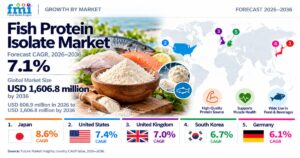

The global fish protein isolate market is projected to grow from USD 808.9 million in 2026 to USD 1,606.8 million by 2036, registering a compound annual growth rate (CAGR) of 7.1%, according to Future Market Insights (FMI). The market was valued at USD 755.3 million in 2025.
Get detailed market forecasts, competitive benchmarking, and pricing trends:
https://www.futuremarketinsights.com/reports/sample/rep-gb-11663
Fish protein isolate converts fish-derived protein into concentrated powder and liquid ingredients for use in formulated foods, beverages and nutrition products. Recovering protein from fish processing by-products offers processors an additional route to use materials that might otherwise enter lower-value applications.
Protein recovery creates opportunities beyond conventional seafood products
Fish processors and ingredient manufacturers are looking for ways to convert protein-rich processing streams into ingredients for human consumption. Concentrated fish protein can be incorporated into products such as protein bars, powders and selected fortified foods, giving manufacturers another ingredient option beyond conventional protein sources.
Powder is particularly important because it is easier to store, transport and incorporate into dry formulations. FMI projects powder to account for 97.6% of the form category in 2026, while food and beverages is expected to represent 45.6% of end-use industry demand.
Where growth is fastest
FMI’s country forecasts indicate that Japan will record the fastest growth among the five profiled markets between 2026 and 2036.
- Japan — 8.6% CAGR: Demand for convenient protein ingredients provides opportunities for powders used in bars, mixes and fortified foods. The Japan Fisheries Agency reported in June 2025 that edible fish and shellfish consumption was 21.4 kg per person in fiscal 2023.
- United States — 7.4% CAGR: A substantial seafood import base and established food manufacturing sector support opportunities for marine protein ingredients. Allergen labeling and species documentation remain important considerations for food manufacturers.
- United Kingdom — 7.0% CAGR: Significant seafood landings and international fish trade create potential sources of processing by-products. Raw-material prices and changing species availability can affect ingredient supply.
- South Korea — 6.7% CAGR: Greater value recovery from available seafood materials offers opportunities for marine protein processing. Raw-material freshness and controlled production remain important.
- Germany — 6.1% CAGR: Food and dietary supplement manufacturing provides potential applications for concentrated protein ingredients, while imported raw materials and product specifications influence sourcing decisions.
What leads the market
FMI identifies two leading segments in the fish protein isolate market for 2026.
- Powder — 97.6% of form demand: Longer storage life, efficient bulk handling and compatibility with dry formulations support the segment’s dominant position.
- Food and beverages — 45.6% of end-use industry demand: Protein fortification across bars, powders and selected formulated foods supports demand for concentrated ingredients.
Liquid formats and other end-use industries, including sports nutrition and dietary supplements, pharmaceuticals, and cosmetic and personal care products, represent additional areas covered by the report.
The hurdle: sensory quality and allergen documentation
Taste and odor remain significant formulation challenges for fish protein isolate. Protein hydrolysis can produce bitter peptides, while delayed handling of raw materials can contribute to undesirable marine odors. Variation in sensory properties may require additional testing and formulation adjustments before a product can be approved for commercial use.
Allergen documentation adds another requirement. On January 6, 2025, the US Food and Drug Administration (FDA) published guidance materials covering allergens, food safety and labeling of plant-based alternatives. Fish is among the major food allergens subject to applicable US labeling requirements.
Recent developments and industry investment
Recent developments in marine protein processing and food formulation illustrate activity across production capacity and human-nutrition applications.
- February 21, 2025: Hofseth BioCare ASA and Symrise announced a strategic partnership involving a second enzymatic hydrolysis plant at Berkåk, Norway. The planned expansion was intended to triple Hofseth BioCare’s production capacity.
- July 30, 2025: Symrise reported changes to its Aqua Feed business, including the sale of its Costa Rica site and closure of its Ecuador site. The business had worked with marine by-products, including materials from tilapia, tuna and shrimp.
- December 19, 2024: A study published in Food Science & Nutrition examined protein bars formulated with blue-whiting fish protein hydrolysate. The research demonstrated an application route for fish-derived protein, while sensory balance remained an important consideration.
FMI profiles the following companies among the notable participants in the market: Omega Protein Corporation, Hofseth BioCare ASA, Bio-Marine Ingredients Ireland Ltd., Bio-Oregon Protein, Copalis Sea Solutions, Colpex International, Janatha Fish Meal & Oil Products, Scanbio Marine Group and TripleNine Group A/S.
The competitive field includes ingredient specialists, marine hydrolysate producers and broader fish-processing businesses. Their capabilities differ, so buyers should distinguish direct fish protein isolate offerings from adjacent products such as conventional fishmeal, fish oil and other marine protein ingredients.
Analyst perspective
“Fish protein isolate will receive wider use when manufacturers are able to maintain similar taste and protein quality in every production batch. In my experience, increasing availability of controlled powder grades will support its application in food and nutrition products.” — Nandini Roy Choudhury, Principal Consultant, Future Market Insights.
What this means for food manufacturers and ingredient buyers
- Qualify suppliers on sensory consistency as well as protein specifications. Evaluate taste, odor, protein content and batch-to-batch variation in the intended finished product. Laboratory specifications alone may not reveal whether an ingredient will meet consumer acceptance requirements.
- Verify raw-material traceability and allergen documentation before approval. Confirm fish species, sourcing records, handling controls and labeling requirements for the intended market. Build these checks into supplier qualification rather than leaving them until commercial production.
- Compare ingredient economics with the full formulation process. Assess storage, transport, blending, processing and any additional work required to manage taste or odor. For processors recovering protein from by-products, evaluate whether raw-material quality and production consistency support the intended application.
For detailed market forecasts, form and end-use segmentation, country-level growth rates and competitive analysis, read Future Market Insights’ Fish Protein Isolate Market Report:
https://www.futuremarketinsights.com/reports/fish-protein-isolate-market
About Future Market Insights (FMI)
Future Market Insights, Inc. (FMI) is an ESOMAR-certified, ISO 9001:2015 market research and consulting organization, trusted by Fortune 500 clients and global enterprises. With operations in the U.S., UK, India, and Dubai, FMI provides data-backed insights and strategic intelligence across 30+ industries and 1200 markets worldwide.
For Press & Corporate Inquiries
Rahul Singh AVP – Marketing and Growth Strategy
Future Market Insights, Inc.
+91 8600020075
For Sales: sales@futuremarketinsights.com
For Media: Rahul.singh@futuremarketinsights.com
For Web: https://www.futuremarketinsights.com/