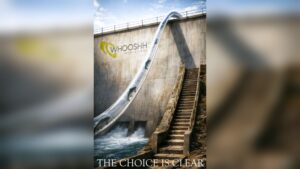

The conventional framing of the fish passage problem at hydroelectric facilities treats it as a compliance cost. Build or maintain a passage structure because regulations require it. Accept the water diversion, the construction expense, and the ongoing maintenance as the cost of operating the dam.
At Whooshh Innovations, we’ve spent over a decade building the case for a different framing. Fish passage hydropower production are not competing goals that have to be traded off against each other. They’re both improved when the passage infrastructure is designed with both in mind from the start.
The problem with the compliance-cost framing isn’t that it’s wrong. It accurately describes the financial relationship between conventional passage infrastructure and hydropower revenue. Fish ladders divert water that could otherwise be generating electricity. That diversion is real. But the framing stops at the wrong place. It accepts the water diversion as a fixed feature of the passage problem rather than asking whether a different passage approach could reduce or eliminate it.
Where Does the Water Diversion Problem Come From?
Conventional fish ladders rely on continuous water flow through a series of stepped pools to create the upstream gradient fish swim through. The water comes from the headpond, diverted through the ladder and returned to the tailrace below the dam. That diverted water is not generating power. At a facility producing hundreds of megawatts, even a modest diversion represents measurable lost generation.
The water volume required scales with dam height and fish species requirements. Taller dams need longer ladders with more pools. Higher ladder discharge requirements mean more water diverted. The compliance cost grows with the engineering requirement in a way that makes high-head dam passage particularly expensive from both a capital and an operational revenue standpoint.
How Does the PassagePortal Model F Change That Relationship?
The PassagePortal attracts fish using tailrace water drawn from below the dam, not headpond water from above it. The fish transport itself uses differential air pressure, approximately 1 PSI, through MigratorTubes rather than a water-filled channel. The volume of water diverted from power generation is therefore a small fraction of what a conventional ladder requires.
Here’s what that means in practice for a hydroelectric operator:
- Up to 10% more of the river’s flow available for power generation compared to conventional ladder alternatives
- No sedimentation in passage channels that requires periodic shutdown and removal
- No water-dependent mechanical components that degrade with flow variation
- Autonomous 24/7 operation that doesn’t require operator presence to maintain passage flow conditions
- Deployment in days rather than the years a civil construction project requires, allowing faster compliance milestone achievement
The U.S. Department of Energy and the National Hydropower Association have both recognized Whooshh’s approach for its contribution to making hydropower and fish passage more economically compatible. That recognition reflects the actual measurement of generation improvement at deployed facilities, not a theoretical projection.
What About the Licensing Data Requirement?
This is the dimension of fish passage hydropower production that the conventional compliance-cost framing most consistently overlooks. Regulatory licensing frameworks are not static. FERC relicensing processes, DFO reviews in Canada, and equivalent bodies in Europe are all moving toward more rigorous data requirements for fish passage compliance. The expectation that a facility operator can satisfy passage requirements with an estimated count derived from periodic manual sampling is becoming less tenable.
The FishL Recognition system embedded in Whooshh’s PassagePortal generates a verified, image-backed record of every fish that passes the facility, automatically, in near-real time. For a dam operator facing a relicensing review, that’s a fundamentally different compliance position than one whose passage record consists of technician sampling notes from a twice-daily observation window.
The automated data record also removes the estimation error that manual monitoring programs introduce. Disputed fish counts between operators and regulators become harder to sustain when the record is a timestamped image of every individual fish rather than an extrapolation from a sample.
How Does Selective Passage Protect the Operator’s Long-Term Position?
Conventional passage structures pass all fish indiscriminately. They’re legally required to facilitate passage for native species. They also facilitate passage for invasive species, whether intended or not. As invasive species establish themselves in upstream habitats via passage structures, the downstream regulatory consequence is additional conservation compliance requirements that generate new costs for the operator.
The PassagePortal’s FishL and GateKeeper system routes target native species upstream and diverts non-native species downstream. Over time, this reduces invasive species pressure in upstream reaches, which reduces the regulatory exposure that invasive dispersal creates. That’s a long-term risk management benefit that a conventional ladder cannot provide.
Explore the full Whooshh product range and see how fish passage and hydropower economics connect at deployed facilities. The published blog Unlocking Hidden Hydropower goes deeper on the generation benefit side of this equation. The fish passage solutions page covers the technical side. For a facility-specific analysis, contact our team.