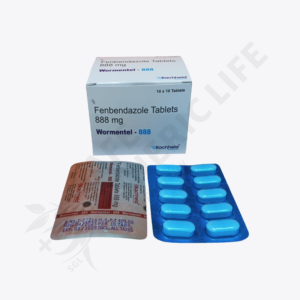

What exactly is Fenbendazole 888, and why has a veterinary dewormer become the subject of so much online curiosity? That question is worth asking before accepting either the enthusiastic claims or the outright dismissals surrounding this product. Fenbendazole is a benzimidazole-class antiparasitic drug used in veterinary medicine. Products containing fenbendazole are approved for particular animals and parasite infections, with official labels specifying the species, indications, dosage, and treatment duration. The FDA’s current animal-drug records include multiple approved fenbendazole products, while veterinary labels make clear that these medicines are intended for animal use rather than as general-purpose human medications.
The number 888 is where some of the confusion begins. People searching for “Fenbendazole 888” may assume that the number represents a standardized medical strength, but a product name or online listing does not automatically establish what the number means. It could refer to a seller’s product designation, packaging, formulation, or another marketing identifier. Unless the label clearly identifies the active ingredient concentration and intended species, there is no sensible way to determine what “888” means simply from the name. That is an important distinction because fenbendazole products can come in different formulations and concentrations. Treating a number in an online product name as though it were a universally recognized dosage could encourage unsafe self-treatment.
Why has fenbendazole attracted so much attention?
The recent interest is not really about deworming alone. Much of the online discussion comes from the question of whether fenbendazole might have effects beyond parasite control, particularly against cancer. Laboratory research has produced findings that have made the subject interesting to researchers. Experimental studies have explored mechanisms involving cellular metabolism, microtubules, glucose uptake, oxidative stress, and programmed cell death. A scientific review has discussed these biological findings while also emphasizing that important questions about human pharmacokinetics, safety, dosing, and effectiveness remain unresolved.
That distinction between interesting laboratory research and proven medical treatment is easy to lose online. A compound can affect cancer cells in a laboratory without becoming an effective cancer medicine. Researchers have to establish whether an appropriate concentration can safely reach the relevant tissues in people, whether the treatment actually improves meaningful outcomes, what adverse effects occur, and how the compound interacts with existing therapies. Until those questions are answered through appropriate human research, laboratory observations remain a reason to investigate—not a reason to declare a cure.
This is also why dramatic personal stories deserve careful interpretation. A person may report improvement after taking fenbendazole, but an individual experience cannot establish that fenbendazole caused the improvement. Cancer patients may receive surgery, radiation, immunotherapy, chemotherapy, targeted therapy, or several treatments simultaneously. The American Cancer Society has highlighted this problem when discussing online fenbendazole cancer stories: some people who reported improvement were receiving established cancer treatments at the same time.
Does Fenbendazole 888 treat cancer?
There is currently no good reason to describe Fenbendazole 888 as a proven cancer treatment for humans. Fenbendazole is a veterinary medicine, and it has not been approved by the FDA for human cancer treatment. The American Cancer Society states that fenbendazole has not been tested adequately in human studies to establish whether it is safe or effective for people.
There has been some scientific interest in the compound, but interest should not be confused with clinical proof. Even a published case report can only provide a starting point for further investigation. In fact, one widely discussed 2025 case series involving three people who self-administered fenbendazole was subsequently accompanied by a formal retraction statement in 2026. That episode is a useful reminder of why individual reports need to be evaluated alongside the broader scientific record rather than treated as definitive evidence.
For someone dealing with cancer, this difference matters enormously. Replacing an established treatment with an unproven veterinary drug could mean losing valuable time. It is reasonable to ask a cancer specialist about experimental therapies and clinical trials, but it is very different from assuming that an internet-promoted product has already been proven effective.
What about using fenbendazole for animals?
This is where fenbendazole has a much clearer role. Veterinary products containing fenbendazole are used against particular parasitic infections in animals. For example, FDA information describes approved canine uses against parasites including roundworms, hookworms, whipworms, and certain tapeworms. The labeled canine regimen cited by the FDA is 50 mg/kg for three consecutive days for the listed indications.
However, that does not mean every fenbendazole product can be used interchangeably, or that a higher-numbered product should automatically be considered stronger or better. Veterinary treatment depends on the animal’s species, weight, parasite, formulation, and circumstances. A veterinarian may also use a medicine differently in particular cases, but that decision requires professional judgment rather than copying a regimen from an online forum.
There is another underappreciated issue: longer treatment is not automatically safer or more effective. The FDA has reported cases of bone marrow hypoplasia or pancytopenia in dogs receiving fenbendazole beyond the labeled duration. Twelve such canine reports had been received by October 2023, with treatment lasting between five and fourteen days. The agency specifically warned veterinary professionals about the association with extra-label use.
That finding gives the Fenbendazole 888 discussion a more practical angle. Instead of asking only, “Does it work?”, responsible use also requires asking, “For which animal, against which parasite, in what formulation, for how long, and under whose supervision?”
Is a bigger number necessarily a better product?
No. This is one of the easiest assumptions to make when browsing online. A number attached to a product name can create the impression that a higher figure means greater effectiveness. Medication does not work that way.
The meaningful information is the actual active ingredient concentration, dosage form, intended species, approved indication, and directions on the legitimate product label. For example, official fenbendazole labels describe products in concentrations such as 10% suspension and 22.2% granules, while individual products have specific directions for particular animals.
So anyone researching Fenbendazole 888 should look beyond the product title. Check the active ingredient, manufacturer, concentration, intended species, registration information, and complete labeling. If those details are missing or vague, that uncertainty itself is a reason to stop and investigate further.
What should buyers be careful about?
Online marketplaces can make veterinary medicines look surprisingly similar to human supplements. Attractive packaging, confident testimonials, and phrases such as “research use” or “natural alternative” can create an impression of legitimacy that the underlying evidence does not support. The safest approach is to treat the label as important evidence, not the marketing language surrounding it.
A few practical questions can help:
- Is the product clearly labeled for the intended animal species?
- Does the package identify the concentration and active ingredient?
- Is there reliable manufacturer and regulatory information?
- Is the proposed use consistent with veterinary guidance?
- Are online claims being presented as evidence when they are actually testimonials?
There is also the issue of parasite resistance. Official fenbendazole labeling warns that resistance to dewormers can develop and recommends diagnostic testing and monitoring where appropriate. That means repeatedly giving a dewormer without confirming whether treatment is needed may not be a sensible long-term parasite-control strategy.
So, what should you make of Fenbendazole 888?
Perhaps the most honest conclusion is also the least sensational: Fenbendazole is a legitimate veterinary antiparasitic, but “Fenbendazole 888” should not automatically be treated as a standardized human medicine or a proven cancer therapy.
The interesting science deserves attention, but it also deserves boundaries. Researchers can investigate a drug because laboratory findings suggest something potentially useful. Patients can ask doctors about emerging research. Veterinarians can use approved fenbendazole products when they are appropriate for an animal and its parasite problem. None of those facts turns an unverified online claim into established medicine.
For pet owners, the sensible question is whether fenbendazole is appropriate for a particular animal and confirmed or suspected parasite. For people searching because of cancer claims, the more important question is whether credible human evidence demonstrates safety and effectiveness. At present, that evidence is not strong enough to support using veterinary fenbendazole as a substitute for established cancer care.
That may make Fenbendazole 888 less mysterious than social media suggests—but arguably more interesting. The real story is not whether a dramatic number on a package signals a hidden breakthrough. It is how quickly preliminary science, veterinary medicine, online testimonials, and marketing can become mixed together. Separating those pieces is the best way to understand what fenbendazole actually is, what researchers are investigating, and where the evidence still falls short.
For More Information visit here: Safegenericlife