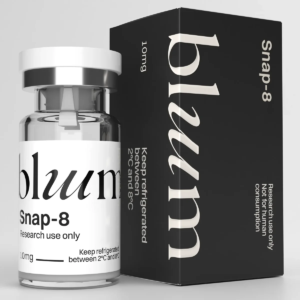

The regulation of synaptic neurotransmission at the neuromuscular junction (NMJ) is a primary focus of modern neuropharmacology, dermatology, and cell biology. Central to presynaptic exocytosis is the Soluble $N$-Ethylmaleimide-Sensitive Factor Attachment Protein Receptor (SNARE) complex.
This multiprotein scaffold coordinates the docking and fusion of acetylcholine-containing vesicles with the presynaptic axon membrane. When SNARE assembly is disrupted, vesicular exocytosis stalls, preventing the release of acetylcholine into the synaptic cleft and attenuating post-synaptic muscular contraction.
Historically, modulating this pathway meant relying on biological neurotoxins that permanently cleave core SNARE proteins. However, advances in rational peptide design have introduced synthetic mimetics capable of modulating this system reversibly and non-cytotoxically.
Evaluating the biophysical differences between permanent enzymatic cleavage and competitive octapeptide inhibition using the SNAP 8 peptide highlights key operational considerations for research laboratories studying synaptic mechanics.
1. Presynaptic Fusion Mechanics of the SNARE Core Complex
To understand how neurotransmitter release is attenuated, one must first look at the structural assembly of the functional SNARE core complex:
The functional core consists of a parallel four-helix bundle comprised of three essential proteins:
-
Synaptobrevin-2 (VAMP-2): A vesicle-bound transmembrane protein (v-SNARE).
-
Syntaxin-1A: A plasma-membrane-bound protein (t-SNARE).
-
SNAP-25: A membrane-anchored protein (t-SNARE) that contributes two distinct $alpha$-helices to the bundle.
When an action potential opens presynaptic voltage-gated calcium channels, $text{Ca}^{2+}$ influx triggers these four helices to coil tightly around each other. This mechanical “zippering” pulls the vesicle membrane against the presynaptic plasma membrane, creating a fusion pore through which acetylcholine exits into the synaptic cleft.
2. Molecular Mechanisms: Enzymatic Cleavage vs. Competitive Inhibition
The functional differences between bacterial neurotoxins (such as Botulinum Neurotoxin Type A, or BoNT/A) and synthetic octapeptide mimetics stem from their distinct molecular mechanisms of action:
Irreversible Enzymatic Cleavage (BoNT/A)
Botulinum Neurotoxin Type A functions as a zinc-dependent endopeptidase. Upon entering the presynaptic cytosol via receptor-mediated endocytosis, its light chain targets native SNAP-25, cleaving nine amino acid residues from the C-terminal end.
This cleavage prevents SNAP-25 from forming a stable four-helix bundle with Syntaxin-1A and VAMP-2. Because the protein is permanently damaged, synaptic recovery requires neuronal sprout growth and new protein synthesis, lasting 90 to 120 days.
Reversible Competitive Inhibition via SNAP 8 Peptide
The SNAP 8 peptide (Acetyl-Octapeptide-3, sequence: Ac-Glu-Glu-Met-Gln-Arg-Arg-Ala-Asp-$text{NH}_2$) takes a non-enzymatic approach. It is structurally engineered to mimic the N-terminal end of SNAP-25:
-
Competitive Occupancy: The synthetic octapeptide competes directly with native SNAP-25 for binding slots along the Syntaxin-1A and VAMP-2 assembly surfaces.
-
Bundle Instability: When the octapeptide incorporates into the nascent SNARE complex, it forms a structurally incomplete bundle that cannot generate the mechanical force required for membrane fusion.
-
Reversible Equilibrium: Unlike endopeptidases, the octapeptide does not alter or destroy native proteins. It establishes a dynamic equilibrium; as the peptide concentrations diminish over time, native SNAP-25 seamlessly resumes its role in four-helix bundle formation, restoring baseline exocytosis without causing structural nerve damage.
3. Comparative Operational and Safety Metrics
Evaluating these two modalities across key laboratory and biological parameters highlights why reversible mimetics are widely used in topical research and cell culture models:
| Parameter / Dimension | Enzymatic Neurotoxin (BoNT/A) | SNAP 8 Peptide Mimetic | Experimental & Practical Considerations |
| Primary Mechanism | Endopeptidase cleavage of SNAP-25 | Competitive displacement of SNAP-25 | Reversible octapeptide avoids irreversible protein damage. |
| Duration of Effect | Prolonged ($90 – 120text{ days}$) | Dose-dependent and transient | Allows precise, step-by-step control over inhibition timelines. |
| Cytotoxicity & Safety | High systemic toxicity; strict regulatory control | Non-cytotoxic; high biocompatibility | Eliminates biohazard risks and complex regulatory tracking. |
| Cellular Entry Requirements | SV2 receptor & ganglioside binding | Direct competitive peptide binding | Suitable for cell-free assembly and cell culture models. |
| Thermal & Storage Stability | Highly labile; sensitive to heat/agitation | High stability as a synthetic powder | Simple storage and reconstitution conditions for routine lab work. |
4. Analytical Quality Metrics for Research Sourcing
Because short synthetic octapeptides are produced via Solid-Phase Peptide Synthesis (SPPS), ensuring sequence fidelity, correct end-capping (N-terminal acetylation and C-terminal amidation), and high purity is essential for reproducible binding assays.
5. Summary and Practical Takeaways
Comparing SNARE complex modulation strategies demonstrates the distinct advantages of competitive inhibition over permanent endopeptidase cleavage. Irreversible neurotoxins completely disable synaptic machinery via enzymatic cleavage, whereas the SNAP 8 peptide provides a controlled, reversible alternative by competing with native SNAP-25 for SNARE bundle assembly.
For research laboratories studying synaptic exocytosis, cell-based neurotransmitter release, or topical cosmetic formulations, utilizing high-purity, analytically verified octapeptide lots ($ge 98%$ purity, verified ESI-MS mass, and low residual TFA) ensures reliable, publication-grade results without the toxicity risks associated with bacterial endopeptidases.