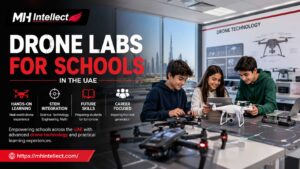

Imagine a classroom where students are not simply reading about flight, physics, or programming but are designing a drone mission, testing flight paths, analysing sensor data, and working together to solve a real challenge. One group may focus on the drone’s movement, another on coding, while another studies how wind or weight affects performance. When the drone does not behave as expected, students investigate the problem, adjust their approach, and try again. This type of experience turns abstract STEM concepts into something students can see, test, and improve.
This is why Drone education is becoming an increasingly interesting learning opportunity for schools. A drone is not simply a flying device; it can become a learning platform connecting science, technology, engineering, mathematics, coding, electronics, data, and problem-solving. For UAE schools looking to make STEM learning more practical and connected to emerging technologies, a well-planned drone lab can provide students with an engaging environment to explore these disciplines together.
What Is a Drone Lab for Schools?
A drone lab is a structured educational environment where students learn about drones through guided activities, experiments, projects, and challenges. Rather than focusing only on flying, students can explore the technology behind unmanned aerial systems and understand how different components work together.
A well-designed drone learning environment can introduce students to concepts such as flight principles, sensors, navigation, programming, electronics, data collection, and engineering design. Activities can be adjusted according to age and experience, allowing younger students to explore basic concepts while older learners work on increasingly complex projects.
Why STEM Drone Learning Matters
STEM drone learning brings several subjects together through one practical technology. Students can use mathematics to calculate distance and movement, physics to understand lift and motion, coding to control behaviour, and engineering principles to design or improve systems.
This interdisciplinary approach can make learning more meaningful because students can immediately see how classroom concepts work in practice. Instead of studying a concept in isolation, they can apply it to a project with a clear objective.
The learning process can also encourage students to experiment. A flight may not follow the expected path, a sensor may produce unexpected data, or a programmed response may fail. These situations create opportunities for students to troubleshoot, evaluate evidence, and improve their designs.
How Drone Technology in Schools Can Support Different Subjects
Drone technology in schools can be connected with a wide range of learning activities. In physics, students can investigate forces, motion, stability, and aerodynamics. Mathematics can be applied through measurements, coordinates, distance calculations, and data analysis. Coding activities can introduce programming logic, automation, and sensor-based responses.
Engineering projects can challenge students to think about design, weight, structure, energy, and performance. Environmental projects can use drones and sensors as examples for exploring mapping, monitoring, sustainability, and data collection.
The key is to make the drone a tool for learning rather than the entire lesson. Students should understand the concepts behind the technology and be encouraged to explain their decisions.
What Students Can Learn Through Drone Projects
Practical drone projects can help students develop:
- Problem-solving and troubleshooting skills
- Coding and programming confidence
- Understanding of flight and engineering principles
- Data collection and analysis skills
- Teamwork and communication
- Design and testing abilities
- Awareness of emerging technology and career pathways
These skills can extend beyond drone activities and support learning in robotics, engineering, AI, IoT, and other technology-focused fields.
Creating a Meaningful Drone Learning Programme
Introducing drones into a school requires more than purchasing equipment. Schools should consider curriculum connections, student safety, teacher preparation, appropriate learning spaces, project progression, and clear educational outcomes.
Younger learners might begin with simple flight concepts, sequencing, observation, and guided challenges. Middle school students can progress into coding, sensors, navigation, and engineering design. Secondary students can explore advanced programming, autonomous systems, data analysis, mapping, and industry-related applications.
This progression helps students build knowledge gradually instead of treating drone activities as isolated demonstrations.
Drone Learning and the Future of STEM
Drones are increasingly associated with applications such as surveying, logistics, environmental monitoring, agriculture, infrastructure inspection, and emergency response. Introducing students to the underlying principles at school can help them understand how emerging technologies are being applied to real-world problems.
For schools, drone learning can therefore complement a wider STEM strategy that includes robotics, coding, AI, engineering, electronics, and project-based learning.
How MH Intellect Supports Future-Ready Learning
MH Intellect helps schools create practical STEM learning experiences that connect students with emerging technologies through structured programmes and hands-on projects. Drone education can form part of a broader learning pathway that develops technical understanding, creativity, collaboration, and problem-solving.
Schools and educators can also explore the Student Gallery to see examples of students engaging with practical, technology-focused learning experiences.
Final Thoughts
Drone labs can give students an engaging way to connect science, technology, engineering, mathematics, coding, and data with real-world applications. The strongest programmes go beyond simply teaching students how to operate a drone. They encourage learners to understand how systems work, investigate problems, test solutions, and improve their ideas.
For UAE schools seeking practical ways to strengthen STEM learning, drone education can provide a powerful bridge between classroom concepts and the technologies shaping future industries.
Ready to Introduce Drone Learning at Your School?
If your school is exploring a structured drone learning programme, book a consultation with MH Intellect to discuss drone education, STEM projects, robotics, coding, and future-ready learning solutions tailored to your school’s goals.