
Businesses today have access to more digital marketing channels than ever before. Search engines, social media, email, paid advertising, content marketing, analytics, automation, and conversion optimization can all contribute to business growth. Yet having access to these channels does not automatically create a successful growth strategy.
This is why businesses increasingly evaluate whether they need a specialized digital growth agency or a full stack marketing agency. Although the terms are sometimes used interchangeably, they can represent different approaches to digital marketing.
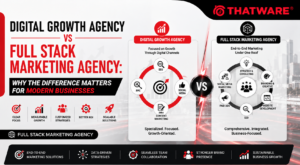
A digital growth agency typically focuses on measurable business growth, experimentation, acquisition, conversion, retention, and scalable marketing systems. A full stack marketing agency, meanwhile, may provide a broader range of marketing services across the entire customer journey. Understanding the distinction can help businesses choose the right partner for their goals, budget, resources, and stage of growth.
What Is a Digital Growth Agency?
A digital growth agency is generally focused on improving measurable business outcomes through coordinated digital strategies. Instead of treating SEO, paid advertising, content, analytics, and conversion optimization as completely separate services, a growth-focused agency looks at how these activities interact.
For example, a company may receive substantial organic traffic but generate relatively few leads. A growth-oriented strategy would investigate the entire journey, from the search query and landing page to the call-to-action, form experience, follow-up process, and eventual conversion. The objective is not simply to generate traffic. It is to create a system that turns relevant attention into measurable business results.
This approach can be particularly valuable for startups, SaaS companies, ecommerce brands, professional service businesses, and established companies looking to accelerate digital acquisition.
What Is a Full Stack Marketing Agency?
A full stack marketing agency typically offers a wide range of marketing capabilities under one roof. The term “full stack” suggests coverage across multiple parts of the marketing ecosystem. Depending on the agency, this can include search engine optimization, content marketing, social media, paid advertising, branding, web development, email marketing, analytics, public relations, and creative services.
The advantage is convenience. Instead of coordinating multiple specialized vendors, a company can potentially manage several marketing requirements through one partner. For a business preparing a major digital launch, for example, a full stack marketing agency may be able to support website development, content creation, SEO, paid campaigns, social media, and analytics within one broader engagement.
However, breadth does not automatically mean depth. Businesses should evaluate whether an agency has demonstrated expertise in the specific channels and industries that matter most to their growth.
Digital Growth Agency vs Full Stack Marketing Agency
The distinction becomes clearer when looking at the underlying objectives. A digital growth agency generally starts with a business growth problem and determines which marketing channels and experiments can help solve it.
A full stack marketing agency often starts with a broader set of marketing capabilities and applies the most relevant services to the client’s requirements. Neither model is universally better.
A company that needs comprehensive marketing support may benefit from a full stack partner. A company primarily focused on scalable customer acquisition, conversion improvement, and measurable growth may prefer a growth-oriented agency. The right choice depends on what the business is actually trying to accomplish.
Why Measurement Matters More Than Marketing Activity
One of the biggest challenges in digital marketing is confusing activity with progress. Publishing dozens of articles, launching advertising campaigns, increasing social media posts, or generating thousands of website visits may sound impressive, but these activities do not necessarily translate into revenue.
A growth-focused digital growth agency evaluates marketing through measurable outcomes. Important indicators can include qualified leads, customer acquisition cost, conversion rate, revenue generated from digital channels, customer lifetime value, organic visibility, and return on advertising spend.
Consider an ecommerce company that increases website traffic by 50% but sees almost no increase in sales. Simply increasing traffic further may not solve the problem. The business might instead need better product pages, stronger calls-to-action, improved checkout usability, better audience targeting, or more relevant acquisition channels. Growth marketing examines these relationships instead of treating traffic as the final objective.
The Importance of a Full-Funnel Strategy
Modern customers rarely move from first exposure to purchase in a single step. A potential customer may discover a brand through search, read an article, watch a video, compare alternatives, revisit the website through an advertisement, subscribe to an email list, and finally make a purchase weeks later. A full stack marketing agency can coordinate multiple channels across this journey.
For example, SEO can capture users with existing search intent, content can educate prospects, paid media can support remarketing, email can nurture leads, and conversion optimization can improve the final experience.
The advantage of this integrated model is that businesses can reduce fragmentation between marketing activities. However, integration works best when every channel has a clear role and performance measurement connects activities to business objectives.
Technology and Data in Modern Growth Marketing
Technology has changed how marketing strategies are developed and measured. Analytics platforms, customer relationship management systems, marketing automation, AI-powered tools, conversion tracking, and search data can provide insights into customer behavior.
A modern digital growth agency can use these signals to identify opportunities and continuously test improvements.
For example, analytics may reveal that visitors from organic search convert at a higher rate than visitors from a particular paid campaign. That insight could influence budget allocation.
Similarly, search data may reveal growing demand around a topic that competitors have not adequately covered. A business can create content early and build topical authority before the opportunity becomes highly competitive. Data does not replace strategic thinking. It helps make strategic decisions more informed.
Where ThatWare LLP Fits Into the Growth Conversation
ThatWare LLP approaches digital marketing through data-driven SEO, AI-powered search strategies, content optimization, technical SEO, and broader digital growth methodologies.
For businesses evaluating a digital growth agency, the focus should be on finding a partner capable of understanding the relationship between visibility, traffic, customer intent, conversion, and long-term growth.
A modern marketing strategy increasingly requires coordination between traditional search optimization and emerging search experiences. Businesses must consider not only where their website appears in conventional search results but also how their content is discovered, interpreted, and surfaced across increasingly intelligent digital platforms.
A capable partner should therefore combine technical expertise with strategic thinking and measurable performance analysis.
Choosing the Right Marketing Partner
The best agency choice depends on the business model and immediate priorities. A startup seeking rapid customer acquisition may prioritize experimentation, conversion optimization, paid acquisition, and scalable growth systems.
An established enterprise may require technical SEO, international search optimization, content governance, analytics integration, and coordinated marketing operations. An ecommerce brand may place greater emphasis on product discovery, category optimization, shopping visibility, paid media, and conversion rate optimization.
A business seeking broad marketing support may benefit from the capabilities of a full stack marketing agency, while a company focused heavily on measurable digital acquisition may find a digital growth agency model more appropriate.
The important consideration is not the label. It is whether the agency’s capabilities, methodology, communication style, and measurement framework align with the company’s objectives.
Conclusion: Choose Strategy Over Marketing Labels
The difference between a digital growth agency and a full stack marketing agency ultimately comes down to approach, scope, and business priorities. A full stack marketing model can provide broad marketing coverage across multiple channels, while a growth agency typically emphasizes experimentation, measurable acquisition, conversion, retention, and scalable business outcomes.
Neither approach should be selected simply because it sounds more comprehensive. Businesses should evaluate proven expertise, strategic thinking, transparency, reporting, technology, and the ability to connect marketing activity with commercial results.
For companies looking to build a sustainable digital acquisition engine, the right partner can turn disconnected marketing activities into a coordinated growth strategy. Explore the detailed comparison through the targeted resource and connect with ThatWare LLP to discover how data-driven SEO and modern digital growth strategies can support your business objectives.