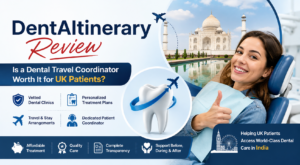

The cost of private dental treatment in the UK has encouraged many patients to explore alternatives outside the country. For someone needing a routine check-up, travelling overseas obviously isn’t practical. But when treatment involves multiple implants, All-on-4, extensive crowns or full-mouth rehabilitation, the economics can look very different.
This is where dental tourism in India has started attracting attention.
One company attempting to simplify that process is DentAItinerary, a dental-treatment coordination platform focused on international patients travelling to India.
But is using a dental travel coordinator actually worthwhile?
Rather than looking only at advertised prices, this review examines the areas that matter most: clinic selection, treatment planning, cost transparency, travel coordination, safety considerations and aftercare.
What Is DentAItinerary?
DentAItinerary is not itself a dental clinic. It operates as a coordination platform connecting international patients with independently operated dental clinics in India.
Its published process includes an initial patient assessment, matching patients with suitable clinics, comparing treatment quotes and coordinating practical elements of the journey such as accommodation, airport transfers and appointments.
The idea is relatively straightforward.
Instead of a UK patient having to independently research clinics, contact dentists, compare treatment plans and organise travel, DentAItinerary attempts to bring those steps together into a single process.
That could be particularly useful for someone considering extensive treatment rather than a single routine procedure.
Why Are UK Patients Looking at Dental Treatment in India?
Price is undoubtedly one of the main reasons.
DentAItinerary’s current published comparison gives indicative Indian prices of approximately £3,400–£4,800 per arch for All-on-4 treatment, compared with approximately £10,000–£18,000 in UK private dentistry.
For full-mouth rehabilitation, it lists an indicative Indian range of approximately £6,200–£9,200, compared with approximately £20,000–£36,000 in the UK.
These figures are substantial enough to make international treatment worth investigating for some patients.
However, price comparisons need to be handled carefully.
A dental quote abroad should not automatically be compared with a UK quote simply because both contain the word “implant” or “full mouth.”
The treatment plans need to be compared on a like-for-like basis.
The Biggest Mistake: Comparing Headline Prices
Suppose one clinic quotes £4,000 and another quotes £7,000.
It would be tempting to choose the £4,000 option immediately.
But what does each quote include?
Patients should find out whether the price covers:
- Consultation
- X-rays or CBCT scans
- Implant placement
- Implant components
- Abutments
- Crowns
- Temporary restorations
- Bone grafting, if required
- Medication
- Follow-up appointments
- Additional laboratory work
Travel costs also need to be considered.
Flights, accommodation, airport transfers, travel insurance and time away from work can all increase the actual cost of treatment abroad.
DentAItinerary’s own guidance recommends establishing a UK reference quote first and then comparing the overseas treatment plan against it.
That’s a much more useful approach than simply searching for the lowest advertised price.
How Does the DentAItinerary Process Work?
According to its current UK patient information, the process has three broad stages.
1. Build an itinerary
Patients provide information about their treatment requirements through the platform’s planner.
2. Compare clinic options
DentAItinerary says it matches patients with multiple vetted clinics and provides personalised treatment quotes for comparison.
3. Coordinate the journey
Once a patient chooses an option, the platform says its coordinator can help arrange accommodation, airport transfers and dental appointments while the patient handles their flights.
This coordination aspect is arguably the most interesting part of the service.
Finding an overseas dentist is relatively easy.
Planning an international healthcare trip around a treatment schedule is considerably more complicated.
Clinic Vetting Matters
A major concern with dental tourism is how a patient can assess a clinic thousands of miles away.
DentAItinerary says its clinic selection process considers factors including clinician qualifications, experience, facilities and experience treating international patients.
The company also highlights NABH accreditation as one quality signal where applicable.
NABH — the National Accreditation Board for Hospitals & Healthcare Providers — has a dental healthcare accreditation programme covering areas such as quality, safety, infection control, documentation and patient experience.
However, accreditation should not be treated as a guarantee of an individual treatment outcome.
Patients should still verify the treating dentist’s credentials, ask who will perform the procedure and understand exactly what treatment is being proposed.
What About Dental Treatment Safety?
“Is dental tourism safe?” is probably the first question many UK patients ask.
The honest answer is that the destination alone doesn’t determine safety.
The clinic, dentist, treatment plan, diagnostic process, infection-control standards, materials, communication and aftercare arrangements all matter.
DentAItinerary’s own safety guidance recommends verifying clinic credentials, checking dentist registration and confirming implant-brand information before making a deposit.
For implant treatment in particular, patients should be cautious about any provider willing to promise a definitive treatment plan without appropriate clinical assessment and imaging.
A low price is not a substitute for proper diagnosis.
What Happens If the Treatment Plan Changes?
This is one of the most important questions to ask before travelling abroad for dental treatment.
A preliminary treatment plan isn’t necessarily the final treatment plan.
Once a patient is physically examined and appropriate diagnostic imaging is completed, a dentist may identify issues that weren’t apparent from photographs or previous records.
DentAItinerary says it uses a written process for treatment-plan deviations, with the intention of documenting changes and associated costs before additional treatment proceeds.
This is something every dental-tourism patient should consider.
Before travelling, ask:
What happens if the dentist recommends additional treatment?
Also ask:
- Will I receive a revised written quote?
- Can I decline the additional treatment?
- Could the change extend my stay?
- Would I need another trip?
- Who will explain the clinical reasoning?
The answers can be more important than the initial price.
How Long Do UK Patients Need to Stay in India?
There isn’t one universal timeline.
It depends on the treatment.
DentAItinerary’s current guidance suggests that surgical cases may require approximately 7–14 days, while some treatments can require a second visit after healing.
Its published treatment timeline gives approximate examples including:
- Single implant: around 5–7 days
- Multiple implants: around 7–10 days
- All-on-4/full-mouth cases: around 10–14 days
Some implant treatments involve a healing period of several months before the final prosthesis is fitted, potentially requiring another visit.
These should be treated as planning estimates rather than promises.
The treating dentist should determine the appropriate clinical timeline.
Travel Planning Is Part of the Treatment Decision
Dental tourism isn’t simply about finding a cheaper dentist.
You’re also travelling internationally for healthcare.
That means patients should consider:
- Flight schedules
- Recovery time
- Accommodation
- Airport transfers
- Travel insurance
- Medication
- Time off work
- Follow-up appointments
- Possibility of a second trip
This is where a coordinated itinerary can potentially add value.
DentAItinerary says its service can coordinate accommodation, transfers and clinic appointments around the dental treatment schedule.
For a complex multi-day treatment, having those logistics organised in advance could reduce some of the practical stress involved.
What About Aftercare in the UK?
This may be the most overlooked part of dental tourism.
Imagine completing treatment in India and returning home a few days later.
What happens if you need an adjustment?
What if you have concerns about healing?
What if your UK dentist needs information about the implant or restoration?
Before travelling, patients should establish how their clinical records will be transferred and whether they have a UK dentist willing to provide appropriate follow-up.
DentAItinerary’s published guidance specifically identifies arranging UK follow-up before booking as an important part of the process.
That is good advice regardless of which international dental provider a patient chooses.
Who Is DentAItinerary Best For?
Based on its current model, DentAItinerary is more likely to be useful for patients considering substantial planned dental treatment.
For example:
- Multiple dental implants
- All-on-4 treatment
- Full-mouth rehabilitation
- Multiple crowns
- Multiple veneers
- Extensive restorative dentistry
For a small filling or routine examination, travelling internationally would generally make little practical sense.
The larger the treatment plan, the more relevant the potential cost difference and coordination benefits become.
Who Should Think Twice About Dental Tourism?
Dental tourism isn’t suitable for every situation.
Patients shouldn’t treat overseas travel as a solution for a dental emergency.
Severe pain, swelling, trauma or a suspected infection requires appropriate professional assessment rather than simply booking an international treatment package.
Likewise, patients with complex clinical circumstances should discuss their options with qualified dental and medical professionals before making travel plans.
The right question isn’t simply:
“Can I save money?”
It’s:
“Is travelling appropriate for my specific treatment, and can I do it with a sensible clinical and aftercare plan?”
DentAItinerary Review: The Pros and Cons
Potential advantages
Structured planning:
The platform brings clinic selection, treatment planning and travel coordination together.
Clinic comparison:
Patients can potentially compare multiple treatment options rather than contacting clinics individually.
Price transparency:
The service focuses on written treatment quotes and itinerary planning.
Travel coordination:
Accommodation, transfers and appointments can be coordinated around treatment.
UK-focused information:
Its content is specifically designed around questions UK patients face, including costs, travel time, aftercare and NHS comparisons.
Things patients should still consider
It isn’t a dental clinic:
The actual treatment is provided by independent dental clinics.
Travel is still required:
Patients need to consider flights, recovery and potentially multiple visits.
Clinical outcomes can’t be guaranteed:
No coordinator can eliminate the inherent risks associated with dental procedures.
Independent verification remains important:
Patients should still investigate the treating dentist, clinic, materials and treatment plan.
Is DentAItinerary Worth Considering?
DentAItinerary is an interesting model because it focuses on something that is often missing from dental-tourism discussions: coordination.
Dental tourism is frequently presented as a simple equation:
UK price vs overseas price = savings.
In reality, the decision is much more complicated.
A responsible comparison should include:
Clinic credentials + treatment plan + total cost + travel + treatment timeline + aftercare.
That’s where DentAItinerary’s approach has potential value.
Its role isn’t to replace a dentist. Instead, it aims to make the international treatment journey easier to organise and compare.
For someone considering extensive dental treatment, particularly implants or full-mouth rehabilitation, that could be useful.
But patients should still do their own due diligence and obtain appropriate professional dental advice before committing to treatment.
Ultimately, the best dental-tourism decision isn’t necessarily the one with the lowest price.
It’s the one where the patient understands who will treat them, what treatment they are receiving, what they are paying for, how long the process will take and what happens after they return home.
And that’s the standard I would use when evaluating DentAItinerary, or any other dental tourism service.
Disclosure
DentAItinerary is a commercial dental-treatment coordination platform discussed in this article. This review is for informational purposes and should not be considered medical or dental advice.
DentAItinerary coordinates with independently operated dental providers and does not itself provide clinical treatment. Patients should independently verify dentist credentials, clinic information, treatment plans, pricing, travel requirements and aftercare arrangements before making healthcare decisions.
Treatment prices and timelines are indicative and may vary according to the patient’s individual clinical requirements and the treating provider.