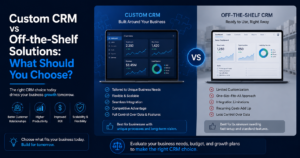

Customer Relationship Management (CRM) software has evolved far beyond contact management and sales tracking. Modern CRM platforms serve as the operational backbone for sales, marketing, customer service, partner management, and business analytics. As organizations increasingly depend on customer data to drive decisions, selecting the right CRM solution has become a strategic business decision rather than a routine software purchase.
Recent market data reflects this shift. According to Gartner, worldwide spending on customer experience and relationship management software continues to grow steadily as organizations prioritize customer-centric operations. Gartner also projects continued double-digit growth in CRM-related investments through the coming years as businesses seek greater visibility into customer interactions and revenue opportunities.
At the same time, Salesforce’s State of Sales research highlights that customer expectations continue to rise, with buyers expecting personalized experiences, faster responses, and consistent engagement across multiple channels.
Against this backdrop, organizations face an important question: should they adopt an off-the-shelf CRM platform or invest in a custom-built solution tailored to their business processes?
The answer depends less on software features and more on how the business operates, scales, and manages customer relationships.
CRM Selection Is No Longer Just a Technology Decision
Many organizations begin their CRM journey by comparing features, pricing plans, and vendor reputation. While these factors remain important, they rarely determine long-term success.
A CRM system eventually becomes connected to multiple business functions, including marketing automation, finance, customer support, inventory management, partner ecosystems, and analytics platforms. As these integrations expand, the CRM transforms from a standalone application into a central business system.
This shift changes how organizations should evaluate CRM solutions.
The primary consideration is no longer whether the software can manage customer records. The real consideration is whether the platform can support operational requirements without creating inefficiencies as the business grows.
Businesses with straightforward sales processes often find that pre-built CRM platforms meet their requirements effectively. However, organizations with specialized workflows, industry-specific compliance requirements, or complex customer journeys frequently encounter limitations that standard solutions were not designed to address.
Standard CRM Platforms Work Well—Until Business Requirements Become More Complex
Off-the-shelf CRM solutions dominate the market for a reason. They provide a mature ecosystem, proven functionality, regular updates, and relatively fast implementation timelines.
Platforms such as Salesforce, Microsoft Dynamics 365, HubSpot, and Zoho CRM offer capabilities that address common business needs, including:
- Lead management
- Opportunity tracking
- Customer communication history
- Workflow automation
- Reporting and analytics
- Customer support management
For startups and small-to-medium businesses, these capabilities often provide immediate value without significant development effort.
The challenge emerges when business processes begin to diverge from standard workflows.
A logistics company may require real-time shipment visibility within customer profiles. A manufacturing enterprise may need CRM records linked directly to production systems and service schedules. A healthcare provider may require compliance-driven workflows that standard CRM products cannot accommodate without substantial modifications.
At this stage, organizations often discover that software flexibility becomes more important than feature availability.
The Hidden Cost of Extensive CRM Customization
Many businesses attempt to address operational gaps by extending their existing CRM platform through plugins, third-party integrations, and custom modules.
Initially, this approach appears cost-effective.
Over time, however, extensive customization can introduce challenges that affect both performance and maintainability.
Every additional integration increases system complexity. Data synchronization issues become more common. Software updates may create compatibility concerns. Reporting accuracy can suffer when information resides across multiple connected applications.
In many cases, organizations find themselves maintaining several supporting tools simply to compensate for limitations in their primary CRM platform.
The result is often a fragmented technology environment that requires continuous administrative effort.
This is one reason enterprises increasingly evaluate whether long-term customization costs outweigh the benefits of adopting a purpose-built solution.
Why Operational Complexity Often Drives Custom CRM Adoption
The decision to build a custom CRM rarely stems from dissatisfaction with existing software. More often, it reflects a need for greater alignment between technology and business operations.
Organizations operating across multiple regions, product lines, service models, or regulatory environments frequently require workflows that cannot be easily replicated within standard CRM structures.
For example, a field service organization may need technician scheduling, equipment history, maintenance records, and customer communications accessible through a single interface. Managing these functions across separate applications can create inefficiencies and data inconsistencies.
A custom CRM allows businesses to design processes around operational requirements rather than adapting processes to fit predefined software structures.
This distinction becomes increasingly important as organizations scale.
The more specialized the operation, the greater the likelihood that standard CRM functionality will require significant modification.
Enterprise Systems Are Becoming More Connected
Another factor influencing CRM decisions is the growing importance of system integration.
Modern enterprises rely on interconnected technology ecosystems rather than isolated applications.
A CRM platform may need to exchange data with:
- ERP systems
- Inventory management platforms
- Customer support applications
- IoT-enabled devices
- Marketing automation tools
- Business intelligence platforms
- Financial management systems
As integration requirements expand, organizations often require greater control over data models, workflows, and application architecture.
Custom CRM solutions provide this flexibility by allowing businesses to define how information moves across systems rather than relying on vendor-imposed structures.
This capability is particularly valuable for organizations managing complex operational environments.
A Practical Enterprise Example
Manufacturing organizations provide a useful example of where CRM requirements frequently exceed standard functionality.
Many manufacturers manage long customer lifecycles that extend well beyond the initial sale. Customers may require installation support, warranty management, maintenance services, spare parts availability, and technical assistance over several years.
While a traditional CRM can track sales opportunities and customer communications, it may not provide direct visibility into production schedules, service records, equipment performance, or inventory availability.
As a result, employees often switch between multiple systems to access information required for customer interactions.
Several large manufacturing enterprises have addressed this challenge by implementing custom CRM platforms integrated directly with operational systems. This approach improves data consistency, reduces manual effort, and provides a unified view of customer relationships across departments.
The objective is not customization for its own sake. The objective is creating a system that accurately reflects operational reality.
Evaluating Cost Beyond Licensing Fees
CRM investment decisions often focus heavily on subscription costs.
While licensing expenses are important, they represent only one component of total ownership costs.
Organizations should also evaluate:
- Integration expenses
- Customization costs
- Administrative overhead
- User training requirements
- Data migration efforts
- Ongoing maintenance costs
A lower-cost CRM platform may ultimately require significant investment in supporting tools and custom development. Conversely, a custom solution may involve higher initial costs but lower operational complexity over time.
Financial evaluation should therefore consider the full lifecycle of the platform rather than initial acquisition costs alone.
The Growing Demand for CRM Software Development Services
As customer operations become more specialized, organizations increasingly seek solutions tailored to their business models.
This trend has contributed to growing demand for crm software development services that focus on custom workflows, enterprise integrations, advanced reporting, and industry-specific requirements.
Rather than implementing generic functionality and adapting processes around it, businesses are investing in platforms designed around their operational objectives.
This approach is particularly common in industries where customer relationships involve complex transactions, regulatory oversight, long service cycles, or extensive collaboration between departments.
Custom development enables organizations to prioritize functionality that directly supports business outcomes while eliminating unnecessary complexity.
How a CRM Software Development Company Approaches Enterprise Requirements
Developing an enterprise CRM requires more than software engineering expertise.
A specialized CRM Software Development Company typically begins by analyzing operational workflows, customer interaction models, data architecture, and integration requirements before defining technical specifications.
This process helps ensure that technology decisions align with business objectives.
Key areas often include:
- Workflow design
- Integration architecture
- Security and compliance requirements
- Data governance
- Scalability planning
- User experience optimization
The goal is not simply to develop a CRM platform but to create a system capable of supporting future business growth and operational change.
This strategic perspective often determines whether a CRM implementation delivers long-term value.
Measuring ROI Through Operational Efficiency
The success of a CRM initiative should not be measured solely through software adoption metrics.
A more meaningful assessment focuses on operational outcomes.
Organizations commonly evaluate CRM performance through indicators such as:
- Sales cycle reduction
- Customer retention improvements
- Service response times
- Data accuracy
- Employee productivity
- Reporting efficiency
For example, reducing duplicate data entry across departments can save hundreds of labor hours annually. Improved visibility into customer interactions can also strengthen decision-making and improve service quality.
When CRM technology aligns closely with business processes, organizations often experience measurable improvements that extend beyond traditional sales metrics.
Final Thoughts
The decision between a custom CRM and an off-the-shelf solution depends largely on business complexity, integration requirements, and long-term strategic objectives.
Off-the-shelf CRM platforms remain an effective choice for organizations with standardized processes and limited customization requirements. Their faster deployment timelines and established ecosystems make them suitable for many growing businesses.
However, as operations become more specialized, the limitations of generic software become increasingly apparent. Organizations managing complex workflows, extensive integrations, or industry-specific requirements often find greater value in solutions designed around their unique operating models.
Rather than asking which option is universally better, businesses should evaluate which approach aligns most effectively with their operational structure, growth plans, and customer engagement strategy. A CRM system delivers the greatest value when it supports how the business actually functions rather than requiring the business to adapt to software constraints.