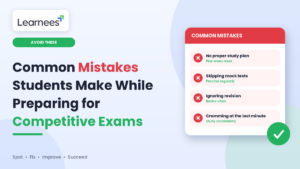

Preparing for competitive exams requires consistent effort, a clear strategy, regular practice, and effective time management. Whether students are preparing for UPSC, SSC, NEET, JEE, Banking, Railway, NDA, or state-level government examinations, following the right preparation strategy can make the learning process more organised and productive. However, many students work hard but struggle to achieve their desired results because of common preparation mistakes. These may include studying without a proper timetable, ignoring revision, relying on too many books, avoiding mock tests, or failing to analyse their performance. Understanding these mistakes early can help aspirants improve their preparation, use their time wisely, and approach examinations with greater confidence.
In this blog, we will explore the 10 common mistakes students make while preparing for competitive exams and discuss practical ways to avoid them.
1. Preparing Without a Proper Study Plan
One of the most common mistakes students make is beginning their preparation without a realistic study plan. They may study whichever subject seems interesting at the moment, spend too much time on one topic, or postpone difficult chapters.
Without a structured plan, it becomes difficult to complete the syllabus on time and maintain a balance between learning, practice, and revision.
How to avoid this mistake:
- Create a weekly and monthly study timetable.
- Divide the syllabus into manageable topics.
- Set achievable daily learning targets.
- Allocate dedicated time for revision and practice tests.
- Review your progress every week and adjust your schedule when necessary.
A study plan should be flexible enough to accommodate difficult topics, unexpected commitments, and additional revision.
2. Ignoring the Official Syllabus and Exam Pattern
Some aspirants begin studying directly from books, coaching notes, or online videos without carefully reviewing the official syllabus. As a result, they may spend time on topics that are not relevant to their examination while overlooking important areas.
Every competitive examination has its own syllabus, question format, marking scheme, and selection process. For example, UPSC, SSC CGL, NEET, and JEE require different preparation approaches.
How to avoid this mistake:
- Download the latest official notification and syllabus.
- Understand the examination stages and eligibility requirements.
- Review the question format and marking scheme.
- Identify high-priority topics based on the syllabus and previous-year papers.
- Check official updates regularly for changes to the examination pattern.
Starting with the syllabus helps students prepare with a clear direction and reduces unnecessary effort.
3. Using Too Many Study Materials
Another common mistake is collecting too many books, notes, reference guides, and online resources. Students may believe that more study material automatically leads to better preparation. In reality, switching constantly between resources can create confusion and leave important topics insufficiently revised.
For most examinations, it is more productive to understand a limited set of reliable resources thoroughly than to study many resources superficially.
How to avoid this mistake:
- Select a few reliable books or learning resources for each subject.
- Use official websites for syllabus details and examination notifications.
- Keep one organised set of notes for revision.
- Use additional resources only when a concept needs clarification.
- Avoid changing your primary study material repeatedly without a clear reason.
A focused approach makes learning more consistent and helps students retain information.
4. Neglecting Revision
Completing a chapter once does not guarantee that a student will remember it during the examination. Without revision, important facts, formulas, definitions, and concepts can become difficult to recall.
Many students spend most of their time learning new topics and leave revision until the final days before the examination. This can increase pressure and make it harder to identify gaps in understanding.
How to avoid this mistake:
- Revise important concepts regularly.
- Prepare short notes, formula sheets, and topic summaries.
- Practise recalling information without looking at your notes.
- Revisit difficult topics more frequently.
- Reserve time each week for revising previously completed chapters.
For example, students can revise a topic the next day, revisit it after a few days, and review it again the following week. The exact schedule can be adjusted according to the subject and individual learning needs.
5. Avoiding Mock Tests and Previous-Year Papers
Reading textbooks and watching lectures are useful, but they do not fully prepare students for the experience of answering questions within a fixed time.
Some aspirants avoid mock tests because they fear low scores or believe they should complete the entire syllabus before attempting a test. This delays valuable feedback about their preparation.
Mock tests and previous-year question papers help students understand question formats, improve time management, and identify areas requiring further practice.
How to avoid this mistake:
- Begin with topic-wise tests after completing individual chapters.
- Gradually introduce full-length mock tests.
- Practise previous-year papers relevant to your examination.
- Attempt tests under realistic time limits.
- Analyse every test to understand incorrect answers and unanswered questions.
Remember that a mock test is not only a way to measure preparation. It is also a learning tool that helps students decide what to improve next.
6. Focusing on Weak Subjects Only at the Last Minute
Students sometimes postpone difficult subjects because they find them confusing or time-consuming. They may continue practising familiar topics because these provide a sense of progress.
Unfortunately, leaving challenging subjects until the final stage can create unnecessary pressure and reduce opportunities for improvement.
How to avoid this mistake:
- Identify difficult subjects early in your preparation.
- Divide challenging chapters into smaller sections.
- Practise basic concepts before moving to advanced questions.
- Seek clarification from reliable teachers or learning resources.
- Include both strong and weak subjects in your weekly timetable.
For example, an SSC aspirant who struggles with quantitative aptitude can practise basic arithmetic regularly instead of postponing the entire subject until the final month.
The aim is to make steady progress while maintaining the subjects you already understand.
7. Poor Time Management
Time management is essential for both preparation and examination performance. Some students spend too much time making notes, repeatedly watching lectures, or perfecting a single topic while leaving other important tasks unfinished.
During the examination, poor time management may also prevent students from attempting questions they know how to solve.
How to avoid this mistake:
- Set time limits for individual study sessions.
- Prioritise tasks according to importance and difficulty.
- Use a timer during practice questions.
- Include breaks to maintain concentration.
- Practise completing mock tests within the prescribed duration.
Students should also learn to distinguish between productive study and activities that consume time without improving understanding.
8. Memorising Concepts Without Understanding Them
Memorisation can be helpful for formulas, facts, definitions, and certain factual subjects. However, relying entirely on memorisation can create difficulties when questions require application, analysis, or problem-solving.
For example, in mathematics and physics, remembering a formula is not always enough. Students must understand when and how to apply it. Similarly, competitive examinations involving reasoning require practice with different question types.
How to avoid this mistake:
- Focus on understanding the basic concept before memorising details.
- Solve different types of questions based on the same concept.
- Explain difficult topics in your own words.
- Connect theoretical knowledge with practical examples.
- Review mistakes to identify gaps in conceptual understanding.
A strong conceptual foundation helps students approach unfamiliar questions more confidently.
9. Ignoring Current Affairs and General Awareness
Current affairs and general awareness are important components of many competitive examinations, including UPSC, State PCS, SSC, Banking, and several defence and government recruitment exams.
Students sometimes postpone current affairs preparation or rely entirely on last-minute summaries. This can make it difficult to remember important developments and understand their background.
However, the importance and scope of current affairs vary by examination, so preparation should always follow the official syllabus.
How to avoid this mistake:
- Follow reliable news sources consistently.
- Make brief notes on relevant national and international developments.
- Revise important events at regular intervals.
- Practise exam-specific general awareness questions.
- Use monthly current affairs compilations as a revision resource when appropriate.
For examinations with a significant current affairs component, regular study is generally more manageable than trying to cover several months of information at once.
10. Comparing Preparation with Other Students
Competitive exam preparation can become stressful when students constantly compare their progress, mock test scores, study hours, or resources with those of others.
Every student has a different learning pace, academic background, schedule, and set of strengths. Comparing progress without considering these differences can distract students from their own goals.
How to avoid this mistake:
- Set personal, measurable preparation targets.
- Track your own progress through practice tests.
- Learn useful strategies from other aspirants without copying every detail.
- Focus on improving weak areas rather than competing over study hours.
- Maintain a balanced routine that includes adequate rest and regular breaks.
The most useful comparison is often between your current performance and your previous performance. Consistent improvement matters more than following someone else’s timetable exactly.
11. How to Build an Effective Competitive Exam Preparation Strategy
Avoiding common mistakes becomes easier when students follow a clear and repeatable preparation routine.
The following table summarises practical habits that can help aspirants prepare more effectively.
|
Preparation Area |
Common Mistake |
Recommended Approach |
|
Study planning |
Studying without clear targets |
Create a realistic weekly timetable |
|
Syllabus coverage |
Ignoring official requirements |
Follow the latest official syllabus |
|
Study resources |
Collecting too many books |
Use a limited set of reliable resources |
|
Revision |
Revising only before the exam |
Schedule regular revision sessions |
|
Practice |
Avoiding mock tests |
Attempt topic-wise and full-length tests |
|
Time management |
Spending too long on one task |
Set time limits and prioritise activities |
|
Conceptual learning |
Memorising without understanding |
Strengthen fundamentals through practice |
|
Current affairs |
Studying irregularly |
Follow a consistent, exam-specific routine |
|
Performance analysis |
Ignoring mistakes |
Maintain an error log and review it regularly |
|
Well-being |
Studying without sufficient breaks |
Maintain a sustainable daily routine |
A Simple Daily Study Routine
Students can use the following example as a starting point and adjust it according to their examination, school or college schedule, and preparation level.
|
Activity |
Suggested Time |
|
Study a new topic |
1.5 hours |
|
Practise subject-related questions |
1 hour |
|
Study another subject |
1.5 hours |
|
Revise previously studied topics |
45 minutes |
|
Attempt a short practice test |
30 minutes |
|
Review mistakes and plan the next day |
15 minutes |
This example includes approximately 5.5 hours of focused study. It is not a universal requirement; students should choose a realistic schedule that they can maintain consistently.
Why Performance Analysis Matters
After each practice test, students should review more than their score. They should identify the reasons behind incorrect answers and decide what action to take next.
A simple mistake-tracking table can make this process easier.
|
Question or Topic |
Reason for the Mistake |
Corrective Action |
|
Percentage questions |
Weak basic concepts |
Revise fundamentals and solve additional examples |
|
Reading comprehension |
Misunderstanding the passage |
Practise timed passages |
|
General awareness |
Difficulty recalling facts |
Use short notes and scheduled revision |
|
Physics numericals |
Incorrect formula application |
Review concepts and practise similar problems |
|
Reasoning questions |
Taking too much time |
Practise question-solving techniques under a timer |
Reviewing these patterns helps students identify recurring problems and use their study time more effectively.
12. How Learnees Can Help Students Explore Learning Resources
Choosing suitable study resources, coaching providers, and test series is an important part of competitive exam preparation. However, finding relevant options can take time, particularly when students are comparing different courses or preparation methods.
Learnees is an education marketplace that helps students and parents discover, explore, compare, and connect with coaching institutes, courses, test series, and education providers.
Students preparing for examinations such as UPSC, SSC, NEET, JEE, Banking, Railway, and state-level government exams can explore relevant learning options according to their preparation needs.
Before choosing a course or test series, students should consider the following factors:
- Exam relevance: Check whether the course or test series matches the target examination.
- Syllabus coverage: Review the topics and subjects included.
- Practice opportunities: Look for suitable mock tests, previous-year questions, and topic-wise exercises.
- Solutions and explanations: Check whether answers include explanations that support learning.
- Course details: Compare available information about fees, batch timings, teaching methods, and course duration.
- Personal requirements: Choose resources that suit your current preparation level, learning preferences, and schedule.
Explore Learnees to discover education and test preparation options that align with your goals.
Conclusion
Competitive exam preparation is not only about studying for long hours. It is also about using the right methods, identifying weaknesses, practising consistently, and making steady improvements. By avoiding mistakes such as poor planning, irregular revision, excessive resource collection, and neglecting mock tests, students can make their preparation more organised and productive. The key is to develop a realistic routine, understand concepts thoroughly, learn from errors, and adjust the strategy whenever necessary. Students should also select learning resources that match their examination requirements rather than following every available recommendation. Whether you are preparing for UPSC, SSC, NEET, JEE, Banking, Railway, or another competitive examination, a focused and consistent approach can help you work towards your academic and career goals.
Looking for coaching options or test preparation resources? Visit https://www.learnees.com/courses/search?category=Competitive-Exams to explore, compare, and connect with education providers and test series based on your learning needs.
13. Frequently Asked Questions (FAQs)
Q1. What are the most common mistakes students make while preparing for competitive exams?
The most common mistakes include studying without a timetable, ignoring the official syllabus, using too many resources, neglecting revision, avoiding mock tests, and failing to analyse mistakes. Students can address these issues through structured planning and regular practice.
Q2. How can I avoid mistakes during competitive exam preparation?
Start by understanding the official syllabus and examination pattern. Create a realistic study plan, use reliable resources, revise regularly, practise previous-year questions, and review your performance after every mock test.
Q3. How important are mock tests for competitive exams?
Mock tests help students become familiar with question formats, practise time management, identify weak areas, and assess their preparation. Analysing incorrect answers after each test is just as important as attempting the test itself.
Q4. How many hours should I study daily for a competitive exam?
There is no single number of study hours that works for every student. The appropriate schedule depends on the examination, syllabus, preparation stage, and other responsibilities. Consistent, focused study with regular revision is generally more useful than following an unrealistic timetable.
Q5. Should I study multiple books for the same subject?
Students should generally begin with a few reliable resources and understand them thoroughly. Additional books or online materials can be useful when they clarify difficult concepts or address specific gaps, but frequently switching resources can interrupt consistent preparation.
Q6. When should I start taking mock tests?
Students can begin with topic-wise tests after studying the relevant concepts. As preparation progresses, they can introduce sectional and full-length tests. The frequency should depend on the examination schedule, syllabus coverage, and the time available for reviewing mistakes.
Q7. How can I improve my time management during competitive exams?
Practise questions with a timer, attempt mock tests under realistic conditions, identify time-consuming question types, and learn to prioritise questions appropriately. Reviewing your performance can help you develop a more effective examination strategy.
Q8. How can I choose the right online test series?
Check the test series syllabus coverage, question quality, alignment with the latest examination pattern, answer explanations, test frequency, and performance analysis features. Compare available options before selecting one that matches your preparation requirements.