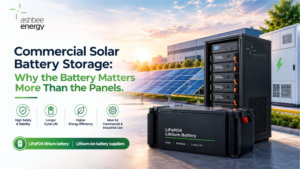

Panels get all the attention. Everyone wants to know the wattage, the efficiency rating, the brand. The battery storage system gets much less attention. It is often chosen late in the project and often on price alone. But for a factory, a warehouse or a cold storage unit, commercial solar battery storage decides how much of the solar power the business can actually use.
Why LFP Batteries Are Used for Commercial Solar Storage
LiFePO4 lithium battery chemistry has been around long enough now that it isn’t new technology. .It is also called LFP (lithium iron phosphate) and it is the battery type specified in most battery storage tenders in India. A solar storage system charges and discharges almost every day, which is more than 350 cycles in one year. LFP batteries are well suited to this kind of daily use over many years.
What Battery Storage Does for a Commercial Site
Solar panels produce most of their power around midday. Many businesses also use a lot of power in the evening. In many states, power during evening peak hours costs more because of time-of-day tariffs. A battery storage system solves this timing problem.
A commercial battery energy storage system usually does four jobs at the same time.
It stores extra solar power. Solar power that the site cannot use at midday is stored for later.
It moves power use to cheaper hours. The site uses stored power during expensive peak hours and buys less from the grid at those times.
It lowers peak demand. Many electricity bills include a charge based on the highest demand in the month. The battery supplies power at those moments, which helps keep that peak lower.
It supports critical equipment during short power cuts. This can reduce how often the diesel generator needs to start.
Which of these jobs matters most depends on the site. That decides the right size and setup for the system.
The Part Most Buyers Don’t Think About
Cell quality is one conversation on lifepo4 lithium battery. System design is a different one and it is where storage systems differ most. A battery management system (BMS) that doesn’t handle cell balancing can make good cells wear out faster than they should. Temperature thresholds matter too. A pack without adequate thermal management in a room that hits 45°C in summer is going to behave differently than the spec sheet suggests.
Temperatures in many parts of India go above 45°C and a storage system installed outdoors or in a plant room has to work safely in that heat. When you’re comparing lithium-ion battery suppliers, asking about operating temperature range is a more useful question than asking about peak discharge rate for most commercial and industrial applications. Ask for the charging and discharging temperature limits separately and ask how the cooling system works at the highest temperature.
Cycle life is another point to check. It tells you how many times the battery can be fully charged and discharged. Ask for the test conditions along with the number, so that you can compare two systems fairly.
How Ashbee Energy Supplies Commercial Battery Storage
Ashbee Energy supplies modular battery energy storage systems from 100 kWh to 5 MWh for commercial and industrial sites, including solar plus storage projects, working with cells and configurations suited to the specific load requirements of each use case .
Our systems use A-grade LFP cells for lifepo4 lithium battery. They are rated for more than 6,000 cycles and work in temperatures from minus 20°C to 50°C. Fire detection and suppression come as standard. Each system has a 5-year warranty, with 85% of the original capacity guaranteed at the end of that period. The focus is on matching the right pack specification to actual usage conditions.
That is why our first conversation with a customer is about the site, not the price. We look at daily power use, the solar generation pattern, the tariff structure and the backup hours needed. The system size and the quotation come from those answers.
To discuss a solar plus storage project, write to sales-energy@ashbee.com.
FAQs
Q. What is commercial solar battery storage?
Ans. It is a battery system installed at a business site. It stores solar power produced during the day, so the business can use it later, for example in the evening or during a power cut.
Q. Why is LFP used for commercial solar storage?
Ans. Solar storage batteries charge and discharge almost every day. LFP batteries are well suited to this daily use over many years. LFP is also the battery type specified in most battery storage tenders in India.
Q. How is a battery storage system sized for a commercial site?
Ans. Start with your average daily consumption and how many hours of backup you need. For a commercial site, also look at the solar generation pattern, the peak demand and the tariff structure. From there, you can work out the usable capacity required. A supplier should ask these questions before recommending a system.
Q. Does cell quality matter if the BMS is good?
Ans. Both matter. A good BMS extends the life of decent cells and protects against misuse. It can’t fix genuinely poor cell quality. It just slows the damage .You need both.
Q. Are lithium-ion battery suppliers in India able to customize pack configurations?
Ans. Increasingly, yes, particularly for commercial and industrial applications where standard configurations don’t fit. Lead times and minimum quantities vary, so it’s worth having that conversation early if you have specific voltage or size requirements.
Q. Can battery storage reduce diesel generator use?
Ans. Yes. A battery storage system can support critical equipment during short power cuts. This reduces how often the diesel generator needs to start. The exact reduction depends on the site.