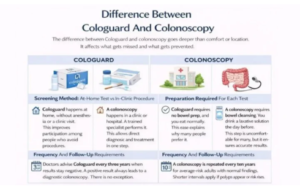

Colorectal cancer screening is essential for early detection, but choosing between Cologuard vs colonoscopy can feel confusing. Both tests aim to identify cancer or precancerous growths, yet they differ in procedure, accuracy, preparation, and frequency.
This article will guide you through the differences between Cologuard and colonoscopy, explain the pros and cons of each, and help you decide which test aligns best with your health needs and lifestyle.
Understanding Colon Cancer Screening
Regular screening significantly reduces colorectal cancer risk by detecting changes early. Depending on your age, medical history, and risk factors, your healthcare provider may recommend different tests. The two most common options are Cologuard, a non-invasive stool DNA test, and colonoscopy, a visual examination of your colon.
What is Cologuard?
Cologuard is a non-invasive stool DNA test that detects abnormal DNA and blood markers in your stool. It is designed for adults at average risk of colorectal cancer and offers the convenience of home testing.
How Cologuard Works
- You collect a stool sample at home using the provided kit.
- The sample is sent to a lab for DNA and blood marker analysis.
- Results are available in a few weeks, indicating whether further testing is needed.
Cologuard is typically recommended every 3 years for individuals at average risk.
Pros of Cologuard
- Non-invasive and pain-free
- Can be done at home
- No bowel preparation required
- Minimal risk of complications
Cons of Cologuard
- Less sensitive than colonoscopy for detecting polyps
- Positive results require follow-up colonoscopy
- Cannot remove polyps during testing
- False positives or negatives may occur
What is a Colonoscopy?
A colonoscopy is an invasive procedure performed by a gastroenterologist to examine the entire colon using a flexible scope. It is considered the gold standard for colorectal cancer screening due to its high accuracy.
How Colonoscopy Works
- You undergo bowel preparation to clear your colon.
- During the procedure, the doctor examines the colon lining and removes polyps if detected.
- The procedure usually lasts 30–60 minutes, with sedation provided.
- Follow-up screening depends on findings, often every 5–10 years for average-risk individuals.
Pros of Colonoscopy
- Highest accuracy for detecting cancer and polyps
- Ability to remove polyps during the procedure
- Longer intervals between screenings if results are normal
- Provides a comprehensive view of your colon
Cons of Colonoscopy
- Requires bowel preparation
- Invasive, with sedation and potential discomfort
- Small risk of complications such as bleeding or perforation
- Typically more expensive and time-consuming than Cologuard
Comparing Cologuard vs Colonoscopy
|
Feature |
Cologuard |
Colonoscopy |
|
Invasiveness |
Non-invasive |
Invasive |
|
Location |
Home |
Clinic/hospital |
|
Preparation |
None |
Bowel prep required |
|
Frequency |
Every 3 years |
Every 5–10 years |
|
Accuracy |
Moderate |
High |
|
Polyp Removal |
Not possible |
Possible |
|
Cost |
Lower |
Higher |
|
Risk |
Minimal |
Small (bleeding, perforation) |
Choosing the Right Test for You
Your choice depends on your preferences, risk factors, and comfort with invasive procedures:
- Cologuard may suit you if you prefer home testing, dislike invasive procedures, or want convenience.
- Colonoscopy is ideal if you want the most accurate screening, ability to remove polyps, or have higher risk factors.
Always discuss with your healthcare provider to tailor the screening to your individual needs.
Preparing for Your Test
Cologuard
- Follow the kit instructions carefully
- Avoid contamination of stool sample
- Send sample promptly to the lab
Colonoscopy
- Follow a clear liquid diet before the procedure
- Take prescribed bowel prep medications
- Arrange transportation, as sedation affects driving
Post-Test Considerations
- Cologuard: If results are positive, schedule a follow-up colonoscopy.
- Colonoscopy: Resume normal diet unless advised otherwise; monitor for rare complications.
FAQ: Cologuard vs Colonoscopy
- Is Cologuard as accurate as colonoscopy?
No. Colonoscopy is more accurate, but Cologuard is convenient for home screening. - Can Cologuard detect polyps?
It may detect some polyps, but colonoscopy is better for polyp detection and removal. - How often should I take Cologuard?
Every 3 years for average-risk adults. - How long does a colonoscopy take?
The procedure usually lasts 30–60 minutes, with sedation included. - Is colonoscopy painful?
Sedation minimizes discomfort, and most patients feel little to no pain. - Can I eat before a Cologuard test?
Yes. No dietary restrictions are required. - Are there risks with colonoscopy?
Yes, though rare: bleeding, perforation, or reaction to sedation. - Which is covered by insurance?
Both are often covered, but coverage may vary. Check with your insurer. - Can Cologuard replace colonoscopy entirely?
No. Positive results require colonoscopy, and high-risk individuals may need direct colonoscopy. - Which test is better for high-risk patients?
Colonoscopy is preferred for high-risk individuals due to its accuracy and ability to remove polyps.