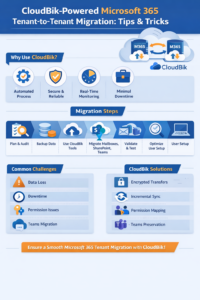

Migrating Microsoft 365 from one tenant to another can be a complex and time-consuming process. Organizations often face tenant-to-tenant migration due to mergers, acquisitions, restructuring, or rebranding. Regardless of the reason, moving data, users, and configurations between Microsoft 365 tenants requires careful planning to minimize downtime, prevent data loss, and avoid disruption to business operations. CloudBik simplifies this process by providing robust tools that make M365 tenant-to-tenant migration faster, safer, and more efficient.
What is Microsoft 365 Tenant-to-Tenant Migration?
A Microsoft 365 tenant-to-tenant migration involves transferring all critical organizational data and user configurations from one tenant to another. This includes:
-
Exchange Online Mailboxes – Emails, calendar entries, and contacts.
-
OneDrive Data – Personal files stored by users in OneDrive for Business.
-
SharePoint Online Sites – Team sites, documents, lists, and workflows.
-
Teams Chat History and Channels – Conversations, files, and collaboration data.
Without proper planning, migrations can result in email downtime, data loss, broken links, and user confusion. Ensuring that all data is accounted for, and permissions are maintained, is key to a successful migration.
Why Use CloudBik for M365 Tenant-to-Tenant Migration?
CloudBik provides a comprehensive, automated solution for migrating Microsoft 365 tenants. Here’s why organizations prefer it:
-
Automated Migration Process – Reduces manual effort and prevents common errors during data transfer.
-
Supports Multiple Services – Seamlessly migrate Exchange, SharePoint, OneDrive, and Teams.
-
Data Security – Ensures end-to-end encrypted migration, protecting sensitive data.
-
Reporting & Monitoring – Real-time dashboards allow IT teams to track migration progress and address issues quickly.
-
Minimal Downtime – Incremental migration and scheduling options keep business operations running smoothly.
By using CloudBik, IT teams can focus on planning, configuration, and user readiness rather than troubleshooting migration issues, ensuring a smoother transition.
Step-by-Step Tips for Successful Tenant-to-Tenant Migration
1. Plan Your Migration Carefully
-
Identify all mailboxes, SharePoint sites, OneDrive accounts, and Teams channels that need to be migrated.
-
Determine the migration sequence to avoid disrupting critical business operations.
-
Communicate with employees about migration timelines, expected downtime, and post-migration access procedures.
2. Audit Source and Target Tenants
-
Verify existing configurations in both the source and target tenants.
-
Ensure licenses, permissions, and policies are in place in the target tenant.
-
Check for conflicting domain names or settings that could cause migration failures.
3. Backup Critical Data
-
Always backup Exchange, SharePoint, and OneDrive data before migration.
-
Even though CloudBik ensures secure migration, backups provide an additional layer of protection and peace of mind.
4. Use CloudBik’s Automated Tools
-
Connect the source and target tenants in the CloudBik dashboard.
-
Select the data you want to migrate, including mailboxes, SharePoint sites, OneDrive files, and Teams chats.
-
Start the migration and monitor progress through real-time dashboards.
-
Use incremental migration to reduce downtime and avoid business disruption.
5. Validate Post-Migration
-
Verify that all mailboxes, files, and Teams chats have been successfully migrated.
-
Check permissions, sharing links, and security settings.
-
Ask users to confirm access to their data in the new tenant.
-
Resolve any discrepancies promptly to maintain business continuity.
6. Optimize Performance and User Experience
-
Reconfigure Outlook profiles if needed to reflect the new tenant.
-
Update Teams apps, SharePoint links, and any embedded workflows.
-
Provide a support channel for employees to report post-migration issues.
-
Educate users about any new features or changes in the target tenant.
Common Challenges and How CloudBik Solves Them
| Challenge | CloudBik Solution |
|---|---|
| Data Loss | End-to-end encrypted migration with verification |
| Downtime | Automated incremental migration reduces business disruption |
| Complex Teams Migration | Preserves channels, chats, and files seamlessly |
| Permission Errors | Maintains original user permissions across tenants |
| Reporting Needs | Real-time dashboards and migration logs |
Final Thoughts
Microsoft 365 tenant-to-tenant migration doesn’t have to be stressful. With CloudBik, organizations can streamline the process, save time, and ensure data integrity. Proper planning, using the right tools, and validating post-migration outcomes are essential for a successful migration.
Key Takeaway: Plan carefully, use CloudBik’s automated tools, monitor progress, and validate results to ensure a smooth and secure Microsoft 365 tenant-to-tenant migration with minimal disruption.