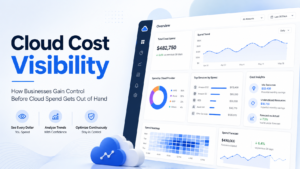

Cloud costs rarely become difficult overnight. They usually grow gradually—one workload, one account, and one infrastructure decision at a time. A development environment stays active longer than planned, storage keeps increasing, or teams deploy new services without clear ownership.
By the time finance notices a meaningful rise in spending, identifying the exact cause can take hours.
That is why cloud cost visibility has become essential for modern cloud financial management. Before businesses optimize spending or improve forecasting, they need to understand where the money is actually going.
Key Takeaways
-
Cloud cost visibility should come before aggressive optimization.
-
A monthly cloud bill does not provide enough context for good decisions.
-
Finance and engineering need a shared view of cloud spending.
-
Cost allocation improves when ownership, projects, and environments are clearly mapped.
-
Continuous monitoring helps identify unusual spending earlier.
-
Multi-account visibility becomes critical as AWS environments grow.
-
Better visibility helps separate productive growth from unnecessary waste.
Why Cloud Cost Visibility Matters
Cloud infrastructure allows teams to provision resources quickly, but that flexibility also makes spending increasingly distributed.
One team may own compute workloads while another manages databases. Data teams may increase storage and analytics usage, while development environments run across separate AWS accounts.
Finance eventually receives the combined bill.
The number may be accurate, but it does not always explain what happened.
Effective cloud cost visibility breaks spending into useful dimensions such as account, service, project, application, team, environment, and cost center.
Instead of asking, “Why did our AWS bill increase?” teams can ask:
Which workload caused the increase?
When did the change begin?
Who owns the resource?
Was the additional spending expected?
Those questions lead to much better decisions.
Visibility Should Come Before Optimization
Cloud cost optimization is often treated as a savings exercise. But reducing resources without proper context can create technical risk.
Imagine a database that appears expensive compared with similar resources. At first glance, it may look like an obvious rightsizing opportunity.
A deeper review may reveal that it supports a customer-facing workload with unpredictable traffic. Reducing capacity purely to save money could affect reliability.
An idle development instance running for several weeks is a very different situation.
Visibility helps teams distinguish between infrastructure that is expensive because it creates value and infrastructure that is expensive because nobody is managing it.
The goal is not to reduce every cloud cost. The goal is to understand which spending supports customers, performance, and growth—and which spending deserves investigation.
What Good Cloud Cost Visibility Should Show
Spend by Service and Account
Teams should understand how cloud spending is distributed across compute, databases, storage, networking, analytics, and other services.
Account-level visibility becomes equally important as organizations scale.
A SaaS company may use separate AWS accounts for production, development, security, analytics, shared infrastructure, or different business units. Without consolidated reporting, understanding the complete financial picture becomes difficult.
Ownership and Cost Allocation
Every meaningful cloud expense should eventually have an owner.
Tags, projects, applications, accounts, teams, and cost centers help connect technical resources with the people responsible for them.
This helps finance determine whether an increase came from customer growth, product development, testing, internal analytics, or infrastructure that is no longer required.
Clear allocation improves accountability without turning cost management into a blame exercise.
Cost Trends and Unusual Changes
A single monthly cost figure rarely tells the whole story.
A service costing $20,000 every month may be completely normal. A service that suddenly rises from $5,000 to $20,000 deserves immediate attention.
Cloud cost monitoring should therefore highlight trends, unexpected changes, and unusual patterns—not simply total spending.
How Better AWS Cost Visibility Improves Decisions
For AWS-focused organizations, centralized cost intelligence helps connect spending across accounts, services, projects, and environments.
Instead of manually reviewing disconnected billing exports, teams can use AWS Cost Visibility to understand where spending occurs and how cloud usage changes over time.
Finance can focus on budgets and allocation. Engineering can investigate services, resources, and usage patterns. Leadership can determine whether infrastructure spending is growing in line with customers and business activity.
Monitor Costs Before Month-End
Waiting for the monthly invoice makes cloud cost management reactive.
Continuous monitoring gives teams an opportunity to identify unusual changes during the billing cycle.
If storage usage suddenly increases, a development environment remains active, or a service begins consuming significantly more resources, teams can investigate before the problem becomes expensive.
Multi-Account Visibility
AWS architectures often become more fragmented as organizations grow.
A business that begins with one AWS account may eventually operate separate accounts for production, staging, analytics, security, shared services, and customer workloads.
Multi-account visibility provides an organization-wide picture while preserving the ability to investigate individual accounts when spending changes.
A Practical Example: Growth vs. Waste
Consider a SaaS business whose cloud spending rises from $120,000 to $145,000 in one month.
Looking only at the total suggests a $25,000 problem.
Better visibility tells a more useful story.
Analysis shows that $14,000 came from legitimate production growth after a successful customer launch. Another $4,000 came from increased database and storage usage directly connected to that activity.
That leaves roughly $7,000 requiring investigation.
Engineering discovers idle development resources, unnecessary storage, and workloads that remained oversized after an earlier traffic event.
Instead of trying to eliminate the full $25,000 increase, the business focuses on the $7,000 that does not appear to create value.
That is the practical benefit of cloud cost visibility: it prevents productive growth from being mistaken for waste.
Common Cloud Cost Visibility Mistakes
Looking Only at the Monthly Bill
A total tells finance how much was spent but does not explain why. Costs should be segmented into categories teams can investigate.
Poor Resource Tagging
Resources without consistent owner, project, or environment tags become difficult to allocate as infrastructure grows.
Ignoring Small Cost Changes
Not every problem begins with a dramatic spike. Small increases across multiple services can become significant over time.
Treating Cost Visibility as Finance-Only
Engineering teams make many infrastructure decisions that influence cloud spending. They need access to cost information as well.
Collecting Data Without Taking Action
More dashboards do not automatically produce better results. Teams still need owners, thresholds, review processes, and clear actions.
Future of Cloud Cost Visibility
Cloud cost visibility is moving from historical reporting toward predictive intelligence.
AI-assisted analysis can help detect unusual patterns, summarize cost drivers, and prioritize issues that deserve attention.
Predictive analytics can also show where current usage trends may push future budgets.
Automated governance will help identify missing tags, budget risks, unexpected service adoption, and unusual resource behavior earlier.
The technology will continue to change, but the core principle remains simple: better cloud decisions begin with better visibility.
Conclusion
Cloud cost visibility gives businesses the context required to understand spending before deciding what to optimize.
It helps finance see where budgets are going, enables engineers to understand the financial impact of infrastructure choices, and allows leadership to distinguish productive growth from unnecessary waste.
For organizations operating complex AWS environments, effective cost visibility should combine monitoring, allocation, trend analysis, multi-account reporting, and actionable insights.
The goal is not simply to collect more cloud data. It is to turn that information into better financial and technical decisions.
FAQs
What is cloud cost visibility?
Cloud cost visibility is the ability to understand spending across cloud services, accounts, projects, teams, resources, and environments.
Why is AWS cost visibility important?
AWS environments can include thousands of resources across multiple accounts. Better visibility helps teams identify which workloads are driving costs and whether spending changes are expected.
How does cloud cost visibility reduce waste?
It helps identify idle resources, unusual spending, poor allocation, and infrastructure that no longer matches business requirements.
Is cloud cost monitoring the same as cloud cost visibility?
No. Monitoring focuses on tracking spending and detecting changes, while visibility also includes ownership, allocation, trends, and business context.
How often should cloud costs be reviewed?
Formal financial reviews may happen monthly, but fast-growing cloud environments should be monitored continuously with regular engineering and FinOps reviews.