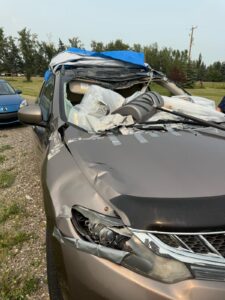

A hailstorm can turn a perfectly usable car into a difficult financial decision overnight. The vehicle may still start, drive, and perform normally, but its hood, roof, trunk, doors, or other panels can be covered with dents.
That leaves many owners asking:
“How much is my hail-damaged car actually worth?”
There is no single percentage or fixed price that applies to every vehicle. The cash value depends on the severity of the hail damage, the car’s age and condition, its pre-damage market value, repairability, demand for the make and model, and whether the vehicle has a documented damage or total-loss history.
Hail damage can affect resale value even when the vehicle remains mechanically sound because buyers may have to account for repair costs and vehicle-history concerns.
The good news is that a hail-damaged car can still have meaningful cash value. The key is understanding what actually determines that value before deciding whether to repair, sell, or scrap it.
1. The Severity of the Hail Damage
The first and most obvious factor is how badly the vehicle was hit.
A few shallow dents across the hood are very different from extensive damage covering the roof, hood, trunk, doors, and other panels.
A buyer may look at:
- Number of dents
- Dent size
- Dent depth
- Number of affected panels
- Paint condition
- Glass damage
- Light damage
- Trim damage
- Whether panels can be repaired
Minor cosmetic damage may have a much smaller effect on value than severe multi-panel damage.
There isn’t a universal “number of dents” that automatically determines a car’s value or whether it will be considered a total loss. Repair estimates have to be considered alongside the vehicle’s actual cash value and applicable insurance rules.
2. Your Car’s Pre-Hail Market Value
Imagine two vehicles receive almost identical hail damage.
One is a newer, high-demand SUV worth significantly more before the storm.
The other is an older vehicle with high mileage and a lower market value.
The same repair bill could have a very different financial impact on each vehicle.
That’s why buyers consider what the car was worth before the hailstorm.
Research comparable vehicles based on:
- Year
- Make
- Model
- Trim
- Mileage
- Condition
- Local market demand
Don’t rely exclusively on asking prices. A listed price isn’t necessarily the final price a buyer will actually pay.
3. Age and Mileage
Age and mileage still matter after hail damage.
A newer vehicle with relatively low mileage may have stronger demand and more valuable components.
An older, high-mileage vehicle may receive a lower offer because its underlying market value was already lower before the hailstorm.
However, high mileage doesn’t mean the vehicle has no value.
A junk or damaged car can still contain useful components and recyclable materials. The important question is how all the factors combine.
4. Whether the Car Still Runs Properly
Hail primarily causes exterior damage, but severe storms can sometimes affect glass, lights, trim, or other components.
If your car still starts, drives, and operates normally, tell the buyer.
A running vehicle can have more potential value than a non-running vehicle because its mechanical components may remain useful and the car may have additional resale or salvage possibilities.
If it doesn’t run, explain why.
For example:
“The car has extensive roof and hood dents, but the engine starts and the vehicle drives normally.”
That gives a buyer much more useful information than simply saying:
“It’s hail damaged.”
5. Paint and Panel Condition
Not all dents are equal.
Small dents with intact factory paint may be candidates for paintless dent repair (PDR). PDR reshapes the metal without requiring conventional repainting when the damage is suitable for that method.
However, larger dents, sharp creases, damaged edges, or cracked paint may require different repair methods.
This distinction matters because the repair approach can influence both the repair bill and the vehicle’s future market appeal.
6. Glass, Lights, and Other Damage
Hail doesn’t always stop at body panels.
A severe storm may damage:
- Windshield
- Side windows
- Mirrors
- Headlights
- Tail lights
- Roof components
- Trim
- Exterior accessories
A vehicle with dozens of cosmetic dents but intact glass and lights may be easier to evaluate than one requiring several additional replacements.
When requesting a cash offer, mention every significant area affected by the storm.
7. Insurance and Vehicle History
One of the most important factors is whether the hail damage resulted in an insurance claim or total-loss designation.
A vehicle’s history can influence how future buyers perceive it.
Depending on the circumstances and jurisdiction, a hail-damaged vehicle that is declared a total loss may receive a branded or salvage-related title. Rules vary by location, so owners should verify the requirements that apply to their vehicle.
Don’t assume that repairing visible dents automatically removes every concern about the vehicle’s history.
Before selling, find out what documentation exists regarding the damage and insurance claim.
8. Repair Cost vs. Vehicle Value
This is where the decision becomes more interesting.
Suppose your car was worth $20,000 before the storm.
You receive a $7,000 repair estimate.
That doesn’t automatically mean you should spend $7,000 to protect $20,000 of value.
You need to compare the expected value after repair with the repair expense, insurance considerations, and what you could receive by selling the vehicle in its current condition.
Ask:
“How much extra value will the repair actually create?”
Then compare that amount with what the repair will cost.
A professional inspection or repair estimate can help you make this decision instead of guessing.
9. Demand for Your Make and Model
Market demand can make a noticeable difference.
Popular vehicles with strong parts availability may attract more interest than unusual models with limited demand.
A buyer who knows there is demand for your vehicle’s engine, transmission, wheels, electronics, or other components may see more value in it.
This is especially relevant when you’re looking for cash for hail damaged cars rather than simply trading the vehicle to a conventional buyer.
10. Your Vehicle’s Location and Accessibility
The physical location of your car can also affect the economics of a cash offer.
A vehicle sitting in an open driveway may be straightforward to collect.
A severely damaged vehicle inside a tight garage or in a difficult-to-access location may require additional planning.
If you’re selling the car for cash, tell the buyer:
- Where the vehicle is located
- Whether it starts
- Whether it rolls
- Whether the keys are available
- Whether it is accessible to a tow truck
- Whether any wheels are damaged
Clear information helps prevent surprises during pickup.
Should You Repair Your Hail-Damaged Car Before Selling?
Not necessarily.
This is one of the biggest decisions you’ll face.
If the vehicle has relatively minor damage and the repair cost is reasonable compared with the value you expect to recover, repairing it may make sense.
But if the car is older, already has mechanical problems, or requires extensive hail repairs, spending thousands of dollars before selling may not be financially sensible.
Consider three options:
Option 1: Repair It
Best when the vehicle is otherwise reliable and the repair cost makes financial sense.
Option 2: Sell It As-Is
Useful when you don’t want to pay for repairs and the vehicle still has market, salvage, or parts value.
Option 3: Sell It for Scrap or Junk Removal
This can make sense when the vehicle has extensive damage, low resale demand, or repair costs that outweigh its realistic value.
How to Get a More Accurate Cash Offer
You don’t need to repair the vehicle just to request an offer.
Instead, provide detailed information.
Take photos of:
- The entire vehicle
- Roof
- Hood
- Trunk
- Doors
- Windshield
- Interior
- Dashboard
- Engine compartment
- Major damage
Then provide the year, make, model, mileage, running condition, and known damage.
Getting multiple offers can also help you understand whether the first quote is competitive.
When comparing offers, ask whether towing, pickup, or other removal costs are included.
The highest advertised number isn’t necessarily the best deal if additional costs are deducted later.
A Simple Hail-Damage Value Checklist
Before accepting an offer, ask yourself:
☐ How much was my car worth before the hailstorm?
☐ How severe is the damage?
☐ Does the car still run properly?
☐ Is the paint damaged or intact?
☐ Are the windshield, lights, and other components affected?
☐ What would professional repairs cost?
☐ Does the vehicle have an insurance or damage history?
☐ What is the car worth as-is?
☐ Have I compared multiple cash offers?
These questions can help you avoid making a decision based purely on emotion after a stressful storm.
Final Thoughts
A hail-damaged vehicle isn’t automatically worthless.
Its value depends on the severity of the damage, pre-hail market value, age, mileage, mechanical condition, repairability, vehicle history, parts demand, and removal requirements.
The smartest decision is not always to repair every dent. Sometimes repairing the vehicle makes financial sense. In other situations, selling it as-is can save you from spending thousands of dollars on repairs that you may never recover.
Before making a decision, determine what the car is worth in its current condition, estimate realistic repair costs, and compare cash offers.
Most importantly, don’t judge your vehicle’s value by its appearance alone.
A car covered in hail dents can still have a functioning engine, useful components, recyclable materials, and real market value.
The goal is to understand that value before you spend money trying to restore the vehicle—and then choose the option that leaves you with the best realistic financial outcome.