
Being advised to undergo heart bypass surgery can be worrying, particularly when treatment requires travelling from Ethiopia to India. Patients and families naturally want to understand whether the operation is safe, how much it may cost and how long recovery could take.
Coronary artery bypass grafting, commonly called CABG or heart bypass surgery, is an established treatment for severe coronary artery disease. India has experienced cardiac surgeons, dedicated heart hospitals and multidisciplinary rehabilitation services for international patients. However, every case must be assessed individually because outcomes and expenses depend on the patient’s health and the complexity of the surgery.
What Is CABG Surgery?
Coronary artery disease develops when the blood vessels supplying the heart become narrowed or blocked. This can reduce oxygen delivery to the heart muscle and cause chest pain, breathlessness or a heart attack.
During CABG surgery, the surgeon takes a healthy blood vessel from the chest, arm or leg and connects it above and below the blocked coronary artery. This creates a new pathway through which blood can reach the heart muscle.
A patient may require a single, double, triple or multiple bypass depending on the number and position of blocked arteries.
Also Read: CABG Surgery Cost in India for Ethiopian Patients
When May CABG Be Recommended?
CABG may be considered when a patient has:
- Significant left main coronary artery disease
- Blockages affecting several coronary arteries
- Severe disease associated with diabetes
- Persistent symptoms despite medication
- Blockages unsuitable for angioplasty or stenting
- Previously placed stents that have narrowed or failed
- Reduced heart function with treatable coronary disease
- An emergency complication following a heart attack
The Indian Council of Medical Research notes that CABG may be preferred over angioplasty in selected patients with left main disease, multivessel coronary artery disease and diabetes.
Types of CABG Available in India
|
CABG approach |
How it is performed |
|
On-pump CABG |
The heart is temporarily stopped while a heart-lung machine supports circulation. |
|
Off-pump CABG |
Surgery is performed on the beating heart without routinely using a heart-lung machine. |
|
Minimally invasive CABG |
Selected vessels are bypassed through smaller chest openings. |
|
Robotic-assisted CABG |
Robotic technology may be used for suitable patients at selected centres. |
The safest technique is chosen according to the number of blockages, previous surgery, heart function and the surgeon’s assessment. Minimally invasive surgery is not appropriate for every patient.
CABG Success Rates in India
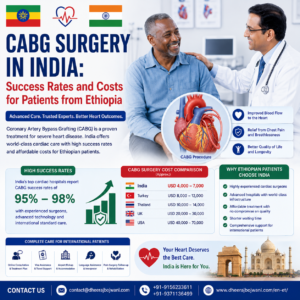
Many established Indian cardiac centres report favourable results for planned CABG surgery. For relatively stable patients undergoing elective surgery, hospital-reported success rates may exceed 95%.
However, “success rate” can have different meanings. It may refer to surviving the operation, leaving the hospital safely, relief from symptoms or long-term graft function. No surgeon should promise one fixed percentage for every patient.
Individual risk is influenced by:
- Age
- Diabetes and high blood pressure
- Kidney or lung disease
- Previous heart attack
- Strength of the heart muscle
- Number of diseased arteries
- Whether surgery is planned or an emergency
- Previous cardiac procedures
- Smoking history and general fitness
A younger, stable patient undergoing planned CABG may have a different risk profile from someone requiring emergency surgery after a major heart attack.
Estimated CABG Cost in India
The approximate cost of CABG surgery in India may range from ₹2,00,000 to ₹5,00,000, although international patient packages can be higher depending on the hospital and treatment requirements. One published Indian healthcare estimate places standard CABG charges at approximately ₹1.5–3 lakh, but this should not be treated as a final quotation.
|
Cost component |
What it may include |
|
Pre-operative assessment |
Blood tests, ECG, echocardiogram and specialist consultations |
|
Surgery |
Surgeon, anaesthesia, operating theatre and graft preparation |
|
Hospitalisation |
ICU, private room, nursing and routine medicines |
|
Medical devices |
Special equipment and consumables used during surgery |
|
Rehabilitation |
Physiotherapy, breathing exercises and cardiac rehabilitation |
|
Stay outside hospital |
Hotel, guesthouse, meals and local transport |
Costs may increase if the patient requires prolonged intensive care, additional procedures, treatment for infection, dialysis, blood products or an extended hospital stay.
Patients should obtain a written treatment plan after their angiogram and medical records have been reviewed.
Hospital Stay and Recovery
Most patients remain in the ICU for approximately one or two days, followed by several days in a hospital room. An uncomplicated hospital stay is commonly around one week.
|
Recovery stage |
General expectation |
|
ICU monitoring |
About 1–2 days |
|
Total hospital stay |
Around 6–10 days |
|
Local recovery in India |
Commonly 2–3 weeks |
|
Return to Ethiopia |
After medical and travel clearance |
|
Initial breastbone healing |
Around 6–8 weeks |
|
Return to normal routine |
Often 6–12 weeks |
Recovery varies considerably. Before flying, the surgeon will assess wound healing, oxygen levels, mobility and the risk of blood clots.
Hospitals Supporting International Cardiac Patients
Hospitals from our partner network that may be considered for CABG evaluation include:
|
Hospital |
Location |
Cardiac focus |
|
Artemis Hospital |
Gurugram |
Adult cardiac surgery and intensive care |
|
Fortis Hospital Mulund |
Mumbai |
Complex cardiac and bypass surgery |
|
Aster CMI Hospital |
Bengaluru |
Cardiothoracic surgery and rehabilitation |
|
KIMS Hospitals |
Hyderabad |
Advanced cardiac surgery and critical care |
The final choice should depend on the surgeon’s CABG experience, expected risk, ICU facilities, rehabilitation services and the patient’s medical needs.
Preparing to Travel from Ethiopia
Before travelling, patients should send:
- Coronary angiography images and reports
- ECG and echocardiography reports
- Recent blood investigations
- Previous angioplasty or stent records
- Current medication list
- Details of diabetes, kidney disease or previous stroke
- Passport details for the hospital invitation process
Patients should not stop aspirin, blood thinners or cardiac medicines unless instructed by the treating cardiologist.
Official Indian Government References
- All India Institute of Medical Sciences (AIIMS), New Delhi – Provides a patient guide to coronary artery bypass grafting, including preparation, surgery, discharge and prevention.
Link: https://www.aiims.edu/index.php/en/cardiothoracic_intro?id=409 - Indian Council of Medical Research (ICMR) – Provides the official Standard Treatment Workflow for the surgical management of coronary artery disease, including CABG indications and perioperative care.
Link: https://www.icmr.gov.in/icmrobject/uploads/STWs/1726643576_5_surgery_for_cad.pdf
Our Commitment to Patients
Our mission is to place patients at the centre of every healthcare decision by providing trustworthy, evidence-based, and unbiased medical information. We believe that informed patients make better decisions. Backed by personalised guidance from our experienced advisory team, we help patients understand their treatment options, compare them objectively, and confidently choose the path that best suits their medical needs and personal circumstances.
Dr. Dheeraj Bojwani
Medical Travel Advisor for International Patients Seeking Treatment in India
📍 New Delhi, India
🏆 24+ Years of Experience | Assisted 5,000+ International Patients
🌐 Website: www.dheerajbojwani.com/en-et/
📧 Email: contact@dheerajbojwani.com
📞 Phone: +91 9156233611
📞 Alternate Phone: +91 9371136499
Disclaimer
This article is intended for educational and informational purposes only and should not be considered medical, legal, or visa advice. Medical recommendations, treatment plans, and procedures may vary from one patient to another based on individual health conditions and circumstances. Readers are strongly advised to consult qualified healthcare professionals before making any medical-related decisions.
Learn More: CABG Surgery Success Rate in India for Ethiopian patients