
How We Keep Telangana Roots Alive
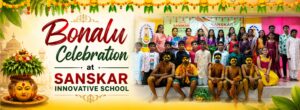
On a regular school morning, the corridors at Sanskar Innovative School fill up with something you won’t find on most CBSE timetables. Women in silk sarees carry flower-decked bonam pots on their heads. A group of boys walk out in turmeric and vermilion face paint, playing Potharaju, the fierce guardian who leads the procession. Students in half-sarees and lehengas dance with neem branches in their hands, right on the school stage. This isn’t a cultural fest planned once a year for a photo. This is Bonalu, celebrated the way it’s meant to be, inside a school in Medchal, Hyderabad, that treats regional tradition as seriously as it treats mathematics.
Quick Answer: This article covers how Sanskar Innovative School, a CBSE school in Medchal, Hyderabad, celebrated the Telangana festival of Bonalu on campus in 2026. The celebration included a student-performed Potharaju procession, a folk dance with neem branches, and a bonam procession led by women staff members. The piece explains what Bonalu represents, why cultural festivals often get sidelined in CBSE schools, and how Sanskar’s approach reflects its broader philosophy of pairing academics with cultural identity.
Key Highlights:
- Bonalu Special Assembly held on Sanskar’s Medchal campus
- Student-performed Potharaju procession
- Bonam procession led by women staff members
- Folk dance performance with neem branches
- Telangana cultural heritage woven into the school calendar
- Full student and staff participation
- Values-based education rooted in academics and culture
Culture Often Gets Left Outside the School Gate
Most schools, especially CBSE (Central Board of Secondary Education) ones chasing board results and English fluency, treat festivals as a line on the academic calendar. A holiday notice goes out. Children stay home. Somewhere between algebra and answer-writing practice, the actual meaning of a festival like Bonalu, why women carry bonam pots, who Potharaju is, why this matters specifically to Telangana, gets skipped entirely.
It’s not that schools don’t care. It’s that the system rewards test scores, not turmeric and neem leaves. And slowly, a generation grows up that can define photosynthesis but has never seen a bonam procession up close, let alone understood what it represents.
Why the Gap Exists
This isn’t neglect on any single school’s part. English-medium instruction, CBSE’s dense curriculum, and packed exam calendars leave very little institutional room for regional identity. Cultural knowledge is usually assumed to happen “at home,” passed down by grandparents or picked up at a local temple. But for residential and semi-residential students living away from that daily home environment, that transmission often just doesn’t happen. Culture becomes something you read about once a year in a school newsletter, not something you participate in.
It’s the kind of gap that’s hard to spot on a prospectus. A school can call its approach holistic education, but the phrase only means something when it shows up in daily practice, not just in a mission statement.
Culture Isn’t Separate From Character. At Sanskar, It’s the Same Thing
Here’s the shift most schools miss: cultural literacy and academic rigor aren’t in competition with each other. They build the same thing, a grounded, confident student who knows who they are.
Sanskar’s approach reflects a principle the school has stated plainly in its own programs: both Desha Bhakti (patriotism) and Daiva Bhakti (spirituality) matter equally. That’s not a slogan reserved for NCC parades. It shows up in how the school treats Bonalu, not as a break from learning, but as a lesson in itself, taught through direct participation rather than a textbook paragraph.
When a school stages a full Bonalu assembly, arranges costumes and face paint for its student-performers, and lets its women staff lead an actual bonam procession outside the main building, it’s teaching heritage the way heritage has always been taught: by doing it, not describing it. It’s a detail easy to miss when comparing the best CBSE school in Medchal by rankings alone, but cultural participation woven into the regular calendar, not set apart from it, says just as much about a school.
What Bonalu Actually Is, and Why Telangana Holds It So Close
Bonalu is one of Telangana’s biggest festivals, dedicated to Goddess Mahakali, celebrated across Hyderabad, Secunderabad, and the wider state during the month of Ashadam, usually falling in July or August. According to the Government of Telangana’s official festival records, Bonalu’s origins trace back to the early 19th century, when a military battalion prayed to the Goddess to end a devastating plague and vowed to build her a temple and offer an annual feast if she did. That vow became Bonalu, “bonam” meaning meal or offering.
The festival’s importance to the region runs deep enough that when Telangana became a separate state, Bonalu was declared its official state festival, according to the Government of India’s official tourism records. Women carry decorated pots of rice, jaggery, and curd on their heads as offerings, while Potharaju, considered the Goddess’s brother, leads processions in turmeric-smeared body paint. It’s a festival built on devotion, gratitude, and community, values that sit comfortably alongside any school’s mission statement, if the school is willing to actually live them out.
For families in Medchal and across Hyderabad, Bonalu is something many households already observe at home. A school that brings the celebration onto its own campus is meeting students halfway between home and classroom, rather than treating the two as separate worlds.
A Day Inside Sanskar’s Bonalu Celebration
The celebration at Sanskar wasn’t a quiet acknowledgement. It was a full production, and every part of it involved students directly.
Boys from the senior classes took on the role of Potharaju, with turmeric and vermilion face paint applied carefully, bare-bodied in traditional red dhotis, performing the same fierce, protective energy the character carries in temple processions across the city. On stage, another group of girls performed a folk dance with neem branches in hand, moving in the same spirit as the ritual dances performed at Bonalu celebrations across Hyderabad, framed against a backdrop the school had decorated with the Goddess’s image and festival motifs.
Outside, women staff members led a full bonam procession, sarees in bright silk, flower-topped pots balanced on their heads, walking the path in front of the main school building while students, staff, and even the school’s security personnel watched and joined in. It wasn’t staged for a photograph. It happened the way it happens in temples and neighborhoods across Telangana, just carried out on Sanskar’s own campus.
By the end, staff and students, from the smallest performers to the senior teaching faculty, gathered together on stage, still in costume, still in the spirit of the morning.
Why This Kind of Celebration Matters for Your Child
It’s easy to see a festival assembly as a break from the “real” work of school. But student cultural activities like Bonalu build things a report card doesn’t measure.
A student who plays Potharaju in front of the entire school, or leads a folk dance on stage, is performing under real pressure, and that builds confidence fast. Group dances demand coordinated timing and expression, teamwork in its most literal form. Senior students organizing costumes or guiding younger performers are practicing leadership, quietly, long before anyone hands them that word.
The same goes for communication. Staying in character in front of a live audience builds the kind of public comfort that debate clubs are designed to teach, just through a different door.
None of it replaces academics. It runs alongside them. A school willing to treat both as equally real is closer to a genuinely well-rounded education than one that only claims it in a brochure.
What Parents Should Know: Sanskar’s Bonalu celebration is one visible example of how the school approaches cultural education day to day, through direct student participation rather than a single announced holiday. For parents evaluating CBSE schools in Medchal or Hyderabad, it’s a useful thing to ask about directly: how a school marks regional festivals, and whether students take part or simply watch.
Why This Matters:
- Cultural awareness, built through direct participation in a Telangana tradition
- Confidence, from performing in front of the full school
- Teamwork, through coordinated group performance
- Leadership, practiced quietly by senior students organizing the event
- Communication skills, built through public performance
- A values-based, holistic approach that treats culture and academics as complementary, not competing
Final Takeaway
Based on how Sanskar structures its cultural calendar, the clearest signal of a school’s real values isn’t what it writes in a brochure, it’s what it stages on an ordinary Tuesday. A Bonalu celebration built around student performance, staff participation, and an actual procession says more about a school’s commitment to “ethics and roots” than any tagline could. If you’re evaluating schools for your child and cultural grounding matters to you, ask to see how a school marks its regional festivals, not just whether it marks them at all.
At its core, this is what Sanskar Innovative School has tried to build since its founding: an environment where a child can chase academic excellence and still know exactly where they come from. A student who can solve for x and also step into Potharaju’s role without hesitation isn’t choosing between two versions of themselves. They’re simply becoming one person, confident in both.
Parents are welcome to visit Sanskar’s Medchal campus, meet the staff and students, and experience firsthand how academics, cultural traditions, and student development come together in everyday school life.
Frequently Asked Questions
Why do schools celebrate Bonalu? Schools celebrate Bonalu to help students connect with Telangana’s regional heritage in a hands-on way, rather than learning about it only through textbooks. It also gives students a chance to build confidence, teamwork, and public performance skills through a meaningful cultural context.
How did Sanskar Innovative School celebrate Bonalu? Sanskar held a full Bonalu assembly on campus, including a student-performed Potharaju procession, a folk dance with neem branches, and a bonam procession led by women staff members outside the main school building, with students and staff participating together.
Why are cultural activities important in CBSE schools? Cultural activities help balance the academic intensity of the CBSE curriculum with identity, confidence, and community values. They give students practical experience in teamwork, leadership, and public expression that classroom learning alone doesn’t always provide.
What makes Sanskar different from other CBSE schools in Medchal? Sanskar pairs its CBSE academic curriculum with a consistent, hands-on approach to Indian cultural values. This includes IIT and NEET Foundation from Grade 6 alongside regional festivals like Bonalu and residential facilities, positioning it as one of the schools in the region that treats culture as part of daily school life rather than a once-a-year event.
Does Sanskar celebrate Telangana festivals every year? Yes. Bonalu is part of Sanskar’s regular cultural calendar, celebrated on campus with student and staff participation each year, alongside other Telangana and pan-Indian festivals observed through the school year.
What is Potharaju in Bonalu? Potharaju is considered the brother of Goddess Mahakali in Telangana tradition. He’s represented by a performer in a red dhoti with turmeric and vermilion body paint, who leads the Bonalu procession as a guardian figure.