
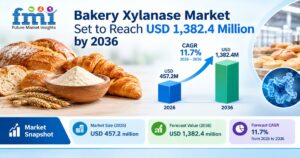

Standard grade xylanase preparations are projected to represent 39.0% of product type demand in 2026, as the global bakery xylanase market expands from USD 457.2 million in 2026 to USD 1,382.4 million by 2036, according to the latest research report published by Future Market Insights.
The bakery xylanase market is entering an accelerated commercial phase as wholesale industrial bakeries, central flour mills, and high-speed continuous baking lines increasingly specify arabinoxylan-degrading enzymes to standardize water distribution, improve dough extensibility, and maintain uniform line throughput across variable wheat flour lots.
Processing consistency is driving rapid technical adoption: with USDA NASS reporting that U.S. mills ground over 916 million bushels of wheat for flour, high-volume operations face constant flour-lot variations that can disrupt makeup and proofing stability. Enzymatic xylanase breakdown optimizes water-binding dynamics within the flour matrix, preventing sticky dough handling and machinery downtime. Concurrently, regional manufacturing investments such as Dubai Industrial City adding over 25 food and beverage clients leasing 1.7 million square feet are establishing new hubs for industrial baking, expanding commercial trial sites for advanced enzyme platforms.
Get Detailed Market Forecasts, Competitive Benchmarking, and Pricing Trends:
https://www.futuremarketinsights.com/reports/sample/rep-gb-34969
Future Market Insights estimates that the global bakery xylanase market will advance at a robust 11.7% CAGR between 2026 and 2036, adding more than USD 925 million in incremental value over the ten-year forecast window.
The primary operational challenge remains product-specific qualification: because xylanase reactivity changes dynamically with native flour protein quality, damaged starch, and operating temperatures, industrial plants must undergo rigorous, plant-specific line trials before replacing an established enzyme specification.
How Are Different Companies Approaching the Bakery Xylanase Opportunity?
The competitive landscape spans pure-play biotechnology innovators, direct enzyme developers, and integrated bakery-performance platforms. Direct enzyme pioneers such as Novonesis, IFF, AB Enzymes, and dsm-firmenich focus on fermentation consistency, specific activity optimization, and comprehensive regulatory dossiers (such as EFSA safety evaluations for Trichoderma-derived xylanases). dsm-firmenich reinforced this technical support model with its Princeton Baking Innovation Center, while AB Enzymes expanded regional baking labs in Curitiba, Brazil.
Concurrently, integrated bakery platforms like Kerry Group, Puratos, and Corbion embed xylanases within broader flour-improver and dough-conditioning systems. Kerry Group supports biotechnology scale-up via its Leipzig Biotechnology Centre, while Puratos addresses flour variability through dedicated testing facilities like its Flour Competence Center. Meanwhile, specialized manufacturers like Advanced Enzyme Technologies provide flexible processing enzymes across diverse industrial food applications.
This market structure highlights distinct operating strategies: primary enzyme developers prioritize enzyme-specific kinetic efficiency and regulatory compliance, whereas integrated bakery platforms focus on turnkey flour-correction solutions and direct technical troubleshooting on factory floors.
The shared commercial objective is predictable processing: a bakery xylanase achieves permanent plant adoption only when its low-dose efficiency and dough-stabilizing performance survive high-speed commercial scale-up without requiring constant formula adjustments.
Why Do Powder – Dry Formats Dominate Industrial Specifications?
Powder – dry xylanase formulations are projected to lead the form category with a 49.0% market share in 2026, driven by their seamless integration into existing flour-side dosing and dry premix workflows.
Because xylanases act at micro-concentrations, dry powders can be blended directly into flour conditioners or bread improvers by weight before entering the active mixing stage. This eliminates the need for specialized liquid-metering pumps or separate injection systems, allowing industrial bakeries to achieve precise, repeatable enzyme distribution without modifying their standard dry ingredient handling architecture.
Standalone Market Stat: The global bakery xylanase market is forecast to add more than USD 925.2 million in value between 2026 and 2036.
Analyst Perspective
“Bakery xylanase earns its place after a plant trial proves stable dough behavior at the intended flour specification and line speed. Commercial value depends on dose efficiency and application support because a lower-priced enzyme becomes costly if variability reaches proofing or packaging.” — Nandini Roy Choudhury, Principal Consultant, Future Market Insights
Market Snapshot
- Market Size (2026): USD 457.2 million
- Forecast Value (2036): USD 1,382.4 million
- Forecast CAGR:7% from 2026 to 2036
- Leading Product Type: Standard grade, capturing a projected 39.0% share in 2026
- Leading Form: Powder – dry, estimated at 49.0% share in 2026
- Leading Application: Bread & rolls, holding 31.0% of market demand in 2026
- Leading Sales Channel: Direct to industrial bakeries, representing 50.0% in 2026
- Fastest-Growing Country: United Arab Emirates (UAE) at a 12.9% CAGR
What Is Driving Demand Across the Bakery Xylanase Market?
Bread and roll lines anchor application demand at 31.0% share in 2026, as high-speed continuous mixing and dividing equipment quickly expose any inconsistency in dough machinability or water absorption.
Standard grade xylanase preparations lead product type demand at 39.0% share in 2026, offering industrial bakers reliable, familiar activity specifications that integrate into conventional formulations without the added cost and documentation overhead of specialty grades.
Direct to industrial bakeries captures the largest sales channel share at 50.0% in 2026, reflecting the collaborative plant-scale trials required to tailor enzyme dosage windows to specific customer flours and mixer speeds.
Geographically, the United Arab Emirates (UAE) leads country-level expansion at a 12.9% CAGR through 2036, propelled by rapid industrial food-processing investments and new manufacturing capacity in Dubai Industrial City. Saudi Arabia follows closely at a 12.6% CAGR, supported by large-scale commercial bakery consolidation, while South Korea (12.2%), the United States (11.9%), and the UK (11.6%) reflect mature high-throughput baking markets seeking labor efficiency and automated process stability.
Exclusive Discounts on Full Report: https://www.futuremarketinsights.com/reports/bakery-xylanase-market
About the Report
The Bakery Xylanase Market report provides an exhaustive commercial analysis of bakery-grade xylanase enzyme preparations used to modify flour properties and stabilize industrial baking processes.
The research segments the market by product type (standard grade, premium / specialty grade, organic certified, clean label grade), form (powder – dry, liquid, paste / semi-solid, granules / pieces), application (bread & rolls, cakes & muffins, biscuits & cookies, viennoiserie & pastry, other bakery & snacks), claim (conventional, clean label, organic, non-GMO / identity preserved), sales channel (direct to industrial bakeries, ingredient distributors, foodservice & artisan supply, online B2B), and 25+ national markets.
The analysis synthesizes primary interviews with industrial enzyme formulators, bakery technologists, and procurement directors, supported by desk research across governmental agricultural data (USDA NASS, FAS), regulatory safety evaluations (EFSA), and corporate R&D announcements.
About Future Market Insights (FMI)
Future Market Insights (FMI) delivers actionable, decision-focused market intelligence that goes beyond traditional research reports.
The company provides:
- In-depth pricing and cost benchmarking analysis
- Demand forecasting based on real industry inputs
- Procurement and buyer behavior insights
- Supply chain and trade flow intelligence
- Technology and application trend analysis across industries
FMI follows a robust bottom-up research methodology, combining insights from industry experts, procurement leaders, manufacturers, and technical professionals to ensure accurate and practical market intelligence.
For Press & Corporate Inquiries
Rahul Singh AVP – Marketing and Growth Strategy
Future Market Insights,
Inc. +91 8600020075
For Sales – sales@futuremarketinsights.com
For Media – Rahul.singh@futuremarketinsights.com
For Web – https://www.futuremarketinsights.com/


